
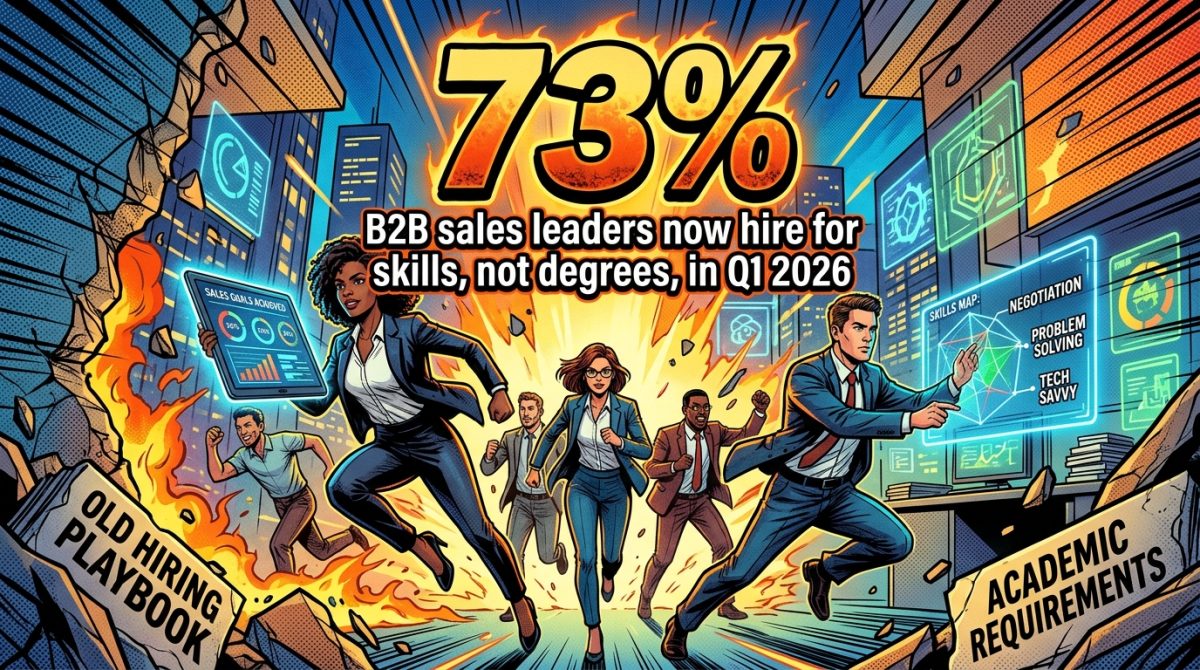
73% of B2B sales hiring managers in Q1 2026 now choose skills and technical literacy over formal degrees when building sales teams. That’s the headline from Meritt.io. Hiring is no longer about diplomas. It’s about what you can do with tech, data, and new tools—right now.
If your sales hiring process still starts with filtering out candidates without the “right” degree, you’re heading backward. The leaders have already moved on. Teams stuck to old rules pay with empty pipelines, slow onboarding, and lost deals.
The Cost of Clinging to Old Sales Hiring Habits
New hires who can’t run a CRM or spot a bot-generated lead cost you hours—and sales. Every day you rely on outdated job descriptions, you let smart, fast-learning talent slip away to your competitors.
Why does this matter? In Q1 2026, technical skills and learning drive results, not a line on a diploma. According to Pitcher.com, entry-level reps are now expected to master AI and CRM tools before their first day on the job.
If your sales floor still runs interviews like it’s 2018, you’re losing to teams that can onboard talent 67% faster, using AI Agent Playbooks. That’s not just a stat—it’s a warning. The cost? Slower deals, higher churn, and lost commissions.
Old habit: Hire for pedigree. New demand: Hire for skill.
But why did this flip happen so fast—and what did the best teams spot before anyone else?
Here’s Why B2B Sales Hiring Flipped in Q1 2026
So what changed? Simple: Everything about selling, tracking leads, and winning deals now runs on tech. AI sorts your pipeline. Targets change in real time. Tools like Gong, Outreach, and Salesforce AI are table stakes, not perks.
The companies winning in Q1 2026 saw a pattern—the reps closing more deals didn’t all look alike on paper. The best ones came from teaching, journalism, and technical support. They learned fast. They could work new apps without a manager holding their hand.
And while most teams still asked about “sales drive” in interviews, the winners built test-drive tasks: “Show me how you use this CRM to build a sequence.” If you did it in 15 minutes—job offer. If you needed hand-holding—move on.
That’s why, according to Randstad USA, sales hires with backgrounds in fields like teaching and technical support are now beating business grads in interviews.
This change didn’t just happen. It broke the old sales hiring model—and winners moved fast.
Proof in the Pipeline: The Data Says Who’s Winning in 2026
The proof is all over the numbers. Let’s look at what the latest data shows, and why it’s not even close anymore:
| 2026 B2B Sales Hiring: What Teams Prioritize vs. 2023 | 2023 | Q1 2026 |
|---|---|---|
| Require formal sales/business degree | 61% | 20% |
| Prioritize technical tool literacy at entry level | 18% | 66% |
| Hire career-changers from outside sales | 9% | 47% |
Stat to quote: 73% of talent leaders now rate critical thinking, discipline, and structured learning above degrees. (Meritt.io)
Here’s where it gets even clearer—some teams cut their sales rep headcount by 28% and saw pipeline grow with smart, AI-trained hires. See the data in How AI Automation Is Rewriting B2B Sales Hiring in 2026.
And tools? Pitcher.com reports that entry-level hiring now starts with a simple rule: “If you can’t run HubSpot, Outreach, or Salesforce AI modules, you’re not getting a callback.”
RevOps teams are changing too. SalesTalent.com found that 81% of sales orgs growing headcount in Q1 2026 are adding supporting RevOps and enablement roles, not just quota-carrying reps. They want performance, not bodies.
The leaders build teams who can learn new tech in days, run smarter sequences, and spot fake leads before they waste pipeline.
The change is bigger than a stat—it’s a talent war fought with skill tests, not business diplomas.
How much faster is AI-powered onboarding in B2B sales hiring?
Teams using AI agents in Q1 2026 onboard new B2B sales reps 67% faster than teams using manual methods, according to HatHawk’s internal research.
AI-driven onboarding shortens ramp time, cuts turnover, and gets new hires closing deals weeks earlier. See the full playbook: AI Onboarding Slashes Sales Ramp Time in 2026.
What types of backgrounds now win B2B sales jobs in 2026?
Career changers from fields like teaching, journalism, and tech support are the most sought-after sales hires in Q1 2026, according to Randstad USA.
Why? They bring clear communication, fast learning, and calm under pressure—skills you can’t fake in a rush. Degrees matter less; outcomes matter more.
Why do B2B teams value technical literacy over sales degrees?
Tech skills cut waste in onboarding, raise CRM adoption, and let teams use AI to win more deals, according to Pitcher.com’s 2026 data.
When new reps know AI-driven sales tools, ramp times drop, and accuracy in forecasting jumps. See 95% B2B Sales Forecasting Accuracy: How AI and Process Turned Predicting into Planning for data on why this matters to revenue.
Summary: The teams that hire for skill and technical confidence are building the fastest deal machines in 2026. The data is clear—the old rules are not coming back.
Your Playbook: How to Hire B2B Sales Teams for Skills, Not Credentials
So what does this look like now? If you want to win, here’s the playbook top B2B RevOps, sales, and talent leaders are running in Q1 2026:
- Screen for skills, not paper. Ditch the degree filter. Ask for three proof points—show me you can build a data-driven sales campaign, set up an AI-powered task in the CRM, or run an outbound sequence fast. Live demos beat bullet points.
- Test technical literacy—before the offer. Use real workflow tasks as part of your interview: “Build this sequence in Outreach,” or “Show your screen as you qualify a lead using Salesforce AI.” If they panic, you know the answer. If they run it fast, you found your next closer.
- Bring in career-changers with proof of learning. Instead of filtering out teachers or journalists, look for signs of real learning and pattern recognition. Give scenario questions: “If our AI flags this as a spam lead, what do you do next?” Listen for sharp, simple answers.
- Invest in RevOps and enablement support roles. Pipeline grows when you add roles to support sales, not just fill territory numbers. Give your best sellers the tools and support they need to run more sequences and close with less admin work. See AI Automation Drives 36% Faster Sales Cycles and 30% More Deals in B2B RevOps Q1 2026 for supporting stats.
- Train for AI—and measure who learns fastest. Use your onboarding as a final filter. If a hire learns AI tools like OutreachAI or Gong faster than peers, promote and multiply. If they drag, coach or cut. For examples, see 67% Faster B2B Onboarding: The Data-Backed AI Agent Playbook for 2026.
Each step connects to the next. Smart, skill-based hiring forces you to run faster. You build a team that never needs to “learn the basics”—they walk in ready for product flows, new software, and change.
Want to spot the highest-ROI hires? Look for short ramp times, past proof of learning, and strong CRM usage from the start.
If You Act Now, Here’s What You Get (And What You Lose If You Don’t)
Everything in B2B sales is compounding now. Teams who switched to skill-based hiring in 2026 already see:
- Onboarding shrunk by 67% (source: HatHawk)
- Sales cycle times drop 36%
- Forecast accuracy hit 95% (with AI-trained sellers—see the full report)
- Pipeline and win rates break records quarter after quarter
But for teams who won’t flip the switch? The pipeline stalls. You pay 30% more for every deal. Your best reps quit for leaner, faster teams. Sales managers see their forecasts slip and miss the quarter—again.
If you still post “BA/BS required” on sales roles this quarter, you’re raising a stop sign to your next top performer.
The next generation of B2B sales hiring isn’t about checking boxes, it’s about closing business. First team in wins. Late teams chase the leaders all year.
Don’t Wait—The B2B Sales Hiring Shift of 2026 Is Already Here
B2B sales hiring changed for good in Q1 2026. Skills and technical learning now beat credentials at every stage. The smartest teams cut degree filters, add tech-driven tests, and close more deals. If your hiring process still screens for pedigree first, you’re already losing top talent to someone who doesn’t care what school you went to. The sales stack doesn’t care about your diploma—just what you can do, today.
Common Questions about B2B Sales Hiring in 2026
What is the main B2B sales hiring trend for Q1 2026?
The main trend is that 73% of B2B sales leaders now pick candidates for skills and technical literacy, not just degrees, in Q1 2026.
Which technical skills does a B2B sales rep need in 2026?
Most B2B sales reps must use AI tools, CRM systems like Salesforce or HubSpot, and know how to run automated outbound campaigns as part of their core job.
How do companies test skills in B2B sales hiring now?
Companies give live workflow tasks. They ask candidates to use tools or complete sample AI-driven sequences, not just answer interview questions.
Are RevOps and enablement roles now required for B2B sales teams?
Yes, most growing B2B sales teams in 2026 add dedicated RevOps and enablement roles to help sellers focus on closing deals, not admin.
Why are career-changers favored in B2B sales hiring?
They show fast learning, clear thinking, and technical skills from fields outside sales—traits now valued above business or sales degrees.
