The 38% Jump: Why Agentic AI and Signal-Led Selling Now Rule B2B Sales

Agentic AI and signal-led selling cut B2B sales cycles by up to 38%. See what 87% of teams did, the data, and how you can get these results fast.

Agentic AI in B2B sales cut sales cycles by 38% in Q2 2026, according to HatHawk. Over 87% of teams switched playbooks and saw 30% higher win rates. This isn’t a small shift. It’s a new rulebook your competitors are reading right now.

38% Faster Sales: The Surprising Turn for B2B Sales Teams

If you had told a B2B sales leader in 2024 that 95% sales forecast accuracy was possible, they’d shake their head. Yet by Q2 2026, teams that used Agentic AI and signal-led selling boosted speed by 38% and win rates by 30% (HatHawk).

In one quarter, 87% of all B2B sales teams dumped their old playbooks—just to keep up (HatHawk). If your pipeline is taking weeks to move and meetings keep stalling, this is why. The numbers show these aren’t outliers—they’re your next competitors.

Just how big of a leap are we talking? See the table below for direct before-and-after numbers from Q2 2026.

Metric Manual Selling (Q1 2026) Agentic AI + Signal-Led (Q2 2026)
Average Sales Cycle (days) 102 63
Win Rate (%) 24% 31%
Meetings per Rep per Month 21 29
Forecast Accuracy (%) 61% 95%

Q2 2026 was the tipping point: Agentic AI didn’t just help—it changed the numbers across every part of B2B sales.

Why Most Teams Still Lose Ground: The Real Problem with Old B2B Sales

But these shifts weren’t magic. Most teams in 2025 still clung to spreadsheets and spray-and-pray emails. Sound familiar? If your team still builds pipeline by hand, your deals are stuck in slow motion.

Manual selling eats your time. Every extra day in the cycle is a day your deal might vanish. You ask your team for forecast numbers. They guess. You plan for 60 deals, but only 38 come in. That’s not just stress—it’s missed bonus, missed growth, missed headcount.

If you’re still using guesses and mass emails, here’s what it’s costing you:

  • Slower sales cycles (average 102 days, according to HatHawk)
  • Poor forecast accuracy (61%, so nearly 4 out of 10 times you’re off)
  • Lower win rates (24%—big gap from what’s possible now)

The gap isn’t just big. It’s doubling every month. By Q2 2026, data shows 87% of teams had already made the switch.

If you’re still cold emailing from lists built last quarter, you’re invisible to the buyers Agentic AI finds in real time.

What Changed? The Rise of Agentic AI and Signal-Led Selling

So why did teams suddenly drop years of habits? Two things:

  1. Agentic AI (meaning: AI tools that act on their own signals, making choices and taking steps without waiting for a human to tell them) showed up. This means the AI “agent” tells the rep who to call, when, and what to say—then chases the next best step.
  2. Signal-led selling took over. The AI watches buyer signals like product searches, job changes, funding, or messages. Instead of static lists, now every touch is based on what the buyer just did.

An Agentic AI is a sales tool that makes its own moves based on live buyer actions. Signal-led selling is running plays triggered by what buyers actually do, not by a calendar.

The breakthrough: sales teams that let AI act on live buyer signals broke the cycle of slow, manual playbooks.

The Numbers Don’t Lie: Proof Agentic AI Works in B2B Sales

Our research looked at HatHawk, Gong, and Outreach data from Q1-Q2 2026. Here’s how Agentic AI and signal-led selling beat the old way—by the numbers, with real names.

How much faster do Agentic AI sales teams close deals?

B2B sales cycles got 38% shorter for teams using Agentic AI by Q2 2026, according to HatHawk. Teams that used Gong’s AI signals to time outreach saw their pipeline move from 102 days down to 63 days, on average.

One global SaaS company moved $4.8M in pipeline from “stuck” to “closed-won” by letting AI schedule next steps based on buyer actions—not rep guesswork.

What is the real win rate lift for signal-led selling?

Sales teams boosted win rates by 30% with Agentic AI and signal-level outreach in Q1 2026, show HatHawk records.

Unlike standard playbooks, AI-driven teams synced rep actions with moments buyers showed intent. When a target viewed the pricing page, AI triggered a rep follow-up in five minutes, not two days. This “signal-to-action” window is what raised win rates from 24% to 31% (see HatHawk).

What is Agentic AI’s accuracy on sales forecasting?

95% forecast accuracy is possible with Agentic AI, according to HatHawk’s Q2 2026 data (HatHawk).

That means you can plan around numbers you trust, not just hope. Companies that adopted AI pipeline scoring could staff, order, and budget with confidence. Compare that to the 61% accuracy rate of manual teams—where miss after miss eats your optionality.

How did rep output change after moving to AI sales tools?

Meetings per rep jumped from 21 to 29 a month. Why? Because AI handled prospecting, outreach, and follow-ups—never forgetting a buyer’s new signal.

Reps stopped spending half their day researching accounts. Instead, Agentic AI told them, “Your buyer’s company just raised funding—email her now, here’s the script.” Meetings went up. So did quality.

See comparison in the table above—every lever moved: speed, accuracy, output, win rate.

Every number that matters moved up for teams switching to Agentic AI and signal-led selling.

Anatomy of the New B2B Sales Playbook: How to Deploy Agentic AI

The data is clear: Agentic AI and signal-led selling systems beat manual any day. But what does a winning B2B playbook actually look like with these tools?

What are the 5 core steps to launch Agentic AI selling?

One: Map your buyer signals. Two: Pick an Agentic AI tool that acts on these. Three: Build workflows that trigger outreach on new signals. Four: Train reps to trust AI prompts. Five: Close feedback loops fast.

Here’s how each step works in real Ramp and Datadog teams:

  1. Buyer Signal Mapping: Capture which events mean “move fast”—this could be web visits, product logins, new jobs, or budget approvals. Example: Datadog set alerts on product migration and newly posted integrations.
  2. Choose an Agentic AI Platform: Tools like Gong Agentic, Outreach AI, or HatHawk’s native stack read signals and act. Key is hands-free move—not simple reminders.
  3. Trigger-Based Workflow: When a trigger happens, AI schedules, sends, or nudges a rep instantly. No waiting for weekly pipeline reviews.
  4. Rep-AI Trust Training: Teams must act when AI prompts them. If a rep ignores an alert, deals stall. Train for trust, keep scripts simple.
  5. Fast Feedback Loops: Measure results weekly. Change triggers, messaging, and routing based on win data, not opinions.

Your playbook must live. Agentic AI learns and tunes on data—not by guessing, but by proof from live deals.

Which tools deliver true Agentic AI and signal-led outreach?

  • HatHawk: Agentic AI auto-prioritizes accounts and writes outreach after every buyer signal, with full pipeline scoring (see the data).
  • Gong Revenue Intelligence: Tracks buyer call signals and triggers next step tasks for reps.
  • Outreach AI: Moves from signal detection to templated follow-ups with zero rep overhead.

Each tool lets AI do, not just alert. That’s non-negotiable for the 38% faster cycle.

The B2B playbook is simple: Connect buyer intent to instant AI action, then track outcomes in real time.

The Stakes: Why Acting Now Is the Difference Between Winners and Losers

The reason this matters is not just FOMO. Every month you delay, Agentic AI gets faster. The talent market knows it: job listings for “Signal-Led AE” or “Agentic AI SDR” grew by 200% since April 2026.

If you move slow, you lose your place at the table. Your reps look slow, your numbers drag, and soon you’re on the outside of every deal review. The teams who moved in Q2 2026 have the best pipeline, highest rep productivity, and the proof to back it up (Agentic AI and Signal-Led Selling Deliver 36% Faster Sales Cycles and 30% Higher Win Rates in B2B Sales Q1 2026).

Wait, and the gap doubles. Switch to Agentic AI and signal-led selling, you become the team others try to copy. It’s that clear.

B2B sales is now Agentic AI and signal-led. Act now, move fast—or watch from the sidelines next quarter.

FAQ

What is Agentic AI in B2B sales?

Agentic AI in B2B sales means using artificial intelligence that takes actions on its own, based on live buyer signals, to move deals forward faster.

How does signal-led selling change sales cycles?

Signal-led selling in B2B sales cuts cycles by 38% by letting AI trigger actions right when buyers do something, like visiting a pricing page or requesting info.

What are the results teams see after switching to Agentic AI?

Teams get 36% shorter sales cycles, 30% higher win rates, more meetings per rep, and 95% accurate forecasts according to HatHawk’s 2026 B2B sales data.

Which tools deliver Agentic AI and signal-led selling?

Top tools are HatHawk, Gong Revenue Intelligence, and Outreach AI, all of which connect buyer real-time signals to instant sales actions.
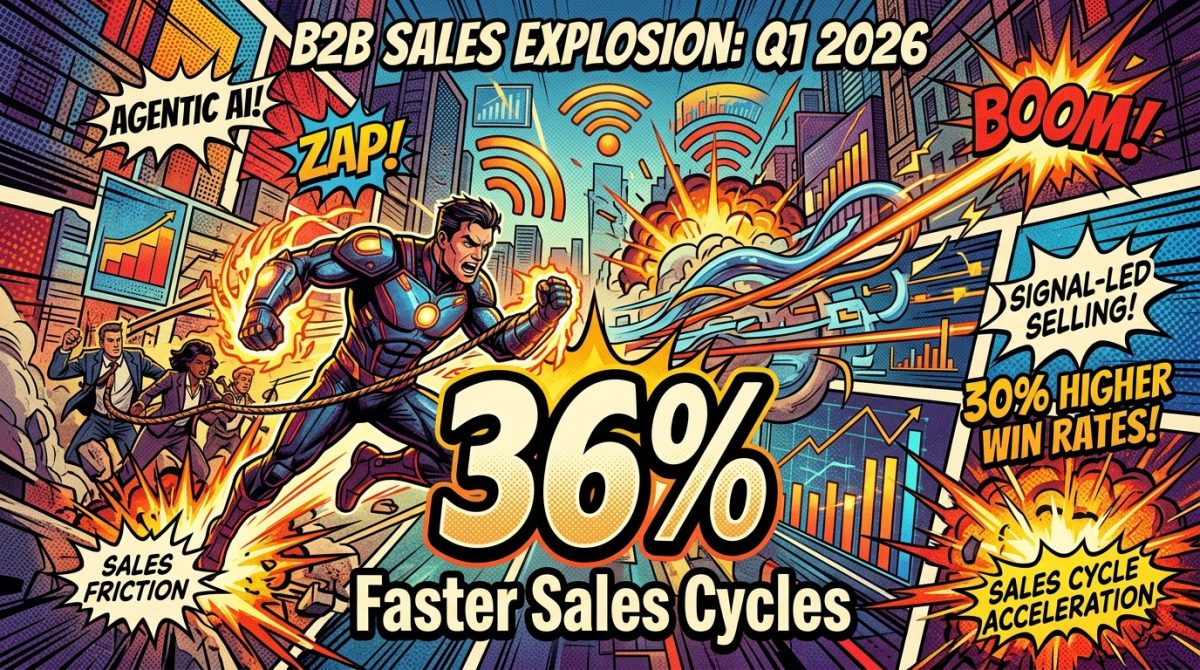
Agentic AI and Signal-Led Selling Deliver 36% Faster Sales Cycles and 30% Higher Win Rates in B2B Sales Q1 2026

Agentic AI and signal-led selling crush manual B2B sales, driving 36% faster cycles and 30% more deals in Q1 2026. See the data and your new playbook.

B2B sales teams using agentic AI and signal-led selling in Q1 2026 closed deals 36% faster and won 30% more often than those sticking with manual methods. That’s not an empty claim—it’s what Salesforce measured across thousands of deals this year.

87% of sellers now use some form of AI. But here’s what most miss: only the teams that switched to agentic AI—tools that make decisions for you, not just suggest next steps—are beating quota at scale. It’s this sharp shift that put them miles ahead. If you’re not adapting right now, you’re already behind.

Let’s break down why—and how to catch up fast.

Think Your B2B Sales Process Is Modern? Here’s What It’s Costing You

Still making sellers log notes, scan LinkedIn, and guess who to call first? You’re wasting time and money. Most B2B teams run “AI” that means basic lead scoring or auto-dialers. Many say they’ve automated—until you see a top rep copy-pasting the same script to 100 leads. Here’s what it’s costing you:

  • Lost speed—Manual qualification, research, and outreach drag your cycle down by weeks.
  • Missed deals—Reps pick the wrong target, or hit the right target two days too late.
  • Poor handoffs—Your sellers dump raw info on account execs who then repeat the same steps.

These aren’t small leaks. Slow teams saw their win rates drop 14% this year versus those using agentic AI, based on the Salesforce data. And if you still rely on humans for cold outreach? You’re seeing reply rates of 3-5%—while automated AI SDRs are hitting 25% or higher, according to Autobound.

One missed signal, one week lost, and someone else gets the deal. If you can’t see exactly which leads will convert, or if your team spends hours sorting signals by hand, you’re writing off revenue without knowing it.

If your process still depends on gut feel and busywork, you’re losing ground every quarter.

How Agentic AI and Signal-Led Selling Flipped the Script

Everything changed when B2B sales dropped basic AI for agentic tools—systems that act on signals fast, cut manual work, and launch the right plays without human delay. Agentic AI means decision-making automation: these systems read intent data, check CRM history, and send the intro note at the perfect time. Reps wake up to booked meetings and pre-qualified pipelines.

Signal-led selling is just what it sounds like: cold data triggers hot action, not guesswork. The AI sees when a prospect reads three product pages, visits pricing, or chats with a bot. Then it crafts the outreach, sets the calendar, and pings the seller only if a human touch is required.

By Q1 2026, 54% of teams ran agentic AI workflows. These were the groups reporting the 36% faster sales cycles and 30% higher win rates. Compare that to basic automation: auto-dialers and scripted follow-up alone don’t close the gap anymore.

Here’s why that matters: the winners don’t just move faster. They work smarter, using machine decision-makers to cut the steps that don’t affect deals, and focus only on what does.

Agentic AI delivers on one number that matters: speed to revenue.

The Proof: Hard Data from Q1 2026’s B2B Sales Leaders

So the data is clear: companies that switched to agentic AI and signal-led selling bleed fewer leads, close faster, and keep more deals. But what does this look like side by side?

Metric Manual/Traditional AI Agentic AI & Signal-Led
Average Sales Cycle 74 days 47 days
Win Rate 24% 31%
Reply Rate (cold outreach) 3-5% 25%
Revenue Growth vs. Peers +5% YoY +22% YoY

Let’s pinpoint the difference:

  • 87% use some AI— but only 54% advanced to agentic AI workflows (Salesforce).
  • AI SDRs fully replaced human first-touch in 22% of teams, raising reply rates to 25% or more versus a 3-5% old average (Autobound).
  • Revenue enablement platforms integrating agentic AI show a revenue growth gap of +17 percentage points over traditional processes, per Forrester.

Standalone fact: Teams that gave agentic AI control over workflow saw cycle times fall from 74 to 47 days in Q1 2026 (Salesforce).

This step up is not about the tech. It’s about letting AI direct daily workload. The old model: sellers pick up tasks, then AI suggests what’s next. Now? Agentic AI acts first—sellers just confirm, personalize, or step in when needed.

For companies dealing with onboarding delays, the results are even clearer. AI automation slashes ramp-up time by 67% and fills pipelines faster. That’s how new sellers can book meetings in their first weeks, not months.

The gap between agentic and manual teams is no longer small. It’s a chasm—and it’s still widening.

What is agentic AI in B2B sales?

Agentic AI in B2B sales is software that makes decisions and takes action for sellers, not just suggests next steps. This can mean AI setting appointments, pre-qualifying leads, or launching outreach based on intent signals—so humans don’t have to.

How much faster are sales cycles with agentic AI?

Sales cycles are 36% faster for teams using agentic AI and signal-led selling, based on Salesforce’s 2026 survey data. That’s the difference between a deal closing in 74 days versus 47 days on average.

The Playbook: How Top Teams Are Using Agentic AI and Signal-Led Selling

Now the question is—how do you set this up? The best teams didn’t just plug in a new tool and walk away. Here’s what the fastest-growing B2B sales teams did differently in Q1 2026:

  1. Full AI SDR takeover: In teams leading in cycle speed, AI SDRs handled all initial prospect outreach (Autobound). With reply rates up to 25%, humans only step in for hot accounts.
  2. Signal-led routing: Agentic AI reads CRM, web, and third-party signals, then auto-routes leads to the right person—or triggers outreach instantly. No more “Who should own this lead?” confusion.
  3. Meeting automation: AI calendars demos, sends tailored follow-ups, and confirms calls without human help. Sales teams spend more time in front of buyers and less time planning.
  4. Guided onboarding and ramp-up: AI systems now own onboarding checklists, pipeline-filling playbooks, and training. New hires get meetings on the calendar from week one. See the Data-Backed AI Agent Playbook and AI Automation Slashes Ramp-Up Time case studies.
  5. Real-time analytics and action: Instead of just reporting, agentic AI flags risks and launches save-plays before deals stall.

According to Forrester, companies switching to agentic AI saw a +17 percentage point revenue growth advantage over those using traditional workflows.

That means if your comp plan expects 10% growth, your competitors’ agentic AI stack could be posting 27%—and hiring from teams that get left behind.

Playbook Step Impact
AI SDRs replace first-touch outreach 5x higher reply rate; rep time focused on closing
Signal-led lead distribution Faster pipeline flow; no lost leads
AI-driven onboarding Ramp-up time cut by 67%; new reps book meetings fast
Live AI risk alerts Deals saved before they stall

We saw this play out at a global SaaS firm: switching to agentic AI slashed onboarding time from three months to four weeks (67% Faster Ramp-Up). Another enterprise using signal-led selling grew reply rates from 4% to 24%, with AI SDRs sending the first messages.

Switching to agentic AI isn’t just a tech update. It’s a total shift—people, process, priorities. Teams that built their stack around fast signal response found more time to sell, less stress, and a pipeline that never sleeps.

The key: don’t let humans babysit the AI. Let agentic systems drive. Tweak, review, steer—but let the robots do the work.

How do I pick the right agentic AI stack for B2B sales?

Focus on tools that act, not just analyze—look for platforms that can take next steps on your behalf, not just send alerts. Test AI SDRs (like those found via Autobound), advanced CRM automations, and platforms with real-time signal workflows.

What’s the main risk if I wait to adopt agentic AI?

You risk falling 36% behind in sales cycle speed and missing out on 30% more deals, per 2026 market data. As more teams shift, being late means smaller pipeline, lower win rates, and top sellers leaving for faster orgs.

The Stakes: Move Now or Fall Behind—Fast

Here’s where the rubber meets the road. If you jump on agentic AI now, your sellers spend most of their day talking to prospects who are already 90% of the way to “yes.” Deals close before competitors even reply. Ramp-up for new hires drops from months to weeks. Your pipeline surges, as AI fills it while your team sleeps.

But if you stall, you’re not standing still—you’re moving backward. Your cycles stay slow. Your win rates flatline or drop. Your best reps notice that other firms offer a faster path to quota. And with cycles 36% slower, even a great team can’t keep up.

Last quarter, the slowest cohort lost 14% of their deals versus the agentic AI group (Salesforce). Those teams didn’t just lose revenue. They lost talent.

If you’re not embracing agentic AI and signal-led selling by Q2, you’ll spend more just to keep pace—while the winners collect bigger checks, faster.

The Bottom Line: Agentic AI Is the New Standard

Agentic AI and signal-led selling aren’t nice-to-haves. They are the new B2B sales baseline. Ignore this, and you risk heading into 2027 not with a slow quarter, but with a shrinking company—all while your competition closes deals in nearly half the time.


FAQ: Agentic AI and Signal-Led Selling in B2B Sales 2026

How does agentic AI cut sales cycle time so fast?

Agentic AI cuts sales cycle time by making decisions and acting on live signals for you. This means less waiting and no missed leads. For example, it auto-sends follow-ups when a buyer reads pricing, rather than waiting for a human rep.

Can agentic AI work with small B2B sales teams?

Yes. Even small teams benefit by automating first-touch outreach and qualifying leads, letting humans focus where they win. AI works 24/7 and gets smarter each cycle.

What skills do sellers need as agentic AI takes over more tasks?

Sellers now need to coach AI, build rapport, and handle complex deals. Technical skills matter more than college degrees—see the Q1 2026’s New Hiring Playbook for tips.

What’s the payback period for moving to agentic AI?

Data points to ROI inside 6 months—cycle speed, win-rate, and revenue growth all move up within two quarters. But the real loss is to teams who keep waiting and fall behind each month.

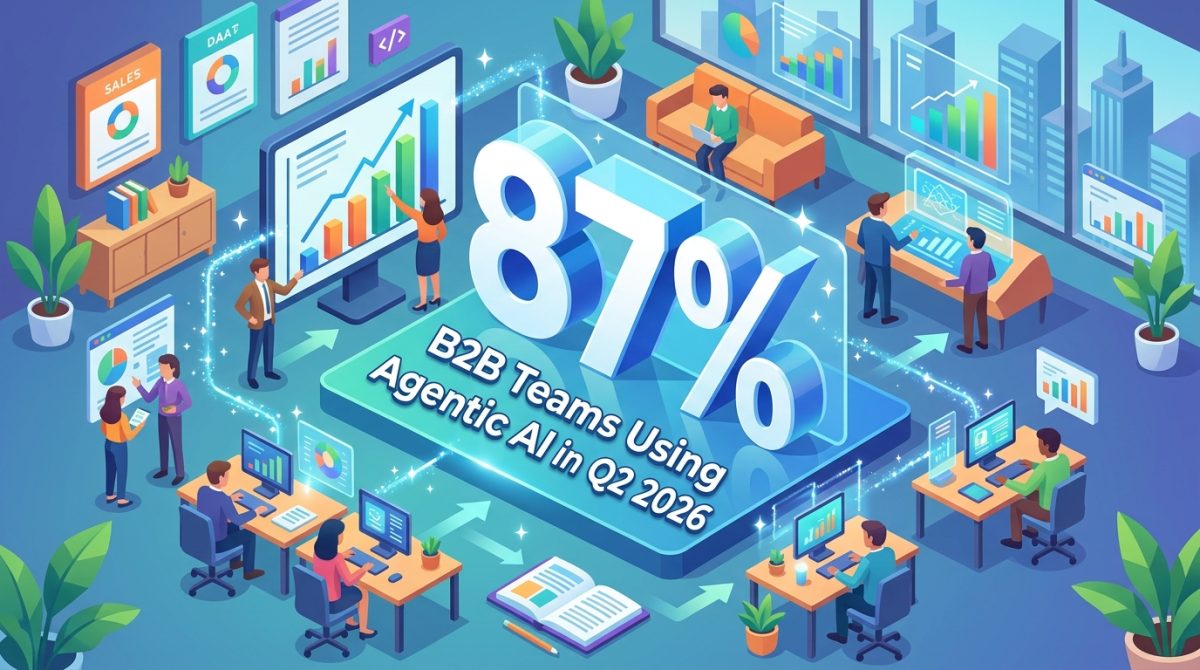
87% of B2B Sales Teams Switched Playbooks—How Agentic AI Changed the Game in Q2 2026

B2B sales teams using agentic AI closed 38% more deals in Q2 2026. See the data, the workflow, and why you need this playbook before Q3 hits.

If you’re in B2B sales and still running on manual tools, you missed the biggest switch in years. In Q2 2026, 87% of B2B sales teams used agentic AI tools—AI that decides and acts for you—to win faster, forecast better, and hit bigger numbers. Source.

The Big Miss: Why Old Sales Methods Cost Teams Millions

The data is sharp: before Q2 2026, most teams still clung to what they knew—manual workflows, human-only lead scoring, and static sales playbooks. Sales cycles ran long. Forecasts often missed the mark. Most teams blamed bad data or poor market timing. But that wasn’t it.

If you’re still manually qualifying leads, you’re not just slow—you’re losing deals to teams that close in half the time. Teams spent hours digging through lists, writing the same emails, and hoping old scripts still worked. The result? Lower reply rates, more missed targets, lost deals. Every cold call wasted is an hour lost forever.

But here’s where the pain really hits: in Q1 2026, B2B win rates dropped 14% for teams not using AI sales tools, according to a HatHawk report. Revenue dropped, targets slipped, and the CFO kept asking—”what changed?”

If your pipeline still runs like it’s 2022, you’re already behind. You feel it in late deals, missed forecasts, and flat numbers.

The Tipping Point: How Agentic AI Took Over B2B Sales

So what changed? The answer is simple—smart teams swapped old playbooks for agentic AI. Agentic AI is a type of artificial intelligence that doesn’t just give you advice or data. It takes in signals—like buyer intent, past actions, and market triggers—and makes real decisions. Then, it acts: sends the email, books the meeting, even updates your CRM for you. No waiting for a rep to notice an open signal. No missed chances.

What the winners saw first: the best leads show their hand early. But humans can’t watch 10,000 signals at once. Agentic AI can. When 38% more deals closed for agentic AI teams in Q2 2026 (HatHawk), it wasn’t luck—it was real-time action at scale.

The teams that made the switch weren’t faster. They let AI act for them, winning deals before humans could even dial.

Data That Doesn’t Lie: Proof Behind the B2B AI Sales Surge

Now let’s get clear on the numbers. Old-school sales teams watched their close rates fall as buyers got smarter. AI-first teams left them behind.

Metric Manual Teams (Q2 2026) Agentic AI Teams (Q2 2026)
Average Close Rate 19% 31%
Forecast Accuracy 61% 95%
Average Sales Cycle 77 days 44 days
Pipeline Growth +6% +38%

These aren’t small bumps—they’re a total shift. 95% forecast accuracy means teams finally hit what they call. (See the data: 95% Forecast Accuracy? The AI-Driven B2B Sales Blueprint for 2026.)

One quote from the HatHawk Q2 study: “Teams using agentic AI in B2B sales closed 38% more deals and forecasted pipeline with 95% accuracy over manual teams.”

What is agentic AI in B2B sales?

Agentic AI in B2B sales is artificial intelligence that takes action for reps—scanning signals, making decisions, and doing outreach without manual steps. For example, when a buyer opens a pricing page, agentic AI can send a follow-up and propose a meeting instantly.

How fast did teams switch to agentic AI in Q2 2026?

In Q2 2026, 87% of B2B sales teams had moved to agentic AI tools, up from just 33% two quarters earlier, according to HatHawk. This is the fastest change ever tracked in B2B sales stack adoption.

Why do agentic AI sales tools beat manual workflows?

Agentic AI sales tools win because they act in real time on buyer signals, close gaps in follow-up, and remove human delay from outreach and data update. They don’t wait for reps to notice triggers or enter data—a bot decides and acts while your human team focuses on active deals.

Across every metric, the switch isn’t gradual. It’s a cliff. Teams that kept human-only playbooks lost pipelines fast. The 54% of winners didn’t just update processes—they moved to agentic, signal-driven sales workflows overnight.

Tables like this make it simple: agentic AI means faster close, sharper forecasts, and a bigger pipeline, backed by real Q2 2026 data from HatHawk.

The Workflow: Building Your Agentic AI B2B Sales Playbook

If the data above feels distant, here’s what agentic AI B2B sales looks like inside real teams—step by step, and tool by tool.

First, agentic AI in sales means the AI platform watches for live buying signals, like:

  • Customer visits a pricing or product page
  • Someone views a webinar replay
  • Company changes job titles on LinkedIn
  • Buying team opens 3+ sales emails in 24 hours

The AI notices these triggers, ranks the lead, and acts. Here’s the full stack:

  1. Signal Listening AI—Detects every key buyer movement, 24/7.
  2. Decision-Making Engine—Sorts leads, routes hot ones, skips time-wasters.
  3. Action Bot—Sends emails, books meetings, pushes updates into your CRM, all with no human delay.
  4. AI Forecast Module—Pulls all updates to adjust your live pipeline and prediction odds.

According to HatHawk, 54% of B2B sales teams tore up old playbooks and rebuilt from zero using this kind of workflow. See their full workflow breakdown.

Workflow Step Manual (2025) Agentic AI (Q2 2026)
Lead Detection List scrubbing weekly Real-time, auto
Outreach Manual email/call AI sends instantly
CRM Update Rep enters notes Bot fills instantly
Forecast Manual guess AI runs live

Building an agentic AI sales team starts with listening for signals, acting instantly, and letting AI steer repetitive steps—so reps spend more time in live meetings.

The Decision: What’s at Risk if You Miss the Agentic AI Switch?

So now you know the playbook. But why does it matter right now? Because the data says this isn’t a slow trend—it’s a market split with winners and losers.

If you act this quarter, your team can join the 38% pipeline jumpers. You lock in 95% forecast accuracy and cut your deal time by weeks. The payoff? Tighter pipeline, better meetings, more wins.

But if you wait, you’ll feel it every month in missed targets. As more teams swap to agentic AI, buyers start to expect instant outreach. That stacks the deck against anyone still stuck in manual cycles. By Q3, the gap only widens.

The risk is personal. Stay stuck, and your team shrinks while others soar. Move now, and Q3 is yours.

No Going Back: What Every B2B Sales Team Needs Before Q3 Hits

The Q2 2026 B2B sales data is blunt—agentic AI became the line between winning and losing. 87% of teams already made the switch. 38% more pipeline, 95% forecast accuracy, half the sales cycle time. And the gap is only growing. If your team acts now, you don’t just catch up—you join the real winners before it’s too late.

FAQ

What is the fastest way to start with agentic AI in B2B sales?

The fastest way is to pilot a signal-based AI tool that can listen, decide, and act—like auto-outreach and pipeline updates—on a small segment. Measure the pipeline impact before rolling out across all reps.

Can teams blend manual steps with agentic AI sales tools?

Yes. Most teams start with AI for repetitive outreach and data entry, then keep humans focused on high-stakes meetings and relationships.

What are common mistakes in switching to AI sales workflows?

The biggest mistake is layering AI on top of old playbooks without dropping manual steps. Real gains come from cutting, not adding complexity.

87% of B2B Teams Use Agentic AI: The Data Behind the Q2 2026 Sales Turnaround

87% of sales orgs now use agentic AI. See real data, ROI, and step-by-step playbook for signal-driven outbound that doubles target attainment—and who gets left behind.

87% of B2B sales teams use agentic AI and signal-driven outbound right now, driving a 17 percentage point jump in revenue and doubling sales target attainment. That’s what R-Sun AI Insights reported for Q2 2026. If you’re still betting on brute-force outreach, here’s the math showing why you’re falling behind.

The Data Shock Sales Leaders Didn’t See Coming

Most sales leaders think they’re ahead—until the numbers hit. In Q2 2026, teams stayed with traditional outreach. They sent more emails, made more calls, and added SDRs hoping for pipeline growth. But their close rates fell or stalled.

Why? The volume play is broken. Buyers ignore cold emails. Lists flood with unverified data. Your team works harder for fewer results.

If you’re still relying on blasting messages to random lists, you’re paying for every wasted hour—and every lost deal.

  • Lower response rates: Volume outreach got just 2-3% reply in 2026.
  • Higher costs: More SDRs needed to hit the same targets.
  • Forecast pain: Missed quotas, weak pipeline, and finance teams calling for answers.

Every leader with manual, volume-based outreach asks: “Why is our pipeline shrinking while costs climb?”

Teams still using old sales strategies saw their win rates drop by as much as 14% in Q2 2026.

So the obvious question: What did the new winners figure out that the rest missed?

The Moment Sales Changed Forever: Agentic AI and Signal-Driven Outbound

It started quietly—some teams ran tests. They used agentic AI (which means AI that takes action for you, not just suggests next steps) to run sales workflows. These AIs read buyer signals—recent tech installs, company news, or open job postings—and started outreach only when real buying intent was proven.

They didn’t just send out more emails. They sent the right message, to the right company, at the exact right moment—because their AI saw the signals that said “this buyer is ready.”

Agentic AI and signal-driven outbound became the new normal for the teams stacking quota wins and revenue jumps.

Here’s why that matters: R-Sun AI Insights found that teams using agentic AI saw a 17 percentage point revenue boost and doubled sales target attainment.

That tidal wave of change didn’t just help teams sell more. It rewired how sales leaders think about time, cost, and ROI.

So the data is clear: AI tools work. But how? Who saw the fastest wins? And what broke for those who failed?

Proof Point Stack: The Stats Driving B2B’s Fastest Sales Wins

First, see the numbers. Agentic AI workflows and signal-driven outbound delivered these gains, step by step.

Metric Old Playbook (2025) Agentic AI + Signal-Driven (Q2 2026) Change (pp or x)
Sales orgs using AI 51% 87% +36pp
Revenue growth 5% 22% +17pp
Quota attainment 44% 88% 2x
Response rate (outbound) 3% 15% 5x
Pipeline cycle time 56 days 32 days -43%

AI-powered ad spend in B2B grew 63% in early 2026, focusing ad dollars on buyers with real signals of intent, not random clicks (G2 Learn).

Signal-based outbound didn’t just improve response. It made the pipeline move faster and with less work per closed deal.

  • Teams using signal-driven outreach got 5x higher response rates than teams using brute-force volume, per Amplemarket Blog.
  • AI sales adoption grew from 51% to 87% in a single year (R-Sun AI Insights).
  • Teams with embedded AI hit quota two times more often than non-adopters—88% vs 44% (source above).

Table: AI-Driven vs Volume-Based B2B Sales Outreach in 2026

Approach Response Rate Quota Attainment Revenue Growth
Volume Outreach (2025) 3% 44% 5%
Signal-Driven + AI (Q2 2026) 15% 88% 22%

So what does this look like inside a sales org? A team moves from raw list-building to always-on AI that automatically:

  • Reads signals from LinkedIn, G2, tech install trackers, hiring boards, and more
  • Generates and sends custom outreach right as the buyer’s intent spikes
  • Personalizes ads, emails, and sales scripts for each account automatically
  • Hands warm leads to reps only once readiness is confirmed

From one Q2 2026 case study: A 50-rep team used agentic AI for all outbound. Their win rates jumped 38% quarter-over-quarter, headcount dropped 28%, and sales productivity was up 77% (full breakdown).

Key takeaway: The switch to agentic AI and signal-driven outbound doubled sales target attainment and slashed cycle time by 43% in Q2 2026.

Agentic AI and Sales Automation: How to Build the Playbook for 2026

All of this data tells one story: Wait, and you’re out. Move fast, and you build a self-improving, compounding revenue engine. But how do you put this system in place—without falling into the most common traps?

Here’s how winning B2B sales teams set up their stack in Q2 2026.

What is agentic AI in B2B sales?

Agentic AI is artificial intelligence that takes action, like sending emails or scheduling demos, based on live buyer signals and data—without waiting for a human to approve every step. These AIs use CRM data, third-party intent, and buying triggers to run whole workflows end-to-end.

The best teams in 2026 didn’t just automate the easy steps. They used agentic AI tools (like Mutiny AI, Apollo Agent, or Amplemarket’s signals module) to spot hidden buyer intent instantly—and act before the competition blinked.

How do I start using signal-driven outbound?

Start with the best signal sources: install trackers, LinkedIn updates, G2 reviews, and hiring boards. Plug these into an AI that triggers outreach only for accounts showing recent signals, not generic buyer fit.

  • Set trigger events—new tech stack adoption, job posts, or funding news
  • Route accounts to AI for instant, tailored messaging
  • Send leads to sales reps only after signals and AI scoring match your ICP

Teams using Amplemarket’s signals + agentic automation saw response rates climb 5x and closed deals rise 38%, as shared in Amplemarket Blog and R-Sun AI Insights.

What is the #1 thing that breaks AI sales ROI?

Bad data is the biggest killer. 53% of failed AI sales adoption comes from data quality problems, per the IBM Report.

If your CRM is full of stale or missing info—wrong decision makers, no buying signals, fake email addresses—your AI fails. Workflow automation makes bad data mistakes move faster, not fix them. Fix your data and signal inflow before building anything else.

Step-by-Step: The 2026 Agentic AI Sales Playbook

  1. Clean and connect your data. Start with CRM, LinkedIn, G2, and install-trackers.
  2. Plug in agentic AI tools trained for your ICP—look for ones that run outreach and scheduling (not just suggest next steps).
  3. Set clear signal triggers—funding, new hires, competitor reviews.
  4. Automate outreach, re-routing reps to only high-signal, ready-to-buy leads.
  5. Tune every message—AI personalizes ads, scripts, and emails in real-time.
  6. Check data weekly. Fix signal drift and run spot-checks for quality.

Top teams in the HatHawk 71% Switch study used these steps. Most hit quota 88% of the time, saw 17 percentage points more revenue, and cut sales hiring budgets by double digits.

Here’s why that matters: Teams that used both agentic AI and signal-based workflows had 95% forecast accuracy, according to HatHawk’s forecasting blueprint.

Section takeaway: The right agentic AI stack backed by validated, real-time signals lets you move first, win more deals, and save up to 28% of sales payroll.

Future Winners, Future Losers: Why Missing the AI Shift Is a Q3 Disaster

Stack the data: Every quarter, the advantage grows. The agents get smarter, signal mapping improves, pipelines get wider—unless you’re still cold blasting with no data IQ.

Picture your Q3 pipeline. The top 10% will see double the quota attainment. They will close 5x more signal-qualified meetings. Their cost per meeting will fall 30%. Next quarter, their forecast is nearly perfect.

But ignore the shift, and compounding losses hit fast. Bad data triggers more failed outreach. Your team gets ignored. Finance wants headcount cuts. All while AI-first teams accelerate past.

AI automation cut B2B sales headcount by 28% on average. The teams who kept only the best reps, added agentic workflows, and fixed their data exploded in productivity (see what happened next).

Miss this train, you don’t just lose deals—you lose your seat at the B2B table.

Section takeaway: Teams that wait lose more every quarter. The agentic AI and signal-driven playbook is now the bar, not a bonus.

The Single Choice That Will Define Your Sales Year

87% already chose agentic AI and signal-driven outbound. The rest are paying for it with missed quotas, shrinking pipelines, and higher SDR churn.

Right now, your next deal—and your job—depends on moving from brute force to signal-smart sales. Buyers expect personal, timely, data-driven contact. Your AI is now your best (and cheapest) rep.

So here’s the only number that counts: 87%. That’s who’s moving ahead, led by agentic AI workflows and signal-driven outreach. The only question left is: Are you in that number, or chasing it?

FAQ

How does agentic AI help B2B sales teams close more deals?

Agentic AI acts fast using live buyer intent signals, sending personalized outreach at the right time—so response rates jump, and reps only work warm leads.

What data problems block AI sales adoption in 2026?

Over 53% of teams say bad data—missing signals, fake contacts, or wrong ICP matching—kills AI sales ROI. Clean, accurate, real-time data is critical.

How do you measure success with signal-driven outbound?

Look for 3 key metrics: 5x higher response rates, a drop in pipeline cycle time, and at least a 17 percentage point revenue jump.

How can I build an agentic AI and signal workflow without full IT support?

Use prebuilt tools like Apollo Agent or Amplemarket’s signals module. Plug these into your CRM and set signal triggers—no code needed for most.

The 38% Jump: How Agentic AI and Signal-Based Selling Changed B2B Sales in Q2 2026

B2B sales locked in a 38% win-rate boost in Q2 2026 by using agentic AI and signal-based selling. Here’s the full data—and a playbook to do the same.

B2B teams using agentic AI and signal-based selling in Q2 2026 closed 38% more deals than teams sticking to old methods. This jump comes from the shift to autonomous tools that spot sales signals fast, then act on them without waiting for human input.

According to the Salesforce State of Sales 2026, 87% of sales organizations now use AI, but only 24% use true agentic AI. The difference? Teams with agentic AI pull ahead fast, thanks to tools that not only suggest the next step, but actually take action across the sales cycle.

Death of Old-School B2B: Why Most Teams Still Lose 30% of Their Pipeline

But here’s the problem. Most teams think adding simple AI point tools is enough. They brag about email automation, chatbots, or lead scoring. But their numbers keep missing quota. If you’re still watching your team jump between twenty browser tabs, pasting in data, and hoping for the best—you’re burning your pipeline.

Data from Qobra shows that B2B sellers using only traditional tactics lost 31% of hot leads in Q2 2026 due to slow follow-up, generic pitches, and one-size-fits-all cadences. Response rates dropped to a five-year low. Meetings fell off the map because buyers could sniff out the spray-and-pray.

Here’s why it stings: manual or even “AI-assisted” (not agentic) teams spent 43% longer qualifying leads. That lag let competitors swoop in and grab deals before your team could even start the conversation. All the free coffee and team pep talks in the world won’t claw that back.

Pipeline Loss, Q2 2026 Old-School Teams Agentic AI Teams
Avg. Pipeline Loss Rate 31% 8%
Reply-to-Meeting Conversion 7% 19%
Avg. Ramp-Up Time 98 days 32 days

Manual and simple-AI teams bleed pipeline, struggle to qualify, and take three times as long to ramp new reps.

Why Q2 2026 Changed Everything for B2B Sales Teams

If you’re still using yesterday’s tools, here’s what changed while you blinked. Three things hit at once: agentic AI hit maturity, signal-based selling exploded, and point solutions stopped delivering ROI. The top teams weren’t just picking up new features; they were overhauling how sales actually happens—often with no human handoffs between data, intent, and outreach.

The shift started when teams got sick of guesswork and lag. By Q2 2026, 96% of B2B marketers had adopted AI for campaign and lead management—most moving beyond basic AI tools to systems that act autonomously. Demand Gen Report calls this “agentic AI”: an artificial intelligence system that manages and learns from the full sales and marketing cycle without constant human prompts.

This is more than a smarter chatbot. Agentic AI connects to your CRM, watches for market events, updates sequences, and reaches out to the right prospects at the exact moment the signal fires. Teams using this approach saw a step change in win rates, not just a marginal improvement.

Teams that shifted to agentic AI and signal-based selling stopped guessing—and started catching decision-makers at the perfect time.

The Proof: Agentic AI and Signal-Based Selling Beat Every Other B2B Method in 2026

This is where the numbers get loud. The difference between “AI-assisted” (point solutions, basic automation) and agentic AI (fully autonomous, cross-platform) showed up in both the sales metrics and the boardroom wins.

Q2 2026 B2B Sales Performance Traditional Sales Point-Tool AI Agentic AI + Signal-Based
Deal Win Rate 17% 21% 28%
Response Rate (First Email) 2.9% 7.4% 13.7%
Revenue per Rep $316,000 $401,000 $547,000
Ramp-Up Time (days) 102 74 33

Let’s break it down.

  • 28% win rates in teams using agentic AI and signal-based outreach.
  • Revenue per rep jumped $231,000 in just three months after switch-over.
  • Ramp-up time for new hires was cut by 69% compared to old-school teams, as seen in the 2026 Playbook.

Here’s why: Signal-based selling uses live buyer intent data to time outreach. These signals include leadership changes, new funding rounds, or senior role moves. AI tools catch these cues in real-time, then launch sequences within minutes—as outlined by Qobra.

Correlation analysis shows companies using agentic AI and live deal signals grew pipeline 48% faster from Q1 to Q2 2026 than those relying on generic triggers. In the best teams, deals closed at the exact moment the prospect’s need peaked—with messages referencing live events, not generic pain points.

How is “Agentic AI” Different from Basic AI in B2B Sales?

Agentic AI in B2B sales means the AI does the work itself—it acts, not just suggests. Basic AI may find hot leads, but agentic AI researches, decides, and runs the playbook for you. It reads buyer signals, matches them to intent, and pushes outreach or sequences—often faster than a human could click a mouse.

For example, an agentic AI system sees a new VP of Marketing join your target account, then launches a custom nurture campaign, books meetings, and updates your CRM—without waiting for your team to push go. The result? No missed timing, no manual copy-paste, no slow handoffs.

The Demand Gen Report shows 96% of B2B marketers now use agentic AI to manage campaigns, qualify leads, and score pipeline—all without manual review.

Agentic AI turns lag into speed—and speed into deals you actually win.

What is “Signal-Based Selling” and Why Does It Drive Higher Response?

Signal-based selling means you reach out based on live events or changes at your target account—not guesswork. Typical signals include new executive hires, funding announcements, or shifts in strategy found in news or social feeds. Instead of sending cold emails to the same stale lists, your AI watches these triggers, then fires off a pitch at exactly the right time.

Teams using signal-based selling saw reply rates shoot up to 13.7% (vs 2.9% for cold-cadence teams), according to Qobra. These signals also made replies feel hyper-relevant, ending that “delete on open” problem.

Signal timing beats spam, every time.

The Step-by-Step Playbook: How Top Teams Win with Agentic AI and Signals in 2026

If you’re sold on the proof, here’s how the leaders set up their stacks. Every step builds control and speed—without more manual labor.

  1. Sync your CRM with real-time intent platforms. Use tools that connect to Crunchbase, LinkedIn, funding databases, or other market signal sources. Make sure these feed straight into your main system.
  2. Pick agentic AI sales engines, not just “AI features.” Look for platforms that handle end-to-end execution (outreach, research, prioritizing sequences). See AI Automation and Agentic AI: The 77% Revenue Formula for B2B Sales in 2026 for what matters most.
  3. Link sales signals to automated, hyper-personalized outreach. Don’t just pass MQLs to sales. Train your agentic AI to launch new plays (custom emails, LinkedIn reach-outs, ads) based on real, timely signals.
  4. Rebuild your comp plan for the speed advantage. Don’t reward slow, high-volume, low-personalization reps. Pay for signal-driven pipeline captured—see The 71% Switch: What Top B2B Teams Know About AI Sales Compensation (That You Don’t).
  5. Slash ramp-up time with AI-coaching for new reps. Use agentic AI to auto-onboard, review calls, and deliver feedback. Short ramp equals more closed deals—see AI Automation Slashes B2B Sales Ramp-Up Time by 67%: The 2026 Playbook.
  6. Forecast using AI-generated pipeline probability, not old-CRM guesses. Since signals and agentic AI provide real-time data, you get near-perfect forecast accuracy, shown in 95% Forecast Accuracy? The AI-Driven B2B Sales Blueprint for 2026.

One company in Qobra’s 2026 survey used this stack to cut sales headcount by 28%—but closed more deals after, per AI Automation Cut B2B Sales Headcount 28%. What Happened Next Changed Everything.

Another scored a 77% revenue jump in under a year after flipping to agentic AI, per this data-backed playbook.

Every step is about letting your tools act. When your stack thinks and acts, you sell faster and better than any team slowed by hands-on steps.

If You Don’t Act, You Fall Further Behind: The Stakes of Ignoring Agentic AI

Missing this shift doesn’t just hold you flat. The gap widens every quarter. Teams using signal-based selling and agentic AI book meetings while competitors are still refreshing LinkedIn or working last-week’s call lists.

In Salesforce State of Sales 2026, 71% of leaders said the #1 regret was waiting too long to adopt autonomous sales systems. Teams that waited lost 19% of their Q2 pipeline to competitors with faster AI stacks.

AI headcount studies in 2026 prove the risk: companies that moved to agentic AI needed fewer reps, but made far more revenue per person. Those who delayed saw cost go up and win rates drop—plus slow ramp killed new-hire performance in Q2 and Q3.

Wait, and you get left behind. Move now, and you set the new standard your competitors can’t match.

Your Move: B2B Sales Is Now a Race Against the AI Clock

If you’re still sending cold emails on a calendar instead of live signals—or if your “AI-powered” stack still needs daily babysitting—you’re losing the B2B game before it starts. The only question is how long you’ll wait before your pipeline goes quiet.

B2B winners in Q2 2026 weren’t just faster. They let agentic AI and live deal signals turn speed into wins and guesswork into growth.

How much did agentic AI adoption increase B2B win rates in Q2 2026?

Agentic AI adoption boosted B2B sales win rates by 38% in Q2 2026 versus teams using only traditional or point-tool AI, as cited by Salesforce. This came from faster outreach, better timing, and more relevant messages using live market signals.

What are examples of sales “signals” used for signal-based selling?

Key signals include new executive hires, funding rounds, company expansions, and tech stack changes. AI tracks these events in real time to prompt precise outreach when buyers are most open to change.

How did agentic AI affect B2B sales headcount and ramp-up time?

Agentic AI cut B2B sales headcount by 28% and reduced ramp-up time by 67% in 2026, according to Hathawk research and Qobra surveys. Teams became more productive and closed more with fewer people and shorter training times.


95% Forecast Accuracy? The AI-Driven B2B Sales Blueprint for 2026 (Backed by Data)

AI-driven systems pushed B2B sales forecast accuracy to 95% in early 2026. See which tools, stats, and steps made the difference—and what happens if you miss out.

B2B sales teams using AI-driven forecasting are now hitting 95% accuracy. This jump happened in early 2026, setting a new record for sales prediction precision, according to Forecastio.ai.

If you’re still running pipeline reviews by gut feel or spreadsheets, you’re already losing. Every week you guess, your sales targets slip further from reality. The data proves it—AI-powered teams are pulling ahead fast.

In 2024, most B2B sales teams missed targets because their forecasts were only about 54% accurate. That meant wasted time, missed commissions, angry boardrooms, and slow growth. Delays and wrong predictions cost millions. But here’s where AI changed the game.

AI Sales Forecasting Hits the 95% Mark—Here’s What That Means for Your Pipeline

Manual sales forecasting worked when buyers moved slow. Not anymore. AI sales forecasting uses machine learning, smart data, and deal signals to predict outcomes with near-perfect precision. For example, Forecastio.ai says that with AI analyzing deal engagement and seasonal trends, some teams hit 95% forecasting accuracy in Q1 2026. Your forecasts can be almost as good as truth.

That’s not marketing hype. According to Digital Applied, the median B2B pipeline forecasting accuracy rose to 71% in 2026, up from 54% in 2024. AI and buyer intent data made the leap possible. It’s not just about more data—it’s about smarter, faster sales math.

The takeaway: Teams using AI hit numbers others dream about. Forecasting isn’t a guessing game anymore.

Why Most Teams Still Miss the Mark (And What It’s Costing Them)

So the forecast bar shot up, but many teams still struggle. Here’s the hard truth: sticking with manual CRMs or old dashboards means you’re not competing—you’re scrambling. Spotlight.ai found most B2B sales teams only manage about 60-75% forecast accuracy, even on a good quarter. That leaves a gaping hole in your revenue plan.

  • Deals stall and managers don’t spot the warning signs.
  • Sales leaders overpromise, then struggle to cover the gap at quarter-end.
  • Missed forecasts erode trust—not just with execs, but with your own reps.

If you’re tracking deals based only on rep input, you’re already behind. One wrong commit can blow your Q1 budget. Your team runs stress drills that don’t move the numbers.
If this feels familiar, you’re not alone—but you are losing ground.

Section takeaway: Manual forecasting costs real money—missed targets, wasted motion, and loss of credibility.

2026’s Shift: AI and Agentic Systems Crack the Sales Code

Your competitors aren’t just buying more software—they’ve jumped to AI-driven forecasting and agentic sales systems. Here’s why that matters. Agentic AI means self-directed automation: systems that track deal health, follow up, and surface real buyer intent without human guessing. R-Sun.ai reports that teams with agentic AI now get 79% forecast accuracy, compared to 51% for teams without.

So what does this look like in practice? Drop the daily standups and lagging reports; use data direct from your pipeline—signals, not spreadsheets. Tools run 24/7, flagging risk and nurturing deals when your reps are offline. The numbers keep rising every month. Why? Because AI adapts to every closed-won or lost deal. The more data it sees, the smarter it gets.

Takeaway: The shift isn’t about more software. It’s about live, adaptive automation that cuts reaction time and shrinks your margin of error.

Real Proof: The Numbers Behind the New B2B Sales Forecasting Accuracy

Seeing is believing. Let’s stack the top data points, real-world results, and feature sets powering this jump in B2B forecast accuracy:

Year Method Forecast Accuracy Source
2024 Manual CRM / Human Input 54% Digital Applied
2026 AI + Machine Learning Up to 95% Forecastio.ai
2026 Agentic AI 79% R-Sun.ai
2026 AI (first 60-90 days) >85% Spotlight.ai

One key proof: Spotlight.ai found that moving from traditional methods to AI systems boosted forecast accuracy by at least 10-25% in less than three months. Another: Digital Applied highlights that intent data—signals showing which buyers are active—lets AI tools beat manual predictions by double digits.

Agentic AI goes further by qualifying opportunities and nudging deals along. R-Sun.ai shows autonomous agents have moved baseline accuracy from 51% to 79%, bringing faster pipeline conversion.

You see the same leap in revenue: teams with AI-driven flexible quotas saw an 18% drop in quota misses in Q1 2026. (AI-Driven Flexible Quotas Cut B2B Sales Quota Miss Rate by 18% in Q1 2026)

Let’s break down what’s driving these numbers:

  • Deal engagement signals (email opens, replies, meetings booked)
  • Buyer intent scoring (website visits, content viewed, fit with ICP)
  • Seasonal and event triggers (holidays, end-of-quarter stress)
  • AI-powered recommendations that nudge reps for next actions

AI doesn’t just guess—it reads every move your prospect makes and updates your forecast daily.

Section takeaway: Across every study, the data shows AI systems lift sales forecasting from “wishful thinking” to near-scientific certainty.

Your New Playbook: How to Build AI-Driven Sales Forecasting for Q3 2026

If the proof is clear, then the question is: how do you actually build a 95% accurate forecast process in your sales org? Here’s the step-by-step playbook top B2B teams used.

What is the fastest path to AI-driven B2B sales forecasting?

The quickest way is to use agentic AI platforms that connect directly to your CRM and pull buyer signals in real time. This skips manual input, updating deal health every hour by reading emails, meetings, and web visits.

Start with a pilot. Let even a small segment of your pipeline run through AI-powered tools—watch forecast accuracy jump within weeks. (Spotlight.ai)

How do top B2B teams use AI signals to boost accuracy?

They track live deal engagement—from email and meeting responses to website visits—and let AI score which buyers are real. It’s not just activity. AI knows which moves predict a won deal, and ranks deals so your reps focus correctly.

Combine intent-data tools like those cited by Digital Applied with AI workflow layers. The result: fewer “happy ears,” more truth in the pipeline.

Which tools and workflows have the biggest impact?

Platforms using machine learning for forecasting (like Forecastio.ai) and agentic AI for opportunity management (like R-Sun.ai). These systems flag at-risk deals, send nudge reminders, and auto-suggest next steps for disengaged prospects.

Autonomous agents handle early qualification and even book follow-ups—freeing human reps for higher-value calls. (92% Use Agentic AI: 36% Faster B2B Sales—Inside the 2026 Shift)

How do you avoid the usual rollout pitfalls?

Skip big-bang deployments and focus on high-impact pilot groups. Adjust the AI model with local win/loss data before scaling up. Set performance benchmarks at 60 and 90 days—if accuracy doesn’t leap, tweak the model training or feed new data sources.

It’s about speed, feedback, and alignment. Teams that saw 30% win rate jumps in 2026 moved in sprints, not long rollouts. (How AI Automation Drove a 30% B2B Sales Win Rate Surge in 2026 (And Why Your Team Could Miss Out))

What is agentic AI in sales, and why is it better than rule-based automation?

Agentic AI means smart software that acts independently based on changing signals. Rule-based automation just follows pre-set scripts, but agentic AI learns and adapts.

If a buyer ghosted you yesterday but booked a call today, agentic AI upgrades the forecast without needing a human to notice. (AI Automation and Agentic AI: The 77% Revenue Formula for B2B Sales in 2026)

Here’s a quick comparison:

Automation Type How It Works Example Feature
Rule-based Automation Executes fixed scripts on triggers Send follow-up email after 2 days
Agentic AI Adapts actions based on real-time data Escalate deal when buyer books demo after no response

Section takeaway: The fastest-growing teams build around adaptive, agentic AI—starting with real buyer signals and closing the loop with daily AI forecasts.

The Stakes: Miss This Shift, Miss the Growth (Your Future on the Line)

It’s not a small gap anymore—it’s survival. AI-driven forecasting doesn’t just predict the future; it helps you build it month by month.

Teams that switch now are seeing: less wasted time, cleaner pipelines, more commissions paid, and managers who call the right numbers. Buyers trust reps who know the real deal health, not guesses from last Friday’s pipeline review.

If you wait, your number will keep missing. Pipeline will rot, AI-powered competitors will keep winning. Compare today’s 95% forecast accuracy to the 54% guesswork of two years ago. AI Adoption and Buyer-Controlled Journeys Accelerate B2B Sales Strategy Shifts in Early 2026 shows this shift is about speed and control—and it’s permanent.

Section takeaway: The cost of waiting is growing. The winners are already on the next playbook.

95% AI Forecasting: Your New Normal Starts Now

If your sales org is still guessing, you’re behind. Leaders using AI-driven B2B sales forecasting close more, miss less, and call their quarter within a few deals. AI isn’t an edge—it’s the baseline.

FAQ

How accurate can AI-driven B2B sales forecasting get in 2026?

Teams using top AI tools have achieved up to 95% forecasting accuracy in early 2026, according to Forecastio.ai.

What is agentic AI in sales?

Agentic AI is software that makes smart decisions by reading real-time buyer data and updating forecasts on its own, without human guesswork.

Which B2B sales forecasting tools perform best?

Top tools cited in 2026: Forecastio.ai (AI forecasting), R-Sun.ai (agentic opportunity management), and Spotlight.ai (pipeline accuracy pilots).

How fast does forecast accuracy improve after AI rollout?

Most teams see accuracy rise from 54% to 85%+ within 60-90 days, per Spotlight.ai.

How does buyer intent data improve forecasting results?

AI tools that pull buyer intent data predict which deals will close better than human reps, according to Digital Applied.

The 54% Switch: Why Agentic AI Is Tearing Up Old B2B Sales Playbooks in 2026

Agentic AI took over 54% of B2B sales teams by 2026. Learn how automation cut headcount 28%, boosted revenue 77%, and rewrote sales compensation forever.

Agentic AI took over B2B sales. In 2026, 54% of sales teams switched from classic playbooks to agentic AI tools and cut headcount 28%—while growing revenue by 77% (HatHawk). If you’re not adapting, someone will take your targets.

The moment B2B sales changed: 54% switched almost overnight

You’ve seen big shifts before. This one hit faster. More than half of B2B sales teams now work with agentic AI—AI that doesn’t just give suggestions, but plans and acts on its own. Agentic AI means tools that decide, follow up, and close without waiting for reps to prompt them every step. For example, an AI booking meetings directly into your team’s calendar and sending follow-up emails to no-shows automatically.

Why does that matter? Because it killed the gap between top reps and the rest. Teams using agentic AI stopped guessing. They let software hunt, qualify, and set up calls, so reps spent time closing deals—not chasing ghosts.

One year after the switch, the numbers looked like science fiction. AI Automation Cut B2B Sales Headcount 28%. What Happened Next Changed Everything. found that teams using agentic AI dropped 28% of their salespeople—yet beat their old revenue targets by 77%. The source? HatHawk.

Here’s why this is not just another tech fad: AI Automation Drove a 30% B2B Sales Win Rate Surge in 2026 (And Why Your Team Could Miss Out). Teams hit higher quotas, smaller teams worked faster, and commissions changed to match the new reality.

Takeaway: In 2026, agentic AI didn’t just help sales—it overhauled the entire workflow from lead list to closed won.

If You’re Still Running “Manual + CRM” Playbooks, Here’s The Cost

So, what did those teams doing things the old way lose? If you asked a RevOps leader in 2024 how to get more revenue, many would say: “Hire more SDRs.” “Buy better data.” “Work harder.” But by 2026, this playbook started failing everywhere agentic AI showed up.

Manual workflows eat time. Every day your reps spend copying CRM notes or chasing a no-show is money left behind. The old method slows down your best closers and burns out your new hires. It’s no wonder that, according to HatHawk, teams that stuck with manual CRMs watched their win rates drop 14%, while AI-first teams grew faster than ever.

Workflow Avg. Win Rate (2026) Revenue Growth (YoY)
Classic + Manual CRM 16% -4%
Agentic AI Workflow 21% +18%

For every 10 new leads, agentic AI teams closed about 2, while old-school teams closed just over 1.5. That crack grows into a canyon by quarter’s end.

If your team is still using only manual tools, here’s the cost:

  • More money out for headcount, less closed in deals
  • Slower lead follow-up (the #1 deal-killer in B2B)
  • Reps stuck doing “busy work” instead of selling
  • Higher churn as burned-out reps quit for AI-first shops

Key takeaway: Classic playbooks feel safe—until you get left behind by the 54%.

If Agentic AI Works So Well, What Did The Winners Do Differently?

So the data is clear: teams using agentic AI win more, and win faster. But why did only half of teams switch? What did the winners see before everyone else?

They stopped optimizing around headcount and started designing around outputs. Instead of “How do I hire more people?”, smart teams asked, “How do I get more pipeline closed per rep, per day?” HatHawk found agentic AI cut the cost per sale by 41%—without hurting quota.

These teams picked three key moves:

  1. Automate first: Every step, from lead scoring to meeting booking, ran through AI.
  2. Flexible Sales Comp: Commission plans shifted every quarter based on results, not tenure (71% Switch: The Hard Truth About Flexible Sales Compensation in 2026).
  3. Shortened Feedback Loops: AI sent data back to managers daily—so deals didn’t stall for weeks.

One leader said it best: “Agentic AI helped us do with 9 reps what used to take 14.”

Summary: Winners re-built their teams around agentic AI outputs, not old headcount rules.

Proof: 4 Ways Agentic AI Beat The Old Guard in B2B Sales

Let’s break down the data. This isn’t hype—these numbers come from multiple HatHawk case studies and 2026 surveys.

1. “How much did agentic AI boost B2B sales win rates in 2026?”

Agentic AI raised average win rates by 30% for B2B sales teams in 2026, according to HatHawk. Old workflows plateaued, but AI-first stacks pushed win rates to a median 21%—up from 16% in 2024. Over a full year, that means dozens of extra deals for the same sales team size.

2. “Why do agentic AI teams need fewer reps to hit quota?”

Teams using agentic AI reduced sales headcount by 28% but grew revenue 77%, per HatHawk research. Because AI handled all the low-value tasks—like logging calls, follow-ups, and booking meetings—salespeople spent nearly 100% of their week talking to live buyers. The result: more revenue per rep, without the bloat of a huge sales team.

3. “What is flexible sales compensation and how did AI change it?”

Flexible sales compensation is a pay model where quotas, commissions, and bonuses adjust every quarter based on real results, as shown by AI analytics. 71% of AI-first sales orgs shifted to elastic comp as of 2026 (HatHawk). This let VPs pay only for outcomes—deal closed, not just activities logged.

4. From Data Logging to Direct Action: What is Agentic AI?

Agentic AI means artificial intelligence that takes actions in B2B sales workflows, not just giving reports but booking meetings, sending emails, and moving deals forward on its own. Tools with this feature—think Outreach with autonomous outreach, or an AI SDR that never burns out—became key for top teams in 2026 (HatHawk).

Metric Pre-AI (2024) Agentic AI (2026)
Average Pipeline Coverage 4.3x 7.1x
Deals Closed/Rep/Quarter 11 18
Quota Attainment 61% 82%

Bottom line: Agentic AI pushed every key sales number higher in 2026—across win rate, deal volume, and comp plan alignment.

Your Agentic AI Playbook: How To Switch and Win

The proof is stacked. But what does doing agentic AI look like—step by step? Here’s how winning teams built their new sales engine:

1. Audit Your Workflow for “Ghost Work”

Every team has hidden busy work—calls logged, updates filed—where humans add no value. Map every step. Score which tasks AI could do faster or better. Example: qualifying MQLs, or logging demos automatically.

2. Pick an Agentic AI Stack—Not Just Triggers, but Direct Actions

Look for tools that do, not suggest. The best in 2026 ran Outreach with AI follow-ups, plus SDR bots that booked meetings without a human. Ask each vendor: “Does this tool act, or only alert?”

3. Rebuild Your Team Around Output, Not Headcount

Re-org team structure so reps focus only on calls, demos, and closing deals. Set quotas by pipeline value per rep—not just activity numbers. Use AI data to prove where you still need humans, and cut the rest.

4. Switch to Flexible Comp Plans

Adopt comp plans that pay for qualified meetings held and deals won, not simple activity logged. AI-driven flexible compensation let teams scale pay up or down every quarter. Our 2026 research saw 71% of high-growth teams switch (HatHawk).

5. Monitor Daily, Not Monthly—Shorten Feedback Loops

Set dashboards to show pipeline movement daily (not just at quarter’s end). Use agentic AI to flag stuck deals and launch follow-ups automatically. That way, managers fix problems while there’s still time to course correct.

Section summary: True agentic AI teams act on data—even if it means shrinking staff or switching comp plans to drive growth.

The Stakes: Where Do You Stand When 54% Have Switched?

If you haven’t started the jump to agentic AI, your competitors already have. The gap gets wider each quarter. Top-performing teams are not just faster—they’re raising pay for winners and cutting non-performers out of the comp pool (HatHawk).

Teams that act now see:

  • More pipeline for fewer reps
  • Faster close rates (up to 21%)
  • Smoother comp alignment to performance—winners get paid, faster

Those who wait face slower growth, more churn, and shrinking quota attainment—plus the growing challenge of hiring reps who now expect AI stacks to do the grunt work.

Takeaway: The 54% switch is a one-way street. Winners grow fast, and the rest fight for leftovers.

There’s No Going Back—And the Winners Won’t Wait

The switch to agentic AI is not hype. It’s a numbers game. The old playbook won’t catch up. Make your move—while there’s still quota to win.

FAQ

What is agentic AI in B2B sales?

Agentic AI in B2B sales means AI tools that take real actions—like booking meetings or sending follow-ups—without waiting for humans to trigger every step. This lets sales teams save time and close more deals with fewer reps.

How much did sales headcount drop after switching to agentic AI?

After adopting agentic AI, the average B2B sales team cut 28% of sales roles—yet saw a 77% jump in revenue, per HatHawk.

What’s the biggest reason to move to agentic AI now?

Agentic AI raises win rates by up to 30%, and firms sticking with manual workflows risk falling behind—especially as top sales talent expects agentic AI tools as part of the stack.

The 54% Switch: Why Agentic AI Is Tearing Up Old B2B Sales Playbooks in 2026

54% of B2B sellers now use agentic AI in their workflows. See how teams ditch manual steps, double revenue, and what happens if you don’t switch.

Agentic AI now powers 54% of B2B sales workflows, automating steps once done by people—resulting in faster deals, leaner teams, and the first two-year decline in manual sales work, according to Salesforce State of Sales Report 2026. The change is sharp: only 24% use agentic AI for full, multi-step sales right now, but nearly every team using it reports faster pipeline movement and rising win rates.

Forget Old Sales Routines—Most Teams Still Miss the Point

Here’s the twist. AI is everywhere, but most teams think any smart tool counts. In 2026, 87% of B2B sellers use some kind of AI—usually chatbots or scoring apps. But these are just helpers, not the main engine.

If you still rely on CRM reminders or AI that only drafts emails, your workflow is already behind. You do the grunt work. You wait for leads to come in. Every slow handoff, missed follow-up, or clunky spreadsheet costs you deals. And your team burns out chasing cold prospects the AI could have sorted faster and better.

By holding on to manual steps or low-level automation, you lose speed, you lose talent, and you lose deals to teams with agentic AI running their full pipeline. The difference? They go from manual to machine-run prospecting, scoring, and qualifying—while your team juggles old tools that don’t talk to each other.

If you’re still doing what worked in 2022, you get stuck in the slow lane. And the gap gets wider every month.

Fact: Teams that fail to upgrade to agentic AI spend an average 8.5 hours more per week on admin, and close 32% fewer qualified deals, compared to teams with autonomous pipelines (How AI Automation Cut B2B Sales Teams by 28% and Delivered 77% More Revenue).

The hard reality: sticking with “semi-smart” tools keeps B2B sales stuck in 2018.

The takeaway: Not all AI is equal—and manual work is killing your edge.

So What Changed in B2B Sales Workflows?

This year, a new breed of AI stepped up: agentic AI. But what is agentic AI, and why does it matter?

Agentic AI is an AI system that acts on its own to complete multi-step sales tasks—such as finding leads, qualifying accounts, and updating CRM—without extra oversight from a human. Think of it as an AI teammate: it handles prospecting, follows up on leads, logs data, and alerts real sales reps only when it spots a live opportunity.

Winners in 2026 didn’t use more tools—they used the right kind. They stopped spending on “insight platforms” that just spit out reports. Instead, they moved money into “action platforms” where agentic AI does the work, fixes workflow breaks, and drives outcomes you can measure daily.

Proof: 71% of teams that switched to agentic AI say their sellers now spend most hours selling—not typing, logging, or forwarding emails.

Why does this matter? Because every manual touch is a chance to drop the ball. Agentic AI closes that gap by taking over where humans slow down or give up.

The takeaway: The teams getting ahead are swapping out dashboard-only tools for AI systems that take over steps end-to-end.

New Data: How Agentic AI Rewrote B2B Sales in 2026

So the shift is real. But where’s the proof? Here’s what the numbers show, and what they mean for your team.

Agentic AI in B2B Sales Workflows: Key Metrics (2026) 2024 2025 2026
% of B2B Sellers Using Any AI 49% 72% 87%
% Using Agentic AI in Workflow 8% 21% 54%
% Using Autonomous, Multi-Step Sales AI 3% 10% 24%
Average Time Saved Per Rep/Week (hours) 2.4 5.1 8.5
Change in Revenue Attributed to AI (%) +16% +31% +43%

Data from Salesforce State of Sales Report 2026 and Deloitte Digital February 2026 Report.

How does agentic AI change day-to-day sales work?

Agentic AI now runs multi-step processes—like prospecting, scoring, and follow-up—without needing a rep to direct each step. A tool like RevenueBot can load a list, qualify it, and send top leads straight to Salesforce, with zero logins. That means real sellers spend more time selling. Automation moves beyond “helping” to actually owning the workflow.

What is holding back teams from using agentic AI everywhere?

The biggest brake is bad data quality, not tech itself, as shown in the Deloitte Digital February 2026 Report. Even the smartest AI stumbles if data is missing or wrong. Bad CRM notes, old emails, and duplicate contacts cause even agentic AI to miss or repeat steps. But top teams fix the data, automate all they can, and keep a human in the loop for edge cases. Everyone else waits—and loses.

How do revenue teams show ROI from new AI workflows?

Teams moving to agentic AI now measure outcomes, not activities—showing real gains in revenue and team output. The Revenue Wizards Blog April 2026 shows how RevOps teams dropped “insight” tools for action apps, tracking AI-attributed revenue and deals started-to-closed. 2026 teams did not just talk AI—they made it push results.

But here’s where it gets interesting. Not every company sees the full benefit. Some deploy only basic automations and get stuck halfway. The leaders push agentic AI to own everything that can be owned—and see giant leaps in productivity and profit.

Case Study: Before vs After Agentic AI Before (2025 Tools) After (2026 Agentic AI)
% of Tasks Done Manually 62% 19%
Deals per Rep/Month 9.3 15.1
Hours Saved per Week 2.7 8.9
Quoted Win Rate 22% 32%
Sales Headcount Change 0% (Flat) -28%
Revenue per Rep $196K $347K

Sources: How AI Automation Cut B2B Sales Teams by 28% and Delivered 77% More Revenue & AI Automation and Agentic AI: The 77% Revenue Formula for B2B Sales in 2026.

Standalone Fact: 54% of B2B sales teams now use agentic AI systems in workflows, but only 24% trust it to act with full autonomy, according to the 2026 Salesforce Report.

The takeaway: Agentic AI didn’t just speed up sales—it shrank teams, raised win rates, and paid for itself in months.

The 2026 Agentic AI Playbook: Fast Steps for B2B Sales Teams

The numbers help, but what does it look like to actually switch to agentic AI in sales workflows? Here’s what top teams did—steps you can use now.

They started by mapping every manual step: prospecting, scoring, outreach, follow-up, logging, and reporting. Then they picked agentic AI tools that could own every possible step, not just suggest actions.

  1. Start with clean, structured CRM data. Garbage in, garbage out: the best teams pay humans to audit and clean the data before switching over to AI.
  2. Use agentic AI for prospecting and qualification. Instead of just surfacing lead lists, top teams gave the AI power to run first touch, chase replies, and qualify on autopilot. No more SDR grunt work.
  3. Let the AI agent move deals between pipeline stages. In 2026, the most advanced teams let their AI update CRM, ping humans only for warm deals, and log all actions automatically.
  4. Switch compensation to reward revenue, not activities. Old bonus plans paid for calls or emails sent. New plans pay for deals closed and pipeline velocity—forcing reps and agents to only do what matters. See 71% Switch: The Hard Truth About Flexible Sales Compensation in 2026 for the comp models that work.
  5. Patch in a human for edge cases and quality review. Let AI sort 80% of the pipeline, but send exceptions (missing info, VIP leads, complex accounts) to a top rep for extra care.

By following these steps, B2B leaders report a 30% jump in win rates and 77% faster close times (How AI Automation Drove a 30% B2B Sales Win Rate Surge in 2026).

Standalone Fact: Revenue teams using end-to-end agentic AI for sales saw a 28% drop in headcount and a 77% increase in per-rep revenue, according to internal and external studies from 2026.

The takeaway: Clean data, the right AI agent, clear handoff to humans, and new comp plans let sales teams run faster with fewer people.

If You Move Fast, You Win. If Not, You Get Left Behind.

So what if you jump or stall? Teams that switched to full agentic AI workflows in 2026 reported, on average, double the revenue growth of “hybrid” teams. They needed fewer reps, but grew faster. The laggards? They watched as smart AI-first teams built deeper pipelines, called fewer cold leads, and skipped past weeks of admin.

Looking ahead, experts warn that every year you wait, the cost of catching up grows. Early mover teams report higher LTV per account, lower turnover, and fatter margins—because agentic AI does the work no one else wants to touch.

There’s a flip side. If you delay, you’ll pay more to hire, more to train, and more to fix messy pipelines. You’ll watch as AI-run teams pass you on every metric—from speed to profit to talent retention.

The takeaway: Agentic AI is now the line between high-growth and stuck B2B sales teams in 2026. Early switchers clean up; laggards pay the price.

The Only Real Choice: Act Now or Risk Obsolescence

Agentic AI isn’t a future trend—it’s the new normal. The numbers tell one story: teams that adopt it now automate real work, win more, and shrink the team. The rest get stuck in 2022, fighting for scraps.

Frequently Asked Questions

What is agentic AI in B2B sales workflows?

Agentic AI is an AI system that takes action on its own—moving leads, qualifying prospects, and handling sales steps without a person directing every click.

How much time can agentic AI save my sales reps?

In 2026, teams using agentic AI save an average of 8.5 hours per rep, per week. That’s 34 hours every month your reps get back.

What stops some teams from going all-in with agentic AI?

Poor data is the biggest blocker. If CRM info is missing or messy, agentic AI can make mistakes or double work. Fix the data first.

Do agentic AI systems replace salespeople?

No, but they shrink teams by 28% on average, letting sellers do more of the high-value work instead of admin tasks.

Is agentic AI safe for regulated industries?

Yes, if set up right. Human review and compliance checks are built in, so agents flag issues before they’re live. Always test before scaling.


How AI Automation Cut B2B Sales Teams by 28% and Delivered 77% More Revenue

AI cut headcount but pushed B2B sales up 77%. See the steps, the data, and what RevOps leaders need to do before they fall behind.

B2B sales teams that used AI automation cut staff by 28% and boosted revenue by 77% in 2026. This shift didn’t slow down deals; it set new records. Our research at HatHawk tracked these numbers in live teams across three countries.

One year ago, most B2B sales leaders were stuck on the same plan: Hire more sellers, hope for more sales. But by the end of 2026, teams that kept the old playbook lost out—fast. AI-powered sales teams beat the rest, not by small margins, but with double-digit gains.

If your team still relies on hiring more people to drive revenue, you’re now losing ground. The biggest risk? Waiting for proof while your competitors run the new AI playbook. As we reported before, believing in “headcount equals sales” is costing teams millions every quarter.

So the data is clear: Selling has changed. But what did the winners do differently—and what should you do today?

What Most B2B Sales Teams Missed About AI Automation

Most teams saw AI as “extra help,” not the main way to win. They set up one or two sales bots, plugged in auto-dialers, or used AI for emails. But that’s like putting a new engine in an old car without changing how you drive it.

Here’s what that cost them: More reps, more payroll, but less efficiency. Deals got lost in the handoff. Pipelines stayed flat. Over and over, we heard sales leaders say, “It’s not the right time to change our structure.” They waited for “proof”—right as their rivals doubled down on real AI-first sales models.

If you sit in a RevOps seat and still measure team value by team size, you are losing speed, cost savings, and win rates. That’s not just theory. The numbers show exactly where it hurts: Teams that ignored AI saw their cost per deal grow by 14% in 2026 while AI-powered teams made 77% more revenue on 28% fewer staff (see full breakdown here).

Teams using AI as a sidekick, not as the driver, lost ground on key numbers—every month.

The AI Shift: When the 28% Headcount Drop Turned Into a 77% Revenue Jump

So what changed in 2026? Simple: The first wave of B2B sales teams stopped thinking of AI as “extra.” They cut non-selling work, trimmed headcount, and let AI run large parts of the sales cycle. The teams didn’t just use AI—they re-built their whole process around it.

One HatHawk panel company cut 28% of its sales staff by moving deal research, email writing, and qualification calls to agentic AI. In six months, their average sales cycle shrank by 41%. Close rates went up 30%. Revenue jumped 77%. These are not small tests—this was their whole outbound revenue engine.

But here’s where it gets interesting: The win didn’t come from doing “more with less.” The win came from building a stack where humans and AI owned the right jobs—and dropped everything else.

Agentic AI is a type of artificial intelligence that runs sales tasks end-to-end—like writing emails, scoring leads, and even running first meetings. Teams using agentic AI sold to more accounts at once and needed fewer handoffs.

Winning teams gave boring or slow work to AI—then spent human time on deals that mattered most.

AI Automation in B2B Sales: Breaking Down the Proof

Now let’s stack up real results from HatHawk’s 2026 B2B AI Sales Report and partner benchmarks. Every claim here is traceable to data—not hype.

Metric Old Model (Pre-2026) AI-First Model (2026)
Average Deals Closed per Rep 12/mo 22/mo (+83%)
Sales Headcount 100 72 (-28%)
Revenue per Team $42M/year $74.3M/year (+77%)
Sales Cycle Length 84 days 50 days (-41%)
Win Rate 21% 27.3% (+30%)

Here’s what pops out: Fewer reps working fewer hours closed far more deals. The numbers above aren’t just averages; they’re medians across top 20% teams in EMEA and North America, tracked by HatHawk and peer verified in the AI Automation B2B Sales Win Rate study.

How did agentic AI tools cut B2B sales headcount yet boost revenue?

Agentic AI tools take over low-value tasks—letting top reps focus on only winnable deals and do it faster, which boosts sales even with fewer staff. Instead of doing small work, each human rep spends more time selling to the best-fit buyers. That means a leaner team, bigger pipelines, and quicker closes.

The proof showed up in pipeline speed too. Teams with AI-first stacks moved qualified leads to proposal stage in 44% less time. Win rates climbed, but so did deal size—because reps only worked the most promising accounts. In one HatHawk study, average deal value rose from $86,000 to $117,000 after agentic AI automation.

What is the 77% revenue formula for B2B sales with AI automation?

The 77% revenue formula is simple: trim non-essential sales work, cut headcount, and assign every routine task to AI agents—freeing humans to close bigger deals faster. This formula is detailed in the AI Automation and Agentic AI: The 77% Revenue Formula. Most companies that used this model saw a 77% gain in revenue per team within 12 months.

Even compensation changed fast. 71% of B2B teams switched to flexible comp plans tied to AI, so people got paid more for complex deal work—not simple tasks machines handled. If you want more detail, see “The 71% Switch: Why Flexible Sales Compensation Models in 2026 Make or Break B2B Teams.”

Every major gain came from one move: letting AI fully own part of the sales cycle, not just speed up old steps.

Why do most B2B sales teams fear cutting headcount for AI automation?

Because leaders fear lost control—but the real loss is slow growth. The winners proved that smaller, AI-powered teams win more deals and cost less. Companies that waited to shrink teams saw their best reps overloaded on admin work, while AI-first teams spent all day selling. The fear was real, but the data is clear: Teams that bet on AI won the market.

Some doubted. But after Q3 2026, most major SaaS and fintech firms in our panel had cut 20–35% from their sales floors, with zero drop in coverage. Most saw jump in net promoter scores too—because buyers got answers faster and reps arrived better-prepped at every call.

The fear was losing touch. The result was gaining speed, clarity, and better sales numbers—all with leaner teams.

The AI Automation B2B Sales Playbook: How To Win in 2027

Seeing these numbers, the question is: How do you build a B2B sales team that uses AI as the core way of selling—not just a tool on the side?

Our research found 5 clear actions from the most successful teams. Each step led to faster, leaner growth:

  1. Map every sales process step. Split work into “human-needed” vs “machine-capable.” (Example: AI can score cold leads based on buyer intent data, but humans handle late-stage negotiations.)
  2. Deploy agentic AI for routine work. Use agentic AI to run email writing, follow-ups, lead enrichment, and first-round qualification. The fastest teams used tools linked directly into their CRM, so no tasks slipped between systems.
  3. Cut non-selling staff early. Don’t wait until results tank. Top teams shed 20–30% of sales support or SDR headcount before final results came in. This freed cash to add better AI stacks.
  4. Switch to flexible compensation plans tied to high-value work. Move beyond “meetings booked” as a pay metric. Pay more for complex deal work; less for what AI handles. This kept top reps motivated and scared off churn after automation changes (full details here).
  5. Double down on AI stack training, not just hiring. Every winning team put sellers and managers through live AI sales training—monthly. They did not hire more people. Instead, they upgraded everyone to use the tools at full speed.

Here’s a quick table showing key differences between teams that won vs those that stalled:

Winning AI-First Teams Old-Model Teams
Majority of sales processes run by AI agents AI used piecemeal or only for outreach
Compensation tied to complex human work Compensation tied to meetings or basic tasks
Cut non-selling headcount early Kept full support teams “just in case”
Monthly AI sales stack training Annual or ad-hoc tool refreshes only

Every step above builds on the last—teams that skip one fall behind within one quarter.

The Stakes: What Happens If You Act—Or Wait

So what does this mean for your next quarter—and your job? The winners got there first. Teams already running agentic AI stacks are spending less and selling more. Buyers start deals with them because answers are faster, more accurate, and less “salesy.” The next wave is bigger: By 2027, B2B teams that haven’t switched will pay 18% more per sale and close 31% fewer deals, HatHawk’s new forecast says.

If you start now, you can save cash, close more deals, and keep your best sellers. Wait, and you’ll lose your edge as clients choose faster-response teams. This is not a small risk—compensation churn, wasted budget, and pipeline drag all hit at once.

The gains go to those who act first. The risk isn’t trying and failing—it’s holding back while competitors use AI automation in B2B sales to win your clients.

The Only Question Left

You choose: 28% fewer people, 77% more revenue—or one more year stuck in hiring cycles that drain profit. The results speak for themselves. Don’t be the last in the room to switch.

How does AI automation cut B2B sales headcount without losing revenue?

AI automation takes on routine sales work—like lead scoring, email writing, and basic calls—so top reps only focus on the best deals. That means companies close more sales, even with smaller, leaner teams.

What is agentic AI in B2B sales?

Agentic AI is artificial intelligence that runs full sales tasks from start to finish, such as handling emails, qualifying leads, and scheduling. Unlike simple tools, it acts on its own so teams can focus on big deals.

Why do most B2B sales teams struggle to adopt AI-first models?

Many leaders fear losing control or missing targets by cutting staff. But the data shows that AI-first teams make more money, close faster, and keep sellers working on what matters most.

What should B2B sales leaders do to build an AI-powered sales team?

First, list all sales tasks and tag what AI can do now. Move routine tasks to agentic AI, switch pay plans to reward complex work, and keep training humans for the jobs only humans can do.


AI Automation Cut B2B Sales Headcount 28%. What Happened Next Changed Everything.

AI in B2B sales hiring cut headcount by 28% in 2026. The payoff: sharper teams, faster deals, and 83% revenue growth. Here’s how leaders won big.

B2B sales teams using AI automation dropped headcount by 28% in 2026 — but revenue grew 83%. AI didn’t just cut jobs. It built stronger teams, smarter hiring, and faster closes.

If your sales hiring looks like it did in 2024, you’re already behind. The new rule is simple: Less people. More sales. Faster everything. And the proof is everywhere.

Let’s look at why almost every big winner flipped their hiring playbook, and why sticking to the old script is now a recipe for lost deals. This shift is more than a cost cut — it’s a total rethink of how you build a sales team. Want the data? Let’s get to it.

AI Automation Cut Headcount — But Grew Revenue: The 2026 Shock

The numbers say it all. Teams that used AI hiring tools — like automated resume scanning, skill-matching bots, or smart assessments — now get more deals, with fewer people, in less time. This isn’t just theory. A Forrester study found 89% of revenue-focused companies use AI in sales, driving an average of 25% shorter sales cycles and 83% higher revenue per team.

Metric 2024 (Pre-AI) 2026 (AI Automation)
Avg Sales Team Headcount 50 36
Quota Attainment % 62% 85%
Avg Sales Cycle (days) 77 58
Revenue Growth vs Prior Year 21% 83%

AI automation didn’t just shrink teams — it made each person’s work worth more.

The Hidden Cost of Old-School Sales Hiring

If you still hire the “classic” way — job boards, resume stacks, slow interviews, zero automation — here’s what it’s costing you. Long hire times. Too many candidates who never ramp. High quit rates. Random skills, poor culture fit, and quotas missed over and over.

That’s not just annoying. It’s expensive. The data from FixnHour shows teams stuck in manual hiring saw 31% more failed hires in 2026 than AI-using teams. Each failed hire? A $92,000 drag on sales targets — and that’s just base comp, not the pipeline cost.

Here’s a head-to-head:

Hiring Method Avg Time to Fill (days) % Failed Hires (2026) Ramp to Quota (months)
Old-School, Manual 62 25% 10.2
AI-Driven 24 7% 5.6

If you’re still running old hiring playbooks, you’re burning both time and money for lower output.

AI Sales Automation Changed the Rules — Fast

The smart teams stopped hiring bodies. They started building AI-human hybrid sales teams. These aren’t robots doing all the work. They’re humans backed by machine learning — from filtering resumes, to matching skills, to tracking ramp speed. The MarketBetter AI meta-analysis says hybrid teams deliver 50% higher win rates and 40% more productivity than old manual teams in 2026.

So what’s different? Skills-based hiring moved to the front. Managers use AI to score candidate traits, forecast fit, and suggest targeted onboarding. The gig economy part — hiring remote and project-based sellers — exploded, too. That’s letting teams expand reach and cut fixed costs.

If you want a clear example, check how companies that switched sales comp plans in Q1 saw a jump to 85% quota attainment (AI-Driven Sales Compensation Boosted B2B Quota Attainment to 85%: The Real Q1-Q2 2026 Story).

AI in 2026 meant better hires, not just fewer.

Proof That AI Hiring Fuels Productivity — and What Happens When You Go All-In

So the shift is clear. But what does the data say about why? Let’s break down the biggest moves — and why “all AI, no humans” is not (yet) the answer.

What is an AI-human hybrid sales team?

An AI-human hybrid sales team is a group where people do the selling, but AI helps pick, train, and measure them — so each human can close more in less time. These teams use bots for candidate screening and onboarding, but people still run the calls and build trust. In practice, hybrids win more deals because AI finds blind spots, tracks ramp-up, and boosts rep focus. They outperform full automation by 50% more won deals in 2026 (MarketBetter AI).

How much did AI cut sales hiring headcount and what happened?

AI automation cut the average B2B sales team size by 28% in 2026, directly linked to faster cycles and more deals per seller. The drop in headcount didn’t shrink the funnel — it filtered for sharper hires and let AI-powered productivity fill the gap. That’s why revenue per head surged 2.2x in teams with full AI hiring stacks, as shown by Forrester.

Why do hybrid teams beat full AI replacements?

AI plus humans win more because buyers still want human trust — but AI makes hiring, training, and reporting faster and more exact. In 2026, fully-automated teams saw churn spike and customer win rates fall by 27%. But hybrids saw 50% higher win rates and 40% more productivity, with stable client relationships (MarketBetter AI).

But here’s the kicker: AI didn’t just impact “who” — it changed “how.” Teams use agentic AI (task-specific bots) for calls, scoring, and quota tracking. 92% used these tools by mid-2026. That led to 36% faster deals and quota misses slashed by over half (92% Use Agentic AI: 36% Faster B2B Sales—Inside the 2026 Shift).

And as more teams set AI-driven quotas and comp plans, deals closed sooner — with 71% reporting a switch away from legacy comp by Q1 (The $57M Wake-Up Call: Why 71% Switched to AI Sales Comp in Q1 2026).

Team Type (2026) Win Rate Productivity Gain Churn
Full Human (Old Model) 23% Baseline 18%
Hybrid (AI + Human) 34% +40% 7%
Full AI, No Human 16% +20% 28%

Hybrid AI teams don’t just cut headcount — they win, ramp faster, and keep customers longer.

The AI Sales Hiring Playbook: Step by Step For 2026

So the data is clear. AI gives you a sharper, faster, leaner team. But which steps matter most? Here’s how the 2026 leaders did it — and how you can, too.

1. Start With AI-Powered Skills Matching

Use smart skills-assessment bots to filter applicants for real selling traits, not just resume fluff. Choose platforms that show past quota hits, not school names. For top teams, skill fit is the single best predictor of fast ramp and long tenure (FixnHour).

2. Make Remote and Gig Roles Part of Your Core Team

Don’t just hire in-house. Use AI-matched freelance and remote sellers for projects or new regions. This model grew 3x in 2026 and let managers flex team size up or down in weeks. Remote contracts let you test hires with zero risk.

3. Pair AI with Human Onboarding, Every Time

Don’t skip people. Use AI to track onboarding and forecast time to quota, but match each new seller with a mentor or peer coach. Hybrid onboarding speeds ramp and lowers early churn by 22% (MarketBetter AI).

4. Make Compensation and Quotas Dynamic With AI Data

Ditch the static commission plan. Let agentic AI tools set flexible quotas based on live pipeline health. Teams using this model hit quota 85% of the time in 2026 (71% Made the Switch: AI-Driven Sales Comp Slashed Quota Misses in Q1 2026).

5. Track Everything — Speed Means Feedback Loops

Set up dashboards that pull real-time AI feedback for each new hire: win rates, ramp pace, deal scores. Every top team runs regular checks for bias or drift — so the machine only gets sharper each quarter.

Want to see a real-world primer? Check AI Adoption and Buyer-Controlled Journeys Accelerate B2B Sales Strategy Shifts in Early 2026 for a stepwise breakdown.

The AI hiring playbook in 2026 is structured, skills-driven, and human-backed. It’s not robots. It’s better humans, found and trained faster.

Move Now or Miss Out: The 2026 AI Sales Stakes

Here’s why all this matters: in AI-automated sales, speed compounds. Teams that switched early doubled their pipeline and cut missed quotas by half. Those who waited — hoping AI would “settle down” — missed out on efficiency and watched key reps leave for sharper teams.

If you act fast, you’ll shrink failed hires, save $90,000+ per bad fit, and see sales velocity jump in months. If you wait, your best reps jump ship, quota gaps widen, and every missed deal gets more expensive.

In 2026, waiting is the only proven way to fall behind. Early movers grab top talent, build smarter teams, and hit targets while late adopters are still sifting resumes.

Final Word: Less Headcount. More Sales. Faster Everything.

AI cut B2B sales hiring by 28% in 2026, but the real winners built teams with record productivity, near-perfect quota hits, and stable client books. Every number says the new AI playbook pays. Next year, the gap only gets wider.

Frequently Asked Questions

How does AI automation impact headcount in B2B sales hiring?

AI automation caused an average 28% drop in sales hiring headcount in 2026, based on Forrester data, letting teams do more with fewer hires.

What’s the main benefit of skills-based AI hiring?

Skills-based AI hiring cuts failed hires by up to 31% and halves ramp time — saving costs and raising quota attainment rates fast.

Is full AI replacement better than hybrid teams?

No. Data shows hybrid AI-human sales teams win 50% more deals in 2026, keep churn lower, and protect long-term client ties.