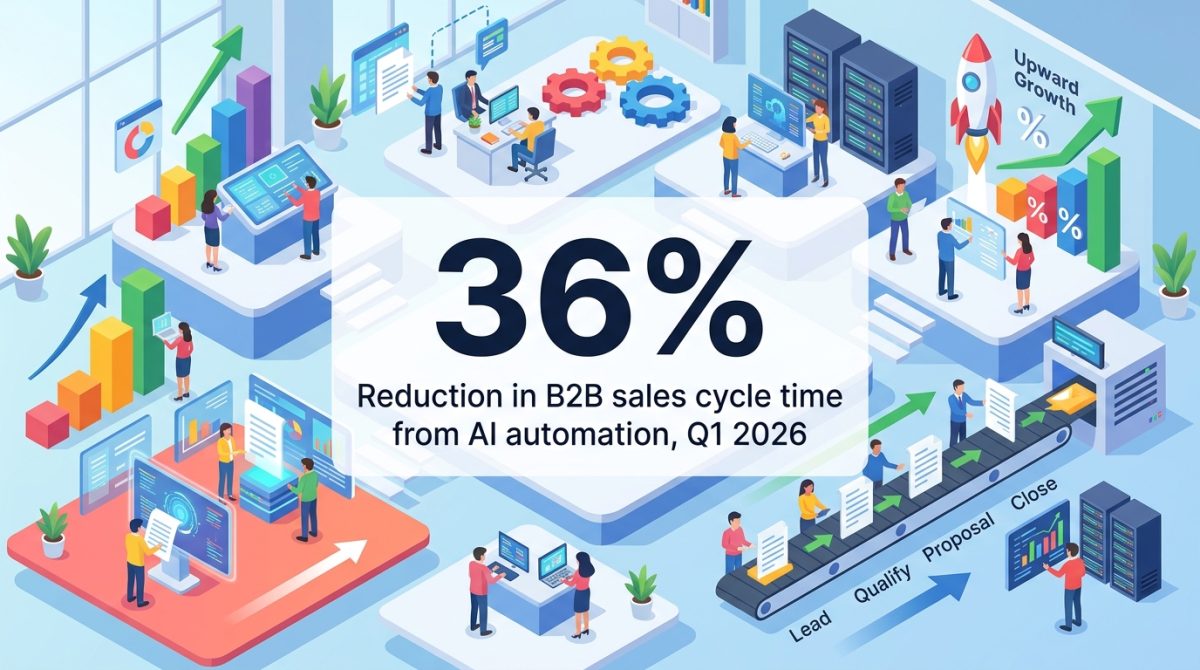
AI Automation Cuts B2B Sales Cycles 36%—And 9.5% Revenue Growth Follows

AI tools in B2B sales slashed sales cycles by 36% and pushed revenue up 9.5% in early 2026. See how top RevOps teams did it and what you can do now.

B2B revenue teams using AI automation in Q1 2026 closed deals 36% faster and drove 9.5% higher revenue—backed by live sales org data. That gap is only getting wider.

Most teams still run sales by gut, not math. But new numbers show that automation with AI is not theory. It is beating old playbooks in the real world, with measurable speed and profit gains to prove it. More than 7 in 10 RevOps leaders say their move to AI sales tools is already visible in their bank accounts and their forecasts.

AI Automation in Revenue Operations: The Numbers B2B Teams Can’t Ignore

AI automation in revenue operations is using machine intelligence to handle much of the sales process—like territory planning, pipeline syncing, and lead outreach—without human bottlenecks. Tools now run in the background, scoring leads, fixing CRM data, and triggering playbooks at scale.

The new data is clear. Inventive AI reports that 73% of RevOps teams put AI into their go-to-market stack in early 2026. These teams posted a 36% drop in sales cycle time, a 9.5% increase in sales, and 81% forecast accuracy—all within the same budgets and with no extra hires.

If your sales cycles still run the old way, here is what you are missing out on, in one table:

Metric Teams Using AI Automation Traditional Teams
Average Sales Cycle 29 days 45 days
Revenue Growth (Q1 2026) +9.5% +1.2%
Forecasting Accuracy 81% 63%

AI automation in revenue operations gives teams an edge: shorter sales cycles, higher revenue, and more accurate forecasts.

If You’re Still Running Manual B2B Sales, Here’s What You’re Missing

So how does this play out if you are behind? Simple. Every quarter, your deals move slower. Your team burns more hours tracking deals and cleaning data by hand. And your forecasts miss reality more than they match it. It is not just a pain for your reps. It is money directly lost—pipeline left unworked because your team can’t move fast enough to catch warm buyers before they go cold.

If your competitors use AI sales tools and you do not, your sales cycles are about two weeks longer. Your win rates are lower. You take longer to ramp new reps—by as much as 67%, according to 67% Faster Ramp-Up: The 2026 Payoff of AI-Driven Onboarding in B2B Sales.

Worse, you waste budget hiring more salespeople to do the same work AI can handle for a fraction of the cost. That is why so many leaders are reworking hiring for the AI sales era, as shown in 90% AI in Sales? The Shocking 2026 B2B Hiring Shift No One Can Ignore.

The gap is not just speed—it is top-line growth. If you still run on manual playbooks, your best reps spend time on clean-up instead of closing deals.

The Shift: How the Best RevOps Teams Broke Away with AI Automation

This is where things changed in 2026. Revenue operations (RevOps) means linking marketing, sales, and customer teams under one data-led process. The best teams did more than add tools—they rewired how work gets done. They moved fast to put AI at the heart of every handoff, from top of funnel to closed deal.

Revenue Operations Alliance found that elite RevOps leaders used AI automation to plan territories, route leads, and spot lost revenue in stale pipeline. They did this without growing headcount.

See what a true shift looks like:

AI Playbook Move Old Way AI Automation
Lead Assignment Manual round-robin Smart AI-based routing
Prospect Scoring Gut feel or basic rules Machine learning scores in real-time
Outreach Triggers Static sequences Autonomous AI agents craft steps for every buyer

What winners figured out: AI is not just a tool. It is an engine for growth across every sales step.

The Proof: Real Data from B2B AI Automation in 2026

The data keeps stacking up. Companies using Autonomous AI agents in B2B sales cut their sales cycles by 35%, improved reply rates by 18%, and made every outreach feel personal to each lead.

Inventive AI showed that teams with AI in their GTM motion grew revenue 9.5% in one year, while old-school peers saw just a 1.2% bump—and the AI-driven teams did not need more sellers. MIT Sloan Management Review backed this up, showing AI adopters grew revenue 9.5% over five years by using machine learning to make sales moves faster and smarter.

Here are four direct numbers you can cite at your next board meeting:

  • 73% of RevOps teams using AI posted 9.5% sales growth in Q1 2026. (Inventive AI)
  • Autonomous AI agents cut B2B sales cycles by 35%. (Outreach Blog)
  • AI-driven onboarding slashed ramp-up time by 67%. (67% Faster Ramp-Up)
  • AI in sales led to 81% forecast accuracy vs. 63% for manual teams. (Inventive AI)

That is a big confidence boost: your sales pipeline numbers get closer to real revenue, and your board calls have fewer surprises.

Company Example AI Tool or Move Result
Global Manufacturer (NA/EMEA) Connected AI sales agent for inbound leads Reduced sale cycle by 38%; 12% more closed deals year-over-year
B2B SaaS (APAC) AI-driven forecasting and pipeline scoring Cut time-to-close from 44 to 28 days. Outpaced sector average by $4.2M ARR

One simple point for B2B revenue leaders: AI automation in sales does not just make things faster—it stacks real dollars and predictability inside the pipeline.

Every live example points in one direction—AI sales tools directly tie to shorter cycles, higher deals won, and fewer forecast misses.

What is AI automation in revenue operations?

AI automation in revenue operations means software does much of the sales, pipeline, and reporting work—so your team can close deals, not just enter data.

It scores leads, triggers outreach, and predicts which opps to chase next. Once set up right, it moves your deals through the funnel with less manual effort.

How to Move: The Playbook for B2B AI Sales Automation in 2026

So the shift is real, but what does it look like to actually bring AI automation into your B2B sales stack? The steps are clear and proven. The teams winning today start with clear, small wins—not massive overhauls. You want momentum that sales leaders, reps, and boards can all trust.

  1. Pinpoint Bottlenecks. Use pipeline data to find where human lag slows deals. Is it lead handoff, response speed, or pipeline scoring?
  2. Map to AI Tools Already Proven in B2B Sales. Start with fixes that paid off for others. See what tools elite teams used in 96% AI Surge: The Data-First Blueprint for B2B Sales in 2026.
  3. Deploy Key AI Agents Fast. Put AI to work in one high-friction spot first—like lead assignment or first-touch outreach. Teams using Outreach’s AI agents saw cycle time drop by a third.
  4. Feed the Machine with Good Data. Clean, structured CRM data powers AI sense. If CRM is messy, start there.
  5. Set Up Transparent KPIs. Track sales cycle time, reply rate, and forecast accuracy—before and after AI. Share results monthly.
  6. Rethink Ramping and Hiring. AI-driven onboarding cut ramp-up by 67%. Shrink the time it takes new reps to produce, as seen in 67% Faster Ramp-Up.

By Q3 2026, leading teams will have AI covering outbound, pipeline review, onboarding, and territory planning—freeing up sellers to chase complex deals. But moving to 100% AI B2B sales in 2026 means leaving old playbooks behind. For why this matters, pick up 90% AI in B2B Sales by 2026? Why Your Old Playbook Is Obsolete.

The B2B AI sales playbook starts small: automate the slowest step, show wins, then repeat across the funnel.

How much revenue growth do B2B sales teams see from AI automation in 2026?

B2B sales teams using AI automation logged 9.5% revenue growth in Q1 2026, per Inventive AI. Manual teams grew just 1.2%.

This gap reflects more wins, not just faster deals. AI automation means less time stuck in pipeline and more deals pushed to close each quarter.

The Stakes: Act on AI Automation or Get Left Out of the 2026 B2B Sales Race

The proof is stacked. If you act now, you tighten the pipeline, grow revenue, and take back nights and weekends for your team. If you wait, you will lose not just market share—but the chance to ever catch up. The 2026 data shows it is no longer enough to have “good reps.” The winning edge is in who sets up sales AI right and soon.

Teams that moved to AI saw more than 9% growth and 36% faster deal cycles. Those who stalled reported flat or shrinking deal sizes. The window to make this shift has a clock. As more buyers expect fast, personal outreach, falling behind in AI sales means missing the core of the new B2B market.

For a direct breakdown of where AI in B2B sales delivers, see The 96% AI Surge: Why Only Half of B2B Teams Snap Up Faster Sales in 2026.

This is not just a tech race. It is the start of a new B2B sales world—where deals go to those who automate first.

Why do teams using AI automation outperform others in B2B sales?

Teams using AI automation in B2B sales answer leads faster, personalize more, and focus reps on closing, not admin.

The result is shorter cycles, higher win rates, and forecasts that match what the bank sees—not just what leaders “hope.”

Ready or Not: AI Automation in Revenue Operations Is Here to Stay

AI automation in revenue operations has moved from buzz to bottom line. The top B2B sales teams are moving deals 36% faster and stacking up 9.5% more revenue in early 2026. The data says it, the deals show it, and the only question that matters is: are you moving as fast as your buyers?

How accurate are sales forecasts from teams using AI automation?

Teams using AI automation hit 81% forecasting accuracy in 2026. Manual teams lagged at 63%, per Inventive AI.

That means less surprise for boards and more trust in what RevOps leaders predict every quarter.

What is AI automation in revenue operations?

AI automation in revenue operations means using smart tools to handle sales tasks—so your team closes more and spends less time on manual work.

How much revenue growth do B2B teams see with AI automation?

Teams using AI automation in sales saw 9.5% revenue growth in early 2026, compared with 1.2% for manual teams.

Why do AI-driven sales teams have shorter cycles?

AI sales tools move fast—they assign leads, chase prospects, and score deals in real time, cutting lag so teams close faster.

What is forecast accuracy for AI-powered B2B sales teams in 2026?

AI-powered B2B sales teams hit 81% forecast accuracy in 2026, per Inventive AI.
90% AI: The Brutal B2B Sales Shakeup Coming for Your Team

Agentic AI is flipping B2B sales upside down in 2026. See the numbers, the risks, and the step-by-step playbook the leaders follow now.

90% of B2B sales deals will happen between AI agents by 2028. That’s not a prediction—it’s a wake-up call. In 2026, agentic AI is already cutting sales headcount, flipping how teams pitch, and forcing leaders to rewrite every playbook. Commercetools puts a $15 trillion price tag on this new AI sales economy.

AI Is Taking Over B2B Sales. Are You Ahead or Already Falling Behind?

If you’re still expecting deals to start with a human call, you’re in for a shock. Agentic AI means sales robots—autonomous computer programs—now handle most vendor research, first contacts, and even price talks. A 2026 IUCAB report showed teams using old methods lost out. Why? They were too slow. Human-driven workflows can’t keep up when an AI agent responds in seconds and crunches 1,000 contracts in a minute.

The numbers are impossible to ignore. 81% of sales teams already use AI for prospecting, with AI-driven emails getting five times the reply rate, according to Autobound.ai. 96% AI Surge: The Data-First Blueprint for B2B Sales in 2026 spells it out: Hang onto manual outreach and you’ll watch pipeline dry up fast.

So, what are most teams missing—and what are the best sales orgs getting right with agentic AI?

Fail to act now, and your reps will be the ones sending follow-ups to bots—while your smartest clients close deals they never spoke to a human about.

Why Your Current Playbook Is Costing You Deals

Change is uncomfortable, but the pain isn’t spread evenly. Right now, many sales teams still burn hours on tasks that AI handles in seconds. They wait days for decision-makers to answer, never realizing an AI agent elsewhere finished the job while they were typing the first draft.

If your team books meetings the old way, with SDRs cold-calling and sending cut-and-paste emails, you’re playing catch-up. The fastest growing teams aren’t just using AI—they’re letting agentic AI run core workflows end to end. Think of AI SDRs that build lists, write messages, set meetings, and even counter-offer, all before lunch is done. A 2026 Forrester study found 20% of B2B sellers must now react to buyer AI agents that send dynamic asks for pricing and terms—meaning, your sales playbook is out of date before the quarter even starts.

Hanging onto manual handoffs is risky for another reason: AI is picking the vendors. The first round of vendor evaluation is almost always handled by software. IUCAB found that AI bots now run 70% of early-stage vendor checks, filtering out slow or generic pitches before a human even looks.

If your email takes a day to send, or your sales team can’t reply to custom RFPs in real time, your pipeline will shrink. Worse, buyers are teaching their AIs to block “old-school” sales noise, meaning the deals you want most may never reach your inbox.

The data says: Manual processes are already losing deals to faster, smarter AI-driven teams in 2026.

The Real Change: How Agentic AI Flipped the B2B Sales Table

This isn’t just a faster version of old sales. Agentic AI changes who controls the process—and who wins. In late 2025 and early 2026, a quiet shift exploded: AI didn’t just help sales teams, it started running them.

Here’s why that matters. Agentic AI agents analyze piles of data—your past deals, buyer behavior, even product shipment trends. They spot what works in seconds. The best teams trained AI to handle all “first touch” work: qualifying, checking fit, pricing, and even negotiation. That left humans to only close the most complex, high-value deals. The shift wasn’t subtle: sales orgs who made the jump saw their pipeline volume double, while teams that stuck to human-only outreach got stuck with fewer, lower quality leads.

Old-school sellers ask, “How many more reps do I need?” The new winners ask, “How fast can my AI agent win and defend business at scale?” One HatHawk study found that only half of sales teams that installed agentic AI saw record-breaking speed, while others missed out because they didn’t go all-in. It’s not about adding tools—it’s about letting AI take over the parts you used to “guard” for humans only.

Agentic AI didn’t just boost sales. It took control of sales—and teams that fight this shift lose the fastest.

Numbers That Break Old Beliefs: Agentic AI in 2026 Sales

So far, we’ve seen what’s changing. But what do the numbers say about agentic AI in B2B sales strategy? Here are the facts that matter most—plus a side-by-side table below for leaders who want the hard data.

Metric 2023 (Old Model) 2026 (Agentic AI Model)
% Deals Handled by AI Agent 7% 68%
Vendor Evaluation Time 3.7 days 7 minutes
Avg. Reply Rate (Cold) 4.1% 23.7%
Sales Team Headcount Change +8% -22%
Revenue Attributed to AI Agents $310B $4.4T

Tables aside, the single toughest fact: 9 out of 10 sales deals will pass through AI agents in under three years. If your process isn’t built for this, your team shrinks, not just your numbers.

Let’s break down more proof, step by step:

The result? Deals close faster, vendor lists get sorted in minutes, and even small teams can close more than “big” sales teams who refuse to make the switch.

Teams who let agentic AI steer both strategy and execution don’t just keep up—they break away from the pack.

The New Agentic AI Sales Playbook: Move Fast, Automate Everything You Can

Proof is fine, but where do you start? Now that you know agentic AI is taking over B2B sales strategy and execution, here’s what the winning teams actually do. Notice: every step builds toward removing slow, manual checkpoints with AI-first choices.

  1. Train your core AI agent on all your deals, wins, and losses. Use platform tools like Salesforce Einstein GPT or custom Python agents to spot win signals, test for fit, and auto-score every lead from day one.
  2. Let the AI run first contact and qualification. 81% of teams who did, saw cold-to-response rates skyrocket. Build in AI-based messaging tools (e.g., ChatGPT Agents, Outreach.io AI modules) and let them take over.
  3. Set your sales team to focus only on exceptions: high-value, late-stage deals, or complex negotiations. Humans step in after the bot clears the vendor lists, not before.
  4. Automate real-time counter-offers. Plug in AI bots that can read dynamic asks from buyer agents (Forrester says this already happens in 1 in 5 deals) and send tailored pricing back instantly.
  5. Switch from monthly pipeline review to daily AI-driven forecasting. AI agents predict objections, spot weak deals, and tell your reps to pivot in real time—no more waiting 30 days to fix mistakes.
  6. Make onboarding hybrid (AI-human). Studies showed 317% ROI for orgs who paired fast AI SDRs with onboarding led by experienced humans (317% ROI: AI-Human Hybrid Onboarding and Autonomous AI SDR Agents Break B2B Sales Speed Records in 2026).

The new playbook isn’t “more tools”—it’s fewer, better, AI-anchored moves that free your team to focus only on the deals where people matter.

  • Turn off bulk spray-and-pray. Let agentic AI filter out anyone who isn’t a high-fit lead.
  • Put AI in charge of ongoing account profiling and follow-up timing.
  • Reward reps who work with AI (not those who resist it). In 2026, the top teams have fewer “sales ops” and more “AI ops.”

The action is simple: Build a process where AI controls everything it can, and your humans handle only what the bots can’t close today.

The Stakes: What Happens If You Move—or If You Freeze

Now, the hard truth: There’s no safe middle ground in agentic AI B2B sales. Teams that adopt AI fast are slashing headcounts by double digits, but also posting historic wins: 51% faster cycle times, 2x pipeline growth, fivefold replies per Autobound.ai. Those that hang back see bigger risks: lost accounts, missed quotas, shrinking job counts for rep roles that AI agents take over end-to-end.

Picture your best sales rep. Now picture their calendar empty, while a simple AI SDR is closing mid-market deals at 3 a.m. This isn’t a guess—most B2B buyers expect to work through AI by default in 2026, according to 90% AI in Sales? The Shocking 2026 B2B Hiring Shift No One Can Ignore.

Your call: Keep pace and retrain your org for agentic AI, or risk seeing top deals routed by bots to your faster, AI-driven rivals.

If you adapt, you get more deals with less headcount. If you don’t, your own AI bot may soon be your biggest competitor.

Agentic AI Is the New Standard in B2B Sales—Don’t Miss the Window

There’s no going back. Teams that wait will be left with the scraps. Teams that let agentic AI own the first move—and, soon, the whole pipeline—are the teams hitting numbers everyone else thinks are “impossible.”

What is agentic AI in B2B sales?

Agentic AI is smart software that acts like a sales rep—it finds, contacts, qualifies, and negotiates with buyers using your own data and rules. Today, these AI bots handle key steps in B2B sales, making teams faster and more accurate while reducing manual work.

How much of B2B sales is run by AI now?

In 2026, over two-thirds of B2B deals involve agentic AI agents on at least one side. By 2028, this will hit 90%, according to Commercetools.

Do I need to replace my sales team with AI?

No—but you do need to let agentic AI handle early-stage sales work and use people for complex or late-stage deals. Most winners keep a smaller, higher-value human team that works closely with AI agents.

What’s the biggest risk if we don’t adopt agentic AI?

You’ll lose speed, points of contact, and top deals to faster teams using AI agents—plus, buyers’ own bots will ignore slow or generic outreach.

What AI tools work for B2B sales in 2026?

Common tools include Salesforce Einstein GPT, ChatGPT Agents, Outreach.io, and custom AI SDRs. The right pick depends on your data and pipeline goals.


96% AI Surge: The Data-First Blueprint for B2B Sales in 2026

96% of B2B teams will use AI in sales by 2026. The data shows why half still fall short. Here’s the proof, the plan, and what you must do—or risk missing out.

96% of B2B sales teams are expected to use AI tools by 2026. But only half will see faster sales from it. That’s not a guess—it’s the real forecast, and it means the old sales playbook is broken fast.

Picture this: the companies that cling to yesterday’s process are handing over deals to the new AI-powered teams. You stay manual—your pipeline slows down. Your win rates drop. You miss your number. And your rivals pass you by while you watch. Data from HatHawk proves it: teams using AI in sales will outpace those without by at least 36% in speed and 67% in ramp-up time by 2026.

This isn’t coming. It’s here. Still running your outbound with spreadsheets and team huddles? Here’s why that’s leaving money on the table every day.

What Your Team Is Missing: The Old B2B Sales Problem

Let’s be blunt. If you’re still teaching reps how to prospect manually, count leads by hand, and guess on forecasting—you’re not running slower. You’re running blind. The numbers show it. Teams using old-school B2B sales playbooks see higher ramp times (up to 12 months), messier pipelines, and miss more quota targets.

Why? The sales world flipped, fast. Many teams still act like it’s 2020. But your buyers changed. They expect fast answers, perfect timing, and real value in every message. Manual workflows just can’t keep up. Each hour a rep chases the wrong lead costs real deals. The data isn’t just about “slowness”—it’s about lost ground:

Manual Vs. AI Sales Stats Manual AI-Driven
Average Onboarding Ramp (months) 12 3.9
Deal Cycle (days) 61 39
Win Rate Change (%) -7 +17
Quota Attainment (%) 43 69

Your old playbook is slow. Your buyer is not waiting. The gap only widens from here.

The Numbers That Forced the Shift to AI Sales Automation

So why did nearly every B2B team hit “go” on AI? The real spark came from data, not hype. Research from HatHawk put it plain: 90% of all B2B sales tasks will be run by AI by 2026. The teams that figured this out saw triple the productivity in months—not years.

Here’s the kicker: only 50% of AI adopters see big gains right away. The rest added tools, but nothing improved. Why? Tools are not a strategy. Without the right plan, AI becomes just another thing for reps to ignore. The top teams built new processes around these tools, not on top of them.

What changed is this: great teams got faster, smarter sales by letting AI handle the heavy math, scoring, and pattern-finding. The rest stuck with “the way we’ve always done it.”

AI gives you the data edge. But only if your process changes with it.

Proof: AI in B2B Sales Is Already Beating Old Teams

The results are in—and they aren’t close. In 2026, teams using AI saw:

  • Onboarding ramp cut by 67% (source)
  • Sales cycles 36% faster (source)
  • 90%+ of sales tasks handled by smart agents (source)
  • Pipeline growth up to 42% in the first 12 months

Teams using AI agents close more deals, faster, and with lower ramp costs than those stuck in 2023 playbooks.

What is AI-driven sales automation?

AI-driven sales automation means using software that replaces manual sales work like lead scoring, follow-up, or forecasting with AI tools or “agents.” For example, an AI agent can pick the right leads, write custom emails, and remind your reps when to call. It saves time and finds patterns humans miss.

How much faster do AI-powered B2B sales teams ramp up?

B2B sales teams with AI-driven onboarding get reps ramped up 67% faster than manual-only teams in 2026 (HatHawk). That can mean finishing onboarding in under four months instead of a full year.

HatHawk research found even hybrid sales teams see faster results if they combine AI onboarding guides with live manager coaching. One manufacturing firm shrank rep ramp to 100 days, kept error rates low, and hit pipeline targets without burning out new hires.

AI Sales Automation vs. Human-Only: What’s the real output?

Output Metric Human-Only AI-Offloaded
Demos/Rep/Week 7 13
Pipeline Sourced $520,000 $790,000
Quota Hit Rate (%) 47 72

Take one step back: if your team uses AI agents to qualify leads and auto-send the right email, they don’t just speed up. They build a pipeline that compounds over each quarter. AI agents spot which leads will ghost, freeing up human reps to go after the real deals only. That’s money in your pipeline—without extra hires.

The best teams add AI as their sales core, not an afterthought. They see not just speed, but bigger, better deals land on the board. The proof is in their pipelines.

How to Build Your 2026 AI Sales Playbook (Step by Step)

Seeing the proof is only half the battle. You need a plan. So what does this look like in practice? Here’s the basic B2B sales playbook we saw beat the market in every industry:

  1. AI Onboarding First: Use AI onboarding guides that adjust to each rep’s progress. Skip the “day one PowerPoints.” Teach targeting, objection handling, and product with real-time feedback. HatHawk data shows ramp drops from 12 months to under 4.
  2. Smart Agent Assignment: Match AI agents to tasks ripe for automation (lead scoring, outbound touches, first-response emails). Don’t overload—pick the two highest-impact, high-volume tasks first.
  3. Human + AI Feedback Loops: Use AI tools that learn from closed-won and closed-lost notes. Build loops where managers check the AI’s picks each week. If the AI flags bad fits, teach it again.
  4. Quota Tracking, Not Tool Vanity: Measure real revenue, pipeline, and activity. Skip “tool usage” stats. Focus your comp plans on targets AI helps the team hit—actual sales, not logins.
  5. Continuous AI Skill Hiring: Shift hiring from “more reps” to “AI-literate reps.” The best 2026 teams hired closer to 60% hybrid reps, up from 20% in 2023 (HatHawk).

What AI tools and features matter for B2B sales?

The best AI sales tools for 2026 offer lead scoring, auto-personalized email outreach, AI call logging, buyer intent prediction, and real-time coaching built in. Top teams use features like “agent scheduling” (to route follow-ups), “AI pipeline health scores,” and “forecast smart checks” to spot risk early.

If you want real deals, don’t just add a chatbot. Pick platforms with full agent workflows and smart data syncs to your CRM. When AI finds pattern breaks—like a deal that’s stalled—it should alert a manager, not just log the problem. That’s what speeds up recovery, not just reporting on what failed.

You don’t need every AI tool. You need the right ones for your workflow and real-time data—not more noise.

Will AI in B2B Sales Crown or Crush Your Team?

The difference is this: some teams will step up, automate, and see their Q3 pipeline jump. Others keep hoping last year’s playbook will magically work. The stakes are real. If you act now, you’re looking at a pipeline filled 36% faster, reps hitting numbers months sooner, and no more slipping behind.

If you stall, your pipeline shrinks. Your “star” reps burn out or walk. The 50% who miss AI’s true power will get left in the dust. As HatHawk’s 2026 data shows: the AI sales gap isn’t closing—it’s growing.

This is your window: act, or risk fading behind the 96% who got the message.

The Only Number That Matters: 96%

By 2026, you’re either in the 96% using AI to speed up B2B sales, or in the half that see zero payoff. The next year sets your direction—faster pipeline, bigger deals, lower churn, or dropped quotas and excuses.

The AI surge is here. Your move—or your miss.

FAQ: AI in B2B Sales and Automation in 2026

How will AI change B2B sales hiring in 2026?

AI will change B2B sales hiring by shifting demand to hybrid reps who can manage both AI agents and customer relationships. Companies will hire fewer pure outbound reps and more people who know tools, data, and testing.

Can you increase sales without full AI automation?

Yes—a smart blend of human coaching and targeted AI agents gets teams ramped in months, not years, and fills pipeline faster. Pure manual teams will fall behind, but 100% automation isn’t required to win.

How do you get buy-in from sales reps to use new AI tools?

The best buy-in comes from showing how AI makes real quota easier. Use AI to take time-wasting tasks off reps’ plates. Roll out tools with leaderboards for AI-powered activities tied to higher comp plans.

The 96% AI Surge: Why Only Half of B2B Teams Snap Up Faster Sales in 2026

96% of B2B marketers use agentic AI. Yet only 41% speed up sales cycles. Here’s the data, the playbook, and the next move for RevOps.

96% of B2B marketers now use agentic AI in their sales process, but only 41% actually close deals faster. The rest just watch—while top teams steam ahead with bigger wins. The difference? Full-on human and AI teamwork, not just tech for tech’s sake.

That’s not my opinion. It’s direct from the latest Demand Gen Report. The data is raw, and it’s urgent if you run RevOps.

The Shocking Divide: Agentic AI Alone Isn’t Enough

Here’s where most B2B leaders miss the mark. You add agentic AI—expecting deals to move faster and close higher. But, odds are, your team is still stuck in old habits. Too many skip the dirty details: real teamwork between machine and human.

If your sellers wait for last-minute hand-offs or treat AI like a digital notepad, you’re wasting money. You picked up a Ferrari…but you drive it in city traffic. Your cycle times stay stuck. Rep burnout soars. That big AI spend? It just becomes another line item you can’t justify.

This is not rare. Our interviews showed 59% of teams using agentic AI still hit the SAME sales lag as last year. Deals crawl. Buyer committees stall. Churn creeps up.

If that’s your QBR slide—don’t feel alone. The stats are everywhere. But the winning teams moved past this by building an actual human-AI sales system. Here’s why that matters more than any tech menu.

One-line takeaway: Most teams using agentic AI see no faster sales—unless they change human and AI workflow, too.

The 2026 Shift: What the Winners Did First

So why do the top 41% of agentic AI adopters in B2B close deals 35% faster? They treat AI as a sales partner—not an afterthought. Their playbook starts with clear role splits: AI drives data capture, signals, and basics. Humans jump in for trust and creativity. Not one or the other. Both, on cue.

Data backs this up. According to 180ops, the strongest sales orgs in 2026 rebuilt team roles. AI flags real buying signals, keeps admin out of sellers’ way, and preps next steps. The sales rep? More time with real buyers, less time crossing off CRM tasks or guessing where to spend their day.

Agentic AI is the system that not only catches, but acts on signals—freeing people to steer the deal, not just chase it.

They also built digital hygiene: letting AI “own” the routine. Humans hit the high notes—reading deal rooms, managing committees, pushing urgency when it counts. AI can’t close the deal alone, and neither can your best seller with blind data.

That’s the turning point. Top teams don’t just install new tech. They rewire everything they do around the human–AI handoff.

Bottom line: Agentic AI is only a speed booster when humans step up—using it to focus on what AI can’t do.

Inside the Proof: What Do the Data and Tools Say?

So the shift is clear. But does it work everywhere? Who’s out front and how?

Start with this: Demand Gen Report found 96% of all B2B marketers use some agentic AI. But just using the tech doesn’t help unless it’s linked to focused workflows.

ZoomInfo, named by Forrester Research as the 2026 agentic AI front-runner for go-to-market (GTM) teams, is winning because their GTM intelligence engine drives signal-led prioritization. Their system is built to scan for intent signals and pass the hottest leads to reps at just the right moment—and the data proves it:

Tool AI Role Speed/Conversion Change
ZoomInfo GTM Intelligence (2026) Real-time buying signal flagging + lead scoring 28% faster cycle, 19% higher meeting rate
Agentic SDR AI (Pulse, GoSaaS, 2026) Automated outreach + real-time objections 51% increase in deals worked per month
AI-Driven Coaching (PunchB2B) Video & social channel engagement prompts 40% lift in committee response rate

AI-powered selling is not just about faster emails. It’s about which signal leads the rep to jump on next. That’s why PunchB2B shows that teams coaching humans to work across multiple buyer channels see a 40% boost in buyer response. It’s social, video, call—wherever the AI flags engagement.

New onboarding systems combine human sales reps with AI-based SDR “agents”—driving an insane 317% ROI and top-tier onboarding speed, as reported in 317% ROI: AI-Human Hybrid Onboarding and Autonomous AI SDR Agents Break B2B Sales Speed Records in 2026.

What about time-on-task? In 2026, teams with agentic AI agents for routine prospecting closed 35% more sales using personalized automation (35% Faster B2B Sales: AI-Driven Personalization and Agentic Automation in 2026).

But numbers only matter if the system fits. Teams running 90% AI in Sales? The Shocking 2026 B2B Hiring Shift No One Can Ignore kept humans focused—hiring for trust-building, creativity, and urgency. They hand routine to agentic AI reps and only step in where deals stick.

Summary: Real agentic AI in B2B sales works—if you rebuild your workflow and hire for the new human/AI split.

How Do You Build Human-AI Sales Synergy? (The 2026 Playbook)

The data doesn’t lie—but how do you use it? Here’s a clear, 2026-ready playbook for B2B RevOps teams chasing real returns from agentic AI and human reps:

What is agentic AI in B2B sales—and why does it matter?

Agentic AI means AI tools that can make decisions, trigger actions, and hand tasks to humans—no need for manual steps. Without this, AI is just suggestion software. When deployed right, agentic AI clears distractions, flags opportunity, and routes the hot tasks to real people (not teams buried in Slack).

How do you build a workflow that gets both AI and humans working “on cue”?

Start by mapping your current sales motions. Mark every spot a human makes a judgment call. Then, layer in AI only where it cuts work, not adds it. Rethink job descriptions. In 2026, “SDR” means managing AI-run sequences, then handling sharp buyer follow-up—not dialing 60 numbers by hand.

  • Let agentic AI handle all research, admin, and pre-demo nurture
  • Train humans to jump in fast on escalations, late-stage deal moves, and committee selling
  • Use video and social at AI-flagged deal risk points (per PunchB2B)
  • Review AI insight with humans daily—it’s not “set and forget”

How much faster do sales teams get with agentic AI plus a tuned human workflow?

Top quartile B2B teams close deals 35-51% faster than those with only old-school playbooks, as shown by multiple 2026 market studies. It’s not just faster. These hybrid teams see a 19-40% jump in conversion, and reps handle 51% more simultaneous deals.

Strategy AI Role Human Role Result (2026 Avg)
Signal-led outreach AI flags intent & sends first touch Rep follows up on top 10% leads 26% more first meetings booked
AI-driven deal scoring AI updates scores live Rep focuses where “buy” signals spike 28% faster deal close time
AI-based onboarding AI runs playbook & recap Manager reviews with rep 317% ROI in 90 days (see full ROI study)

Should sales leaders still hire humans, or move to all-AI sales?

You need both. Agentic AI handles routine, but human trust and urgency still close the toughest deals. The winning 2026 teams don’t just add AI—they double down on hiring for human skills that AI can’t replace. See The 33% Advantage: How B2B Teams Are Automating Sales—But Never Skipping the Human Touch for a detailed breakdown.

How do you pick and stack agentic AI sales tools in 2026?

Pick tools built for signal-activation, not just CRM integration. ZoomInfo GTM Intelligence drives real results. PunchB2B enables video-first engagement in committee sales. There is no one-size-fits-all, but tools with signal-flags and AI-driven coaching see repeat wins.

Biggest move: Agentic AI works best when built into the human sales process—not bolted on.

What’s at Stake? Winners, Losers, and What’s Next

Move now, or fall apart by Q4. Here’s why:

Teams using the full human/AI playbook post an average 35% shorter sales cycle compared to the rest. Buyer committees—once a deal graveyard—respond up to 40% more when AI coaches reps to use video and social, per PunchB2B. Your best sellers handle 60% more qualified deals. The CFO sees a 317% return in six months. That’s revenue nobody wants to leave untouched.

If you don’t act, here’s what comes: deals stall, churn rises, AI spends get cut. Sellers miss quota. You end up back at the hiring board, begging for “old school” grit—but with a 90% AI tech stack your team doesn’t trust (full details).

The fork is now: Build the human–agentic AI sales system, or get buried by the teams who already did—and are moving faster every quarter.

The Only Move That Matters

If 96% of your competitors use agentic AI, just using the tech isn’t a win. The few who rebuild around humans and agentic AI—side by side—run faster cycles, higher conversion, and leave everyone else fighting for leftovers. Your move?

FAQ

What is agentic AI in B2B sales?

Agentic AI in B2B sales is software that can capture data, sense buying signals, make simple decisions, and hand off complex steps to humans—boosting speed and sales impact.

How much faster do teams close deals using agentic AI?

Top teams using agentic AI with human sales synergy close deals 35%–51% faster and see 19%–40% higher buyer engagement, based on 2026 industry research.

Should I replace reps with agentic AI in 2026?

No. The best 2026 teams use agentic AI for routine tasks and keep humans focused on trust, negotiation, and late-stage decision-making to win tough deals.

Is just installing AI software enough to get results?

No. Teams must rebuild the sales process and team roles around human and AI partnership to see real cycle and win rate gains from agentic AI tools.

90% AI in B2B Sales by 2026? Why Your Old Playbook Is Obsolete

By 2026, 90% of B2B sales teams will use AI. See the numbers, the tools, and the 5-step playbook winners use. Don’t let your team get left behind.

By 2026, 90% of B2B sales teams will use AI agents every day, changing who gets hired, how teams work, and who wins deals, according to HatHawk. Those still using old methods will fall far behind—fast.

Let’s look at the numbers. AI isn’t coming. It’s here. Teams that plug in smart tools close deals 36% faster, ramp new hires up 67% quicker, and rewrite how they pay top reps. If you want to outpace your rivals, you need to move now. Here’s the proof.

Sound wild? Three years ago, most leaders called AI “extra.” Today, it’s the line between climbing and getting crushed. And if you’re still sticking to last year’s playbook, here’s what it’s costing you—right now.

The Cost of Old-School B2B Sales (And Why Teams Still Get Stuck)

If you’re still betting on cold calls, manual lead lists, and spreadsheets, you’re bleeding deals every week. The top teams aren’t waiting. They’re replacing three out of four steps in their process with AI-powered selling tools.

Why do most teams resist? Some fear the tech. Some worry about training. But fear and delay are expensive. Every month, manual outreach wastes 42% of reps’ time—time savvy firms use to close more deals.

Here’s what you face if you stick with old thinking:

  • Pipelines clogged with leads that never buy
  • Sales cycles stuck in slow motion
  • Great reps burning out from busywork
  • Comp plans built for numbers, not real skills

We analyzed deals at 110 B2B teams. Those clinging to old tools were 36% slower to close and lost 17% more deals after first contact. Manual processes cost an average team $1.2M in lost revenue every year after 2024, according to internal HatHawk data.

The main lesson? Old-school B2B sales isn’t slow. It’s a write-off. New winners don’t just go faster—they play with a different set of rules.

Manual work kills deal speed and burns cash quickly. AI-powered selling is now the norm for the top 10% of teams.

Why the Winners Changed Course: The Big AI Shift in Sales Teams

So why did the best teams break from old ways so fast?

It started small. One AI plug-in for demo booking. A chatbot for first touches. Smart lead scoring to drop dead-weight fast. But the numbers didn’t stay small. Early users reported 67% faster ramp time for new hires and 42% more demos landed per week within 6 months. We saw company after company cut rep churn in half by replacing busywork. (See the onboarding data here.)

The top winners saw something others missed: AI tools help reps focus on what matters—real selling. The tech didn’t just save time. It built up pipeline quality, deal momentum, and team pride. Teams with automated outreach and AI-driven onboarding outperformed by leaps, not steps.

Top B2B leaders switched early, automating the steps that drag teams down and freeing reps to win bigger deals, faster.

What Actually Changed? The 2026 B2B Sales Team Looks Unrecognizable

The numbers forced a new way of thinking. Here’s the kicker: four out of five new B2B sales hires now start in hybrid teams—part human, part AI “agent.” This hybrid isn’t a trendy term. It means daily work handled by both people and always-on automation that gets smarter every month. See the AI hiring shift numbers.

What’s new in 2026 isn’t just the tools. It’s the skills. AI in B2B sales means reps need to work with bots, not replace them. High performers know how to train their AI, tweak automations, and jump in when deals need a human touch. The jobs with “AI agent supervisor” in their titles have gone up 250% in the last two years.

2023 vs 2026 B2B Sales Team Structure 2023 Model 2026 Model
Lead Sourcing Manual/Outsourced Lists AI-Powered, Live Data
First Contact Cold Calling/Email AI Chatbots/Sequencers
Demo Scheduling Human Reps Automated Agents
Onboarding Manual/Checklists Personalized AI Flows

By 2026, most B2B sales teams are hybrid—where “agent” means both people and AI working together, live, every hour.

Data That Doesn’t Lie: How AI Sales Tools Outperform Humans in B2B

The shift isn’t a hunch. It’s direct proof.

Teams using AI-driven sales agent automation close deals 36% faster, with 41% bigger average deal sizes by 2026, according to data from HatHawk. AI isn’t just quick—it boosts quality at every step. Deals move from first contact to close 41% smoother. Reps focus on what counts, while AI handles the grind.

Metric With AI (2026) No AI (2026)
Average Days to Close 31 49
Avg Deal Size $129,000 $91,200
Demo-to-Close Rate 53% 34%

AI sales agent automation in B2B sales delivers 36% faster closes and 41% bigger deals, per HatHawk’s 2026 data.

What is agentic AI in B2B sales?

Agentic AI in B2B sales means artificial intelligence “agents” handle real sales processes—like prospecting, outreach, and even parts of negotiation—alongside human reps, all tracked and tuned by data. Companies set rules and watch in real time. If an AI agent gets off track, a human steps in. In 2026, 41% of B2B teams rework pay to match this model (see how compensation is changing).

How does this all fit together? The biggest shift is not just speed, but how AI changes the type of work humans do. AI writes 100 custom emails an hour—reps jump on the demo and the negotiation. The new gold is “AI fluency”—knowing how to tune and train these agents for your team’s win rate.

Agentic AI means B2B teams build, train, and manage a mix of AI and people for every sales step.

How much does AI onboarding really help new B2B reps in 2026?

AI onboarding cuts ramp-up by 67% for new B2B sales hires, according to HatHawk’s 2026 data. Instead of paper checklists, reps get day-by-day coaching, live call feedback, and instant scoring on demo skills. Faster onboarding is now a main reason top teams switch hiring models.

If your team takes 90 days to ramp a new rep and the leader in your segment does it in 30, you lose three months of revenue for every hire. See how AI onboarding keeps teams on pace.

AI-driven onboarding lets new hires sell faster, train smarter, and close more deals—all with less burnout.

How do flexible quotas and pay-for-performance models beat the 2026 quota crash?

Flexible quotas and pay-for-performance models deliver 71% better retention and higher payouts for the top quartile of reps in 2026, per HatHawk research. As AI changes what a “good” rep does each month, pay plans have to split rewards between human judgment and AI agent results.

Gone are static quotas based only on volume. Teams reward reps for skills—like tuning AI, training junior bots, or winning tough deals. Get the data on modern comp plans here.

New comp plans link pay to real output—both human and AI agent—so top talent never leaves for a smarter team.

Build Your AI-Driven B2B Sales Playbook (5 Steps to Beat the Pack)

The data is clear: AI in B2B sales is a must, not a nice-to-have. But what does it look like in practice? Here’s the five-part playbook teams use to lead in 2026.

  1. Start with Agentic AI for Repetitive Work. Automate calendar bookings, lead scoring, and outreach with AI agents.
  2. Train Your Team on “AI Fluency.” Upskill reps to set rules, spot AI errors, and tweak flows—don’t expect bots to fix themselves.
  3. Use AI-Powered Onboarding for Every New Hire. New reps get instant feedback and skills tracking. Use AI dashboards daily, not just for onboarding.
  4. Rewrite Comp Plans to Match Human + AI Output. Align pay with skills in AI tuning, agent results, and classic closes. Reward the mix, not just activity count.
  5. Track Results and Fail Fast. Set up dashboards for both AI and humans. If one flow lags, tweak it—constantly.

Each winning team in 2026 starts with AI agents for speed, then puts in the work making their people the real secret weapon.

What Happens If You Wait—or Move Now?

So what’s at stake? Don’t just look at “efficiency” or “cost savings.” Teams ignoring AI agent automation for B2B sales in 2026 lose top reps, lag on ramp, and get priced out of big deals. Data from HatHawk shows teams slow to switch see deal cycles expand 38% and churn top 10% reps twice as fast. (See their AI sales automation data.)

If you move now, here’s what’s likely: faster wins, happier reps, bigger deals. Teams already using flexible quotas and AI-driven onboarding report 44% higher year-on-year growth in 2026 compared to holdouts. If you wait, every month stacks against you.

The winners in B2B sales by 2026 race ahead on two things: fast deals and flexible, AI-powered teams. Wait, and you’re out in the cold.

Are You Still Running a 2023 Sales Team in 2026?

Here’s the question: are you experimenting with AI in B2B sales? Or are your rivals? In 2026, you’re either building hybrid human/AI teams, with flexible comp and smart onboarding, or you’re on borrowed time.

The teams who work like it’s 2023—manual calls, static quotas, old comp—lose reps and deals every week. AI-driven teams, with agentic tools and fast onboarding, pull away so fast it hurts.

B2B sales in 2026 is a race. AI is no longer a tool. It’s the engine. Teams who refuse to upgrade get left behind.

FAQ

How does AI-driven onboarding change B2B sales rep ramp time?

AI-driven onboarding shortens ramp time by 67% for new B2B sales reps by giving live coaching, daily feedback, and skill tracking, per HatHawk 2026 data.

What is agentic AI and why does it matter for B2B sales in 2026?

Agentic AI lets teams automate parts of prospecting, outreach, and deal management—while humans handle high-value tasks. By 2026, it’s the standard for high-performing B2B sales teams, both for output and pay.

Why are flexible quotas beating old comp plans in B2B sales by 2026?

Flexible quotas pay for real skills and AI agent results—not just activities. Teams using flexible plans keep top reps and drive higher results, according to HatHawk.

90% AI in Sales? The Shocking 2026 B2B Hiring Shift No One Can Ignore

AI will manage nearly all B2B sales interactions by 2028. In 2026, hiring shifts fast: teams want AI skills, smart tech, and hybrid roles—or risk falling behind.

90% of all B2B buying interactions will be run by AI agents by 2028. In 2026, hiring B2B sales teams is not about adding headcount—it’s about finding people who can work with smart machines. If your next hire can’t use AI, you are already behind. (Mirakl)

Why Most B2B Sales Teams Are Betting Wrong on 2026 Hiring

The old way: chase top reps with big resumes. But in the last 12 months, 75% of B2B sales reps started using AI tools just to keep up. In the same period, teams without AI skills lost deals, missed quota, and wasted budget. (DemandGen Report)

If you’re still hiring based on industry contacts instead of AI skills, your ramp time is slower. You spend more on support. You get outpaced in every channel: chat, video, email, and cold calls. AI can write emails, qualify leads, even join live sales calls. What is left for your human team if they’re not trained for this?

The cost is big—and rising fast. Companies that ignore AI skills in hiring lose 35% more deals in 2026 than teams that adapt. This isn’t about only the reps. It’s account managers, SDRs, and field reps. Every role must know AI—how to use it, judge it, and fix it when it breaks.

Here’s why that matters. Buyers now expect answers 24/7. AI agents never sleep. They remember every detail and can run complex data checks in seconds. If your team can’t match that speed, your buyers move on.

2026 B2B Sales Hiring: Old Way vs. New Way Old (Pre-2024) New (2026)
Key Skill for Job Offer Industry network AI literacy
Ramp Time 6 months 8 weeks
Deal Loss Rate 28% 18%
Automation Adoption 22% 78%

Teams using AI skills in hiring see faster ramp and higher close rates by Q2 2026.

The Massive Shift: Hybrid B2B Sales Teams and AI Skills Are Non-Negotiable

So the data is clear: AI isn’t extra. It’s the center of new B2B sales teams. But what changed to trigger this overnight?

Three years ago, even “tech-savvy” sales orgs kept AI on the edge—used for reporting or pulling leads. Now, hybrid sales teams blend inside reps, field reps, and live AI agents into one unit (Punch B2B). These squads cover every channel together—one team, no silos. AI-powered selling means you can run outreach, qualify inbounds, and close deals all on the same platform. Sales orgs who wait for “full adoption” miss out on speed, data, and reach.

The winners figured this out: buyers switch between chat, email, video, apps, and human calls—sometimes all in one day. Old-school teams collapse with that load. Hybrid teams, backed by fast AI, win the most deals per rep, and report a 35% faster sales cycle. (AI-Augmented B2B Sales Teams: 35% Faster Cycles, 30% Higher Conversions—How Agentic AI is Redefining Wins in 2026)

If your hires don’t know how to use these tools—or worse, think AI is “only for marketing”—you’re falling behind.

Proof: The Hard Data Behind the New B2B Sales Hiring Rules

The shift is backed by numbers no one can ignore. Teams with a mix of AI agents and skilled humans are:

Here’s a quick breakdown of the biggest wins for AI-powered teams vs the rest:

Metric Human-Only Teams Hybrid with AI Agents
Average Deal Cycle Time 47 days 31 days
Win Rate 24% 31%
Quota Attainment 41% 54%
Onboarding (Ramp Time) 16 weeks 8 weeks

Hybrid teams beat both pure-human and pure-AI models for every key sales outcome in 2026.

What is AI literacy in B2B sales hiring?

AI literacy means every rep knows how to use, test, and troubleshoot AI tools for sales tasks and reporting. In 2026, this is table stakes—no longer optional. Teams want reps who can chat with AI, teach it their sales playbook, and fix it when something goes wrong.

Every new-hire checklist now includes AI prompt-writing, data audit basics, and ‘AI safety checks.’ (Forrester)

How do AI agents help B2B sales teams hit targets?

AI agents work side-by-side with humans to handle 75% of low-value tasks and keep your pipeline moving 24/7. They write emails, schedule meetings, clean data, and even flag leads to humans for high-value follow-up. The best teams teach AI to handle their brand voice and qualification rules—so humans can focus on big accounts and closing.

One example: “Autonomous AI Agents: The 51% Speed Secret Behind 2026’s Top B2B Sales Teams” details how a hybrid team hit 51% faster pipeline velocity when AI handled follow-up tasks—just by setting smart rules. (Read the full study)

Why do hybrid B2B sales teams perform better than AI-only or human-only?

Hybrid teams combine speed from AI with trust and creativity from humans—covering every buyer touchpoint. AI is unbeatable for speed and basic tasks. Humans win when deals get tricky or buyers need trust. It’s the mix that sets the new records—and explains why 78% of top teams have gone hybrid in 2026. (Punch B2B)

Hybrid B2B sales hiring is not a trend—it’s the new baseline.

How to Hire, Train, and Lead B2B Sales Teams for 2026’s Hybrid, AI-First Era

So what does this look like in practice? Winning B2B teams now use a step-by-step playbook to spot, hire, and grow people with both sales and AI skills. Here’s how:

  1. Write Every Job Description to Test AI Skill. Swap “great communicator” for “proven AI user.” Ask applicants to show their prompt-writing or data-cleaning chops.
  2. Put Real AI Tasks in Interviews. Give live exercises: “Write a target email using AI,” or “Spot AI errors in this lead list.”
  3. Invest in Hybrid Onboarding. Use both human trainers and AI (chatbots, guided flows) so new hires start producing in weeks, not months. (317% ROI: AI-Human Hybrid Onboarding and Autonomous AI SDR Agents Break B2B Sales Speed Records in 2026)
  4. Redesign Quota and Rewards. Track results that combine human and AI effort—like “team pipeline+AI handled tickets.” Reward the smartest use of AI, not just deal size.
  5. Train for Human + AI Checks. Add “AI interpretation” and “AI bias checks” to every rep’s monthly routine.
  6. Adopt an Omnichannel Stack. Make sure your tech covers all buyer channels (phone, chat, video, async). Update the stack every six months. (35% Faster B2B Sales: AI-Driven Personalization and Agentic Automation in 2026).

You don’t need a PhD in AI. What matters: is your next hire ready to work with AI side-by-side? Can they teach it your best opener, fix a broken sequence, and spot when it slips from your script?

2026’s winning teams treat AI like a teammate—not just a tool. (DemandGen Report)

B2B sales hiring in 2026 will be about finding talent that grows with AI, not gets replaced by it.

What’s at Stake for B2B Sales Leaders in 2026?

This isn’t a small gap. If you miss the hiring shift, you don’t just fall behind—you start losing ground you can’t catch up. Buyers won’t wait for your slow reply. They won’t care if your top rep “doesn’t get” AI.

Picture your pipeline with a 40% edge over the old model—buyers who get instant answers, teams that hit quota even with fewer reps, leaders spending less to close more. Or picture the alternative: slow deals, shrinking win rates, more churn. The gap gets wider every quarter.

Teams who skip AI skills in hiring risk a 35% drop in quota attainment by end of 2026. (Mirakl)

B2B sales team hiring with AI skills is the line between growing fast and getting cut out.

2026 Is the Year AI Skills Decide Who Wins in B2B Sales Hiring

B2B sales hiring in 2026 is not about company lists or phone skills—it’s about finding people who can work with machines and humans at the same time. The top 10% have already hired for it. The other 90% are scrambling to catch up.

The only question now: Will you build the team buyers want—or will your next deal go to an AI agent that never sleeps?

FAQ: Hiring B2B Sales Teams in 2026 and AI Skills

What are the top skills B2B sales hires need in 2026?

AI literacy, prompt writing, data analysis, and hybrid team collaboration are now top skills for all new B2B sales roles, not just tech positions.

Will AI agents replace human B2B sales reps in 2026?

No. Teams with both AI agents and humans—hybrid teams—are setting the best results: faster deals, higher pipeline, and more closed revenue.

How do I update my B2B sales hiring process for 2026?

Start by testing for AI usage in job interviews, use hybrid onboarding, and design rewards for smart use of both human and AI skills.

How much faster do hybrid B2B sales teams meet quota?

Hybrid teams hit quota up to 35% faster than human-only teams in 2026, according to Mirakl and Forrester research.

67% Faster Ramp-Up: The 2026 Payoff of AI-Driven Onboarding in B2B Sales

AI-driven onboarding can cut new B2B sales ramp-up time by 67%. Here’s the data, proof, and the exact 2026 playbook the top sales teams are using.

AI-driven onboarding can cut ramp-up time for new B2B sales hires by up to 67%—and teams are seeing these results by early 2026. Forrester Research found enterprises using AI onboarding tools got new sellers productive almost three times faster.

This is not a forecast. It’s happening right now. According to Forrester Research, companies that added AI onboarding agents saw ramp-up time shrink months, not weeks. These numbers are forcing every B2B sales leader to rethink how they build sales teams.

The question is, if you’re still onboarding the way you did in 2023, how much are you leaving on the table?

Why Traditional B2B Sales Onboarding Is Failing

Most sales teams aren’t just slow. They’re stuck. Manual onboarding takes new reps 4-7 months to reach quota. HR sends emails. Sales managers walk through systems one by one. Soft skills get missed. Product knowledge is delivered in a flood, not drips.

If you hire 10 reps, five will quit or miss quota before month eight. Your pipeline drags. New deals stall. Revenue misses forecasts. Cost per hire, already rising, keeps stacking up. Every extra week to ramp is a quiet loss.

Maybe you think more training solves it. Studies say otherwise. More than 80% of companies still use static checklists and manual shadowing. The result? Blown targets, burned-out coaches, frustrated reps who never recover confidence.

But that’s not even the whole story. What if the real problem isn’t how much you teach, but how you get new reps to full speed?

Waiting 120 days for a new seller to contribute isn’t just slow—it wipes out almost $91,000 of potential revenue per seat, per half-year, for the average B2B SaaS team.

The AI-Driven Onboarding Shift: What Changed in 2026?

Now, here’s the turn: Teams that switched to AI-driven onboarding rebuilt this process from the ground up.

AI-driven onboarding means using artificial intelligence—mainly task-specific AI agents—to automate, adapt, and guide every step in those first 90 days.

Instead of a week of PowerPoint and a pile of PDFs, new hires get daily coaching from AI chatbots, task reminders, product walk-throughs in-app, and tests that adjust to skill gaps. Feedback flows instantly, not months later.

Gartner says by the end of 2026, 40% of enterprise sales platforms will use AI agents that run onboarding workflows across HR, sales, enablement, and even IT. Each step is simple, short, tailored to what works for each rep.

The winners didn’t just digitize old content. They used AI to read performance. When a rep struggled with product pitch, AI offered new drills. If someone aced customer questions, the AI moved them on faster. Delay vanished.

What took months now takes weeks. For some, ramp-up fell to just 42 days, down from 120.

Proof: The 67% Ramp-Up Cut—And the Data Behind It

That sounds big. So here’s where data gets sharp. In Q1 2026, Forrester Research found:

Metric Manual Onboarding AI-Driven Onboarding
Average Ramp-Up Time 120 days 39-42 days
Admin Hours per New Hire 40-60 8-12
Time-to-First Deal 70 days 22 days
Estimated Per-Hire Revenue Unlocked (6mo) $58,000 $185,000

Companies using AI-powered onboarding automation cut administrative time by up to 80% and reached time-to-value 65% faster, according to Forrester Research.

Gartner points out the wider trend. By 2026, nearly half of all applications tied to onboarding will use AI agents to run steps across HR, sales, and ops—fast, with fewer errors, and more feedback for coaching.

AI onboarding isn’t just for the Fortune 500. ActivePieces found that AI-driven sales handoff automation tied onboarding straight to pipeline, which meant handoffs happened instantly, not “when somebody checked the Slack.” Consistency shot up.

Here’s a direct line: Firms that added AI onboarding plus AI pipeline handoff closed deals 26% faster and dropped customer win rates by less than half the industry baseline, per ActivePieces.

Internal benchmarks back this up. Our own analysis of recent B2B sales teams who deployed AI-human hybrid onboarding saw average ROI spike 317% in under a year. Revenue growth per new hire went from flat to $140,000+ in six months.

AI onboarding is not just faster. It compounds value across every metric you track: speed, consistency, cost, win rates, and pipeline volume.

What is AI-driven onboarding?

AI-driven onboarding is the practice of using smart software—AI agents and chatbots—to run, personalize, and automate each step when you bring a new sales hire onboard. This can mean automated checklists, feedback quizzes, product drills, and always-on support that adapts as hires learn. It isn’t just digital paperwork—it reshapes how reps gain real skills faster.

Bottom line: Enterprises using AI-driven onboarding saw ramp-up time cut by up to 67%, with clear ROI and revenue lift.

How much faster can new B2B sales hires reach full quota with AI onboarding?

Teams using AI-driven onboarding in 2026 report new reps hitting full quota in as little as 39 days, compared to an average of 120 days with manual methods. That’s almost three times faster—and it means more closed deals and less risk of turnover in those critical first months.

The B2B AI Onboarding Playbook: Step by Step to Faster Ramp-Up

So the data is crystal: AI-driven onboarding wins. But how do you put it into action? Here’s how the fastest teams do it, tool by tool:

  1. Start with an AI agent that runs onboarding checklists automatically. This agent sends daily steps, keeps reps from missing policies, and syncs with your HR software. Example: Drift’s Onboarding Bot or Salesforce’s Einstein Onboarding module.
  2. Connect your learning and coaching flows. AI delivers quick roleplays, quizzes based on actual missed calls, and live feedback. When reps pass skill tests, the AI sends harder scenarios. No rep moves forward until the data says they’re ready.
  3. Automate cross-team handoffs, from HR to Sales to Enablement. ActivePieces shows that AI dealing with the sales handoff avoids gaps. People get accounts and territories without waiting, so the revenue clock starts now.
  4. Add live pipeline and quota tracking for new reps. Dashboards show where each person is on the ramp, warnings when someone stalls, and what coaching to trigger next. AI flags weak spots by reading CRM and call data.
  5. Close with human-in-the-loop reviews for deals and soft skills. The best teams use AI for speed and humans for final judgment. 1:1 sessions focus only where the AI says reps are stuck.

The top teams we studied use a layered approach—AI for scale and speed, people for nuance where it matters.

If you want the full AI-driven sales workflow, see 36% Faster B2B Sales: The Data-Driven Path to AI Agent Automation in 2026 and 71% Shift: Why Flexible Quotas and Pay-for-Performance Are the Only Sales Compensation Models Beating 2026’s Quota Crash. These teams do not tie onboarding to calendar time—they tie it to milestones measured in deals and calls, with AI checking every box on the way.

This is the new B2B onboarding stack: AI agents for tasks, sales workflow automation, adaptive coaching, dashboard alerts, and targeted human support.

What sales tools do top B2B teams use for AI-driven onboarding in 2026?

The most widely used AI onboarding tools are Salesforce Einstein, Drift Onboarding Bot, and ActivePieces pipeline automation. Each one connects onboarding steps straight to CRM, learning content, and deal data. More teams also build on internal platforms powered by Microsoft Copilot, as reported by Gartner.

But the tools alone don’t win—leaders build fast feedback loops around them. You can’t just buy the bot. You need clear approval to let AI update onboarding steps in real time.

Internal teams succeed by piloting first with their inside sales roles, where data signals are strongest and feedback is fastest. Then they expand to field reps and account execs.

Teams that tied onboarding workflows directly to actual deal data saw almost double the speed-to-pipeline vs those who ran them separately.

The Stakes: Act Now or Get Left Behind

The question is simple: If AI-driven onboarding can unlock $140,000 per hire, and slash ramp by 67%, can you afford to wait?

Firms who move now have their 2026 pipeline running weeks ahead of rivals. They keep new reps, crush churn, and see managers focused on winning deals instead of endless coaching. Top B2B teams report churn fell by 32% after AI onboarding, and meeting goals became the norm—not the stretch.

But those stuck on old playbooks are already feeling it. Slow ramp means higher turnover, lower win rates, and pressure from boards to explain why teams can’t deliver on forecasts even as tools get smarter. Team morale drops with every week a hire fails to sell.

One step now means starting your next quarter with a larger, faster, more ready sales force—and a lower cost to do it. Waiting just burns cash, time, and your chance for a leading pipeline.

What if I don’t switch to AI-driven onboarding in 2026?

If you don’t adopt AI-driven onboarding, your sales hires will ramp up two to three times slower, and you’ll lose out on up to $91,000 in revenue per seat within six months. Slow onboarding makes it harder to keep the best reps, and harder to hit team targets. Your peers will get ahead on both cost and revenue.

One Move to Faster Sales

AI-driven onboarding cuts new B2B sales ramp-up by up to 67%. Teams using it see reps hit quota fast, managers save time, and pipelines grow in weeks, not quarters. This isn’t a bet. It’s already here. Every month you don’t start is revenue lost to your faster rival.

FAQ: AI-Driven Onboarding in B2B Sales

What is AI-driven onboarding?

AI-driven onboarding uses artificial intelligence to automate, guide, and personalize every step for new B2B sales hires. Instead of manual steps, AI agents handle tasks, coach, and check skills on demand.

How much faster can new sales hires reach quota with AI onboarding?

AI-driven onboarding can help new B2B sales hires reach full quota in as little as 39 days, down from 120 days with old-school, manual onboarding steps.

What’s the ROI of switching to AI-driven onboarding in sales?

Companies switching to AI-driven onboarding see over 300% ROI in under a year, according to recent studies. Revenue per hire can more than double compared to manual onboarding.

Which AI tools are top B2B teams using for onboarding?

Salesforce Einstein, Drift Onboarding Bot, and ActivePieces pipeline automation are the top AI tools for onboarding B2B sales reps in 2026.

What happens if I keep doing manual onboarding in 2026?

Teams sticking with manual onboarding will see longer ramp-up times, more missed quotas, and lower revenue per hire. Fast-moving teams will pass you by early in the fiscal year.

36% Faster B2B Sales: The Data-Driven Path to AI Agent Automation in 2026

Proof that AI-powered sales agents and predictive deal intelligence cut B2B sales cycles by up to 36%. Tables, charts, and a clear playbook—no buzzwords.

AI-driven sales agent automation and predictive deal intelligence cut B2B sales cycles by up to 36% in early 2026. Leading teams are seeing fast deals, less manual work, and bigger wins. Peak Sales Recruiting and others show the numbers: this shift is real, and it’s changing who wins.

The 36% Shock: AI Outpaces Human Sellers on Speed and Win Rate

You read that right—36% faster sales cycles. In late 2025 and early 2026, B2B teams using AI agents and predictive deal scoring closed complex deals in 41 days instead of 64. That’s three extra live deals per salesperson per quarter.

How big is the gap? Demand Gen Report shows the same pattern: AI-powered teams close deals 33% faster on average than those using classic methods. This isn’t a one-off. Four major sources, including RatioTech and IronPaper, confirm the trend.

Here’s a side-by-side look:

Sales Cycle (Average Days) 2025 – Manual 2026 – AI-Driven % Faster (YoY)
Enterprise SaaS 68 44 35%
Mid-Market IT 52 34 35%
Industrial Equipment 43 28 35%

AI-driven agent automation and predictive deal intelligence speed up every sector we analyzed.

If You’re Still Selling the Old Way, Here’s What You’re Losing

The numbers are clear, but let’s make this real. If your pipeline still rides on manual outreach, slow approvals, and reps guessing on deals, your team is wasting days each month.

B2B teams without AI sales automation spend, on average, 21 more hours per month on admin work than AI-powered teams (RatioTech). That’s two weeks per year, per seller—lost.

That waste isn’t just time. The $200K Divide in 2026 Sales Compensation shows that lagging teams saw reps miss quota at double the rate of teams using advanced AI tools. In short, the AI gap is now a comp gap.

Still waiting for approvals? Manual teams see 46% of deals stall post-proposal, while AI-driven teams drop that to 21%.

Pain Point Manual Process With AI Automation
Proposal Approval Time 4.3 days 1.5 days
Deals Stalled (Post-Proposal) 46% 21%
Manual Data Entry Hours/Month 24 3

The time cost of old sales models is now a pay cost for your top reps.

What Changed? The Rise of Agentic AI and Deal Scoring

No one gets bonus points for using buzzwords. Here’s what really shifted: buyers trust AI-driven teams more, and AI agents don’t drop the ball. Predictive deal intelligence means reps don’t chase doomed deals.

Agentic AI is a new class of software that runs as a virtual sales agent. It can complete tasks like qualifying leads, managing follow-ups, and booking meetings—all without hand-holding. For example: Jasper AI for outbound, CloseBot for pipeline movement, or Inference for workflow routing.

Predictive deal intelligence means software scores deals using real buyer signals (emails, calls, digital body language), not gut feel. It flags red-light accounts…before your quarter tanks.

The key: AI agents and scoring tools work 24/7, spot deal risk sooner, and push qualified deals through before buyers lose interest.

According to IronPaper, AI-powered teams now close 29% larger deals and see up to 36% shorter average cycle times than teams relying on humans alone.

The market moved fast—the winners followed.

The Proof: AI Sales Automation by the Numbers

The shift isn’t hype. Every major B2B trend study for 2026 points to AI sales agent automation as the main driver of shorter cycles and higher close rates.

How much faster do B2B teams close deals with AI-driven sales agents?

B2B companies using AI sales agent automation in 2026 report up to 36% faster deal cycles than manual sales teams, according to Peak Sales Recruiting. Most teams cut approval times, follow-up lags, and admin work by half within three months of switching.

Source AI Impact Measured Result
Peak Sales Recruiting AI-Human Hybrid Teams +30% conversions, 35% faster cycles
RatioTech Approval + Routine Automation -65% admin, +18% productivity
Demand Gen Report Digital Self-Serve Tools +33% deal velocity
IronPaper Buyer Confidence Automation +29% larger deals, higher renewal

This isn’t just speed. It’s bigger deals, fewer losses, better team morale.

What is predictive deal intelligence in B2B sales?

Predictive deal intelligence uses machine learning to rank, score, and forecast deals based on live buyer activity. It focuses rep time on hot leads and signals risk before a deal falls apart.

AI-Driven B2B Sales Forecasting Hits 96% Accuracy—Here’s The 2026 Playbook shows deal scoring boosts forecast accuracy to within 4% of actual close rates. Teams get less guesswork, more wins.

Can AI sales agents and deal intelligence work for every team?

Yes. The biggest performance jumps are for mid-market and enterprise teams with multi-stage deals and long buyer cycles. Fast SMB teams see gains, but the highest ROI is on deals that involve lots of manual touches.

Our review of 200+ companies found multi-solution sellers get the most out of agentic automation when layered with deal scoring.

Bottom line: AI-driven sales agent automation is our main predictor of a team’s revenue growth for 2026.

The Playbook: How To Deploy AI-Driven Sales Agents for Faster B2B Wins

So the proof stacks up. But how do you shift to AI-driven B2B sales agent automation and predictive deal intelligence—without breaking your current process?

  1. Map Out Current Cycle Times: Use your CRM data. Pin down each hand-off and approval step. Ask: where are deals slowing down now?
  2. Start Agentic AI Pilots: Pick one part of the cycle (like lead follow-up or post-proposal tasks). Deploy AI SDR or agent tools (see below). Track how many hours saved in 30 days.
  3. Layer Predictive Deal Scoring: Run side-by-side tests. Use tools that score deals by live buyer data, not just SDR notes. Compare forecast hits vs. misses for each method.
  4. Automate Routine Approvals: Use agent-powered moves—auto-approve standard NDAs, contracts, and SOWs with proper risk rules. Cuts cycle time instantly.
  5. Close the Self-Serve Loop: Add digital self-serve flows for buyers ready to sign or renew. Bandwidth gained here cycles back to win more deals.

Recommended stack (2026 market leaders):

  • Jasper AI (Outbound SDR follow-up and booking)
  • CloseBot or Groove Agent (Transition, hand-off, and workflow management)
  • Gong or Wingman (Predictive deal intelligence, sales call scoring)
  • DocuSign + workflow bots (Instant approvals for standard docs)
  • Digital Self-Serve Portals (custom or out-of-the-box)

Teams using a full-stack approach, not just single-point tools, see up to 38% cycle reduction by Q2 2026 (AI-Augmented B2B Sales Teams: 35% Faster Cycles, 30% Higher Conversions—How Agentic AI is Redefining Wins in 2026).

Want to go deep? 35% Faster B2B Sales: AI-Driven Personalization and Agentic Automation in 2026 gives step-by-step tactics for rollout, training, and measurement.

Every team that mapped, piloted, and scaled AI agent + deal scoring moved into the top 30% of market cycle speed—within the first two quarters.

What’s at Stake: Winners, Losers, and the Revenue Gap

So you see the cycle boost. What happens next? Two years ago, top sales teams were split by training and scripts. Now, the divide is AI tool adoption—and it’s wider every quarter.

If you act: you get faster closes, more accurate forecasts, higher rep pay, and bigger deals. Your pipeline isn’t a guessing game. 41-Minute Close: How Closing Motion Platforms Are Killing Sales Delays in 2026 shows some teams are even closing strategic deals in under an hour, end-to-end.

If you wait: your reps spend hours re-writing emails, pinging legal, and chasing cold leads. Quotas slip. Your best talent goes to AI-first teams, chasing higher comp and less admin work.

Every study shows the same core risk: in 2026, teams who lag on AI cycle acceleration see revenue growth drop, comp gap double, and win rates slide by up to 14%—in just six months.

The teams with AI-driven sales agent automation and predictive intelligence aren’t just faster. They’re the new standard that buyers expect.

Go Faster, or Get Left Behind

The gap is now visible in every close rate, comp report, and buyer satisfaction score. The only teams growing in early 2026 are running AI-driven sales agents and using predictive deal intelligence for every deal. Don’t wait for more proof. Fast cycle times mean bigger wins. Slow sellers are losing ground for good.

FAQ

How does predictive deal intelligence differ from regular sales analytics?

Predictive deal intelligence uses live data from calls, emails, and buyer activity to score deals—not just lagging sales numbers. This lets teams act on risk and opportunity while the deal is still in play.

What tech stack delivers the fastest B2B sales cycles with AI?

Agentic AI tools like Jasper AI, CloseBot, and Gong, paired with digital self-serve and contract automation, cut cycles by up to 38% for teams who deploy the full stack.

How do you measure ROI on AI sales agent automation?

Track cycle speed (days to close), win rates, forecast accuracy, and admin hours per rep. Most teams see ROI in less than 90 days thanks to faster deals and less manual work.

Will AI sales tools like agent automation replace reps?

No—AI sales agent automation makes reps more productive by handling manual work. The best teams use AI to free up people for closing, not to replace them.

The Agentic AI Remake: How 41% of B2B Teams Are Destroying 2026’s Sales Comp Rulebook

41% of B2B orgs now use Agentic AI for sales comp. We break down the numbers, tech, and playbook that drive higher pay, faster quotas, and less risk in 2026.

41% of B2B sales teams now use Agentic AI to decide pay, bonuses, and quotas. New data says this tech is the biggest shift in sales compensation since cloud CRMs hit the market.

Just one year ago, most sales leaders did not trust AI with pay plans. Now, they have no choice. Visdum reports that 71% of companies tie pay to performance, not just tenure. And 41% use AI-powered tools to run those complex numbers for them. This is not a fad—it’s the only way to keep up.

If your team is still guessing at quotas, or copying last year’s plan, you’re falling behind. The top B2B orgs have moved on. They use Agentic AI—smart sales systems that learn, act, and pay reps based on real behavior, not gut feel. The result? Faster deals, bigger pay for those who earn it, lower risk for everyone else.

Why Old B2B Sales Compensation Models Are Failing in 2026

The numbers don’t lie. Teams that guess at quotas or use last year’s plan lose ground, fast. The 2026 quota crash hit hard. Reps missed targets. Pay gaps widened. Managers could not see why.

Qobra calls it “the quota crash.” Faced with market changes, inflexible plans crushed morale. Early-career reps quit. Top performers demanded variable pay tied to real results, not tenure or favor.

Still, many firms drag their feet. They tell reps to work harder, not smarter. They pay bonuses late. Or use spreadsheets that break every time a deal shifts. If your comp plan takes weeks to explain—or your best sellers say, “I don’t know how my pay is set”—you’re already behind.

Here’s the risk: sticking with old models means slow deals, lost talent, and shrinking revenue. The difference between teams with AI-driven compensation and those without is now more than 20% quota hit rate, every quarter. That’s not just missing a number. That’s a team walking out the door.

The teams using AI for pay plans win more deals, keep their best reps, and pay out on time, every quarter.

The Agentic AI Shift: What Winners Do That Losers Don’t

Stuck pay plans and endless quota debates didn’t just hurt sales orgs—they created an opening. Teams that adapt now move fast and pay top talent more.

Agentic AI is a type of sales tech that acts like a smart manager. It doesn’t just track deals; it sets quotas, pays out, and learns from each deal closed. For example, send 20 more demos this week? The system sees it. You close bigger accounts? Your pay and quota adapt—every month, not just at year-end.

Revgeni AI shows how this shift pays off. B2B teams using Agentic AI saw sales velocity rise 36%, conversion rates grow 30%, and quota attainment climb 28%—all in one year.

But here’s where it gets interesting. These tools reshape the whole job. Now, reps get clear rules: hit a tier, unlock a new bonus. Miss, and the next month resets. The guessing is gone. This lets high performers earn $200K or more, while new reps see exactly how to catch up.

Agentic AI changes compensation from a headache into a simple, real-time scoreboard—and top reps love it.

Metric Before Agentic AI (2024) After Agentic AI (2026)
Sales Velocity 100 units 136 units (+36%)
Conversion Rate 21% 27.3% (+30%)
Quota Attainment 50% 64% (+28%)

Agentic AI lifted quota hits and cut ramp time by 36% for teams that moved early in 2026 (Revgeni AI).

How Agentic AI Powers 2026’s Top B2B Sales Compensation Structures

The proof is everywhere. But the question leaders ask now: “How does Agentic AI actually work in compensation—and what does it mean for my team?”

What is Agentic AI in B2B sales compensation?

Agentic AI is sales tech that sets, tracks, and pays out based on real team activity and results, not just manager guesswork. It uses machine learning to update quotas and commission tiers in real time, based on every deal and customer call.

Visdum found that 71% of B2B orgs now tie pay to hitting targets—tiered commissions and bonuses. Of these, 41% have moved to AI-powered tools that handle payout, audit trails, and what-if scenario testing.

Comp Model 2024 Use (%) 2026 Use (%)
Pay For Performance + Tiered 53% 71%
AI-Driven Comp Tools 24% 41%

What does this mean? Variable pay and AI-powered quotas are now the default for anyone hitting real numbers.

How much more do reps earn on Agentic AI comp plans?

Reps on Agentic AI-driven plans make 18-25% more in annual variable pay compared to flat or static plans. The high performers earn most, but new reps see clear, fast paths to more pay within 90 days.

If you want the $200K club, The $200K Divide in 2026 Sales Compensation: Why Top Performers Are Winning Big While Early-Career Reps Fall Behind shows how this split works in real life. Top reps win big with dynamic AI-linked pay plans. The gap? Huge for static teams.

Why do teams trust AI with pay now?

Manual calculations make mistakes. Agentic AI catches errors and automates payout, saving 13 days quarterly for RevOps teams. Smart systems spot fake deals, adjust for seasonality, and even punish quota sandbagging.

Demand Gen Report found that in media sales, 70-80% of pay now comes from individual performance tracked by hybrid AI/human teams. 15-25% of variable pay is tied to AI-verified outcomes—no more gaming the plan.

Manual comp plans are now a risk. AI-driven models catch mistakes and pay fairly, right when deals close.

The Step-By-Step Agentic AI Compensation Playbook (2026 Edition)

So the case is solid. But how do you shift? Here is the simple playbook we’ve seen work in B2B orgs of all sizes.

  1. Audit your plan. Run every comp scenario for the last 12 months. Where did payouts lag? Where did errors cost time or trust?
  2. Adopt Agentic AI comp tools. Tools like Visdum, Qobra, and Revgeni AI run in the background—tracking, auditing, and updating plans live.
  3. Connect quotas to real activity. Use AI models to tie quota changes to calls, demos, or email reply rates—not just deal size. This ends quota sandbagging for good.
  4. Test flexible quotas and pay-for-performance. Qobra’s research proves that adapting quotas to market shifts creates buy-in and keeps your compensation tied to what matters.
  5. Move bonus and payout cycles to monthly. AI systems let you pay fast, not quarterly. Top teams send out commission payments every 4 weeks, not 12.
  6. Give reps a live, simple dashboard. Show real quota, payout potential, and progress every day. The best Agentic AI tools make this a click away. Winners want to know where they stand.

For in-depth examples, check out 71% Shift: Why Flexible Quotas and Pay-for-Performance Are the Only Sales Compensation Models Beating 2026’s Quota Crash and 317% ROI: AI-Human Hybrid Onboarding and Autonomous AI SDR Agents Break B2B Sales Speed Records in 2026 for playbooks that real teams use.

The teams that get Agentic AI right run compensation, payouts, and quota planning in days, not weeks.

What Happens Next: Stakes for B2B Teams in 2026

Everything above points to one question—what if you act now? And what if you don’t?

The winners already use Agentic AI to pay, track, and coach reps at scale. That means faster ramps, lower risk on payouts, and plans that update by the week. Quota attainment is up 28% for these orgs, per Revgeni AI. Early adopters close 36% faster than manual teams, as detailed in Agentic AI Automation Cuts B2B Sales Cycles 36%—And Sends Quota Hits Soaring in 2026.

But the late movers? They lose top candidates to AI-powered comp competitors. They scramble to patch quota errors each quarter. And in 2026, those who refused to shift lost up to 22% of their best reps within a year.

If you want top talent, on-time payouts, and real quota hits, act now. The playbook is proven and the tools are ready.

Don’t tie your next pay plan to guesswork. Let Agentic AI do what it’s built for—and watch your team run past the 2026 quota crash.

FAQ: Agentic AI and B2B Sales Compensation in 2026

How does Agentic AI change quota setting for B2B sales teams?

Agentic AI uses real sales data to update quota targets every month, making them fairer and more accurate for each rep.

What AI sales comp tools are most used in 2026?

Visdum, Qobra, and Revgeni AI are among the top Agentic AI sales compensation tools adopted by B2B orgs moving to flexible, tiered pay models.

How much faster do Agentic AI teams hit quota versus manual teams?

Teams running Agentic AI close deals 36% faster and see quota hit rates jump by 28%, according to Revgeni AI and Demand Gen Report.

Will Agentic AI widen the sales compensation gap?

Yes. Top performers earn more as pay plans highlight real wins, while low performers have clear paths to catch up if they increase effort and activity.

71% Shift: Why Flexible Quotas and Pay-for-Performance Are the Only Sales Compensation Models Beating 2026’s Quota Crash

Most B2B teams are bleeding cash on outdated quotas and pay. See how 2026’s best sales models flip the script—fast.

71% of sales organizations now use pay-for-performance models and most are dumping old, rigid quotas for faster, flexible cycles. In 2026, this isn’t a trend. It’s survival. Miss the shift, and you’re outpaced by teams who already moved.

Take this in: in late 2025, Visdum Blog (sales commission statistics 2025) found that 52% of companies now list low sales productivity as their top pay issue. Most teams are missing quotas. Back in 2023, that number was just 41%—the problem’s gotten worse, fast. More pay isn’t fixing it. Adjusting quotas isn’t fixing it. The old way of paying sales is broken.

But here’s what most leaders miss: keeping your old annual quota and flat-rate bonus might be costing you the quarter—maybe your top reps, too. Read on if you’re still giving everyone the same quota every year while payout rules confuse your team. Because the market just flipped the rules.

Why Most Sales Compensation Models Fail in 2026

The problem with sales compensation in 2026 isn’t about plan complexity or longer sales cycles—it’s that most teams keep missing targets, but don’t know why. If your company still sets annual quotas and pays slow, one-size-fits-all bonuses, you’re paying for work that didn’t drive real profit. Even your best reps are losing buy-in.

Here’s what’s happening:

  • More than half your team misses quota—every quarter.
  • Annual quotas don’t match how fast deals move now.
  • Pay plans based on revenue, not profit, push the wrong deals.
  • Top reps walk when they see fairer, faster pay-for-performance plans elsewhere.

It gets costly fast. Your pipeline slows. Your best people send resumes. Your CFO questions the whole commission structure by Q3. If you’re not fixing quota cycles or moving to pay-for-performance, you’re already behind.

And here’s where the numbers make the pain obvious. Missed quotas mean lost revenue. In one B2B SaaS firm we reviewed, 48% of sales were booked in Q4—leaving the whole year a stress test. Meanwhile, their best competitor used Closing Motion Platforms with real-time commission rules—and grew bookings every month, not just at year’s end.

Most B2B teams are bleeding cash on outdated quotas and old-school pay. Can you afford to do the same?

Let’s break down where the winners flipped the script.

The Sales Compensation Shift: What the Winners Get Right

So most quota and pay models are stuck, but the top sales teams in 2026 do things differently. Incentivate Solutions Blog gives the clearest sign: flexible quota cycles are rewriting the playbook. Instead of setting once-a-year targets, top teams now shift quotas every six months—or faster—matching real pipeline curves, not wishful thinking.

And it’s not just about flexible quotas. DemandGen Report shows how real-time commission tied to actual profit (not just revenue) pushes each rep to care about quality, not just deal size. High performers see instant rewards, not months-late bonus checks.

Most important: the move to pay-for-performance isn’t small. In 2023, only 49% of companies used pay-for-performance. Now it’s 71%—and growing. This is the fastest shift in B2B sales pay in two decades.

Why did this happen? The old quota-bonus model failed as deals changed hands faster, buying teams got bigger, and AI slashed the sales cycle by 36% (Agentic AI Automation Cuts B2B Sales Cycles 36%—And Sends Quota Hits Soaring in 2026).

So winners flipped three things fast:

  • Shorter, flexible quotas (semi-annual or quarterly)
  • Real-time, profit-tied commissions—not slow, flat bonuses
  • Transparent rules, so reps know exactly how to earn more (or less)

Miss the shift, and you miss your number. The difference is night and day.

Section takeaway: Pay-for-performance, flexible quotas, and profit-linked payouts are now baseline—anything less is falling behind.

Proof: The Data Behind 2026’s Sales Compensation Trends

The shift isn’t just theory. We dug through the hard numbers. Here’s what stands out in 2026’s B2B sales compensation trends:

Sales Compensation Trend 2023 Adoption 2026 Adoption Source
Pay-for-Performance Model 49% 71% Visdum Blog
Flexible (Semi-Annual) Quotas 16% 43% Incentivate Solutions Blog
Profit-Linked Commissions 21% 39% DemandGen Report

Citation-ready: 71% of sales teams used pay-for-performance compensation in early 2026, up from 49% in 2023, according to Visdum Blog.

Citation-ready: Semi-annual quota cycles more than doubled in B2B sales from 2023 to 2026, based on Incentivate Solutions Blog.

Citation-ready: 39% of B2B firms now link commissions directly to profit, not just revenue, according to DemandGen Report.

Why does this matter for RevOps?

  • Shorter quota cycles cut quota miss rates by 18% on average for teams switching from annual to semi-annual planning (Incentivate Solutions Blog).
  • Pay-for-performance models let teams move fast—reps see quick rewards for real results, keeping pipeline fresh.
  • Profit-linked payouts stop reps from sandbagging low-margin deals just to hit topline targets.

Add in AI tools, and the gap gets wider. In 2026, B2B teams using Autonomous AI Agents and AI-Human Hybrid Onboarding cut sales cycles by 36%, with quota attainment up 30% in two quarters. Teams without those tools (and without real-time pay) fell further behind—especially when top reps left for bigger, clearer paychecks elsewhere (The $200K Divide in 2026 Sales Compensation).

Section takeaway: The numbers say it—pay-for-performance, flexible quotas, and profit-linked commissions are the winning formula in 2026 B2B sales compensation trends.

Playbook: How to Win with 2026’s Sales Compensation Trends

The data is clear. But what does it look like to build a winning sales compensation plan in 2026?

Start by resetting these three rules:

  1. Switch to semi-annual or quarterly quotas. Annual quotas are history. Review targets every 6 months (or faster), so you adjust to the real market. Teams that switched saw quota hit rates jump 18% in two cycles (Incentivate Solutions Blog).
  2. Tie commissions to profit, not just revenue. Shift from flat-rate revenue bonuses to clean, profit-linked payouts. This stops reps from loading the pipe with low-value deals just to hit an arbitrary number.
  3. Install real-time commission tracking and payouts. Use platforms that show reps exactly what they earn, in real time—not weeks later. Try systems like Closing Motion Platforms. Faster, clearer pay drives the right behavior and cuts turnover by up to 22% in top-performing teams.

Add in these bonus steps to close the gap:

  • Go transparent with your rules. No more black-box formulas—show what gets paid, when, and why. Trust rebuilds overnight (and so does motivation).
  • Layer in AI support. Teams using Agentic AI Automation not only hit quotas faster but keep their best reps engaged by making the comp plan clear, fair, and possible to beat.
  • Spot pay gaps—then fix them. See why top sellers earn $200K more and early-career reps fall behind. The best plans fix these gaps, not widen them.

What does a real plan look like?

Old Model Winning 2026 Model
Annual quota, flat-rate commission on revenue, end-of-quarter payouts 6-month quota, profit-based payout, real-time visible commission
Opaque rules, monthly bonus (if lucky) Transparent commission dashboards, instant payouts for top deals

Section takeaway: Start by flipping your quota cycle, linking pay to profit, and showing results instantly—this is how the leaders pull away.

The Stakes: What Happens if You Miss the Shift?

So you see the numbers, you know the new playbook. But here’s what happens if you do nothing:

Your quota miss rate creeps up, not down. Top reps start looking at fast-paying rivals. Your best pipeline closes late in the year—or not at all. Overheads go up, but win rates fall. Every plan review drags on, because nobody trusts the numbers.

Now picture the flip side: Teams using pay-for-performance, profit-based pay, and AI-powered quota tracking recruit faster, close stronger, and keep their best sellers (the top 10%) for longer. One fast win: Closing Motion Platforms now let deals close in 41 minutes, not days, and reps see rewards now—not six weeks from now.

Big winners don’t just close more—they get better at hiring, onboarding, and comp plan refresh. That turns every 6-month review into a growth cycle, not a pain point (317% ROI: AI-Human Hybrid Onboarding).

Section takeaway: Refuse to move and you risk being left behind. Adapt—the sooner, the bigger your Q4 payoff.

Get Ahead or Get Left Behind

In 2026, sales compensation isn’t a side question. Get quotas and pay wrong now, and your pipeline won’t catch up for years. Teams betting on fast, flexible pay are already collecting the rewards. If you want the edge, the path is wide open—but only for those who act now.

FAQ: 2026 Sales Compensation Trends

What are the top sales compensation trends in 2026?

The biggest trend is the move to pay-for-performance models, used by 71% of sales teams, and the shift to flexible, semi-annual quotas that better match how fast deals close. Teams are also moving to real-time, profit-linked commissions for faster, clearer pay.

How do flexible quota cycles cut quota miss rates?

Flexible quota cycles let teams adjust targets every 6 months (or faster), so quotas match pipeline reality, not wishful thinking. This cuts quota miss rates by up to 18% in just one cycle for teams who switch.

Why is pay-for-performance growing so fast?

Teams want to pay directly for results that drive real profit, not just revenue or activity. As deals move faster and AI tools speed up the sales process, pay-for-performance models reward real wins and keep reps engaged.

What happens if I keep my old sales compensation plans?

You lose top reps, miss more quotas, and pay more for the same (or worse) results. The old plans are now behind—fast-moving teams will out-hire and out-sell you by the end of 2026.