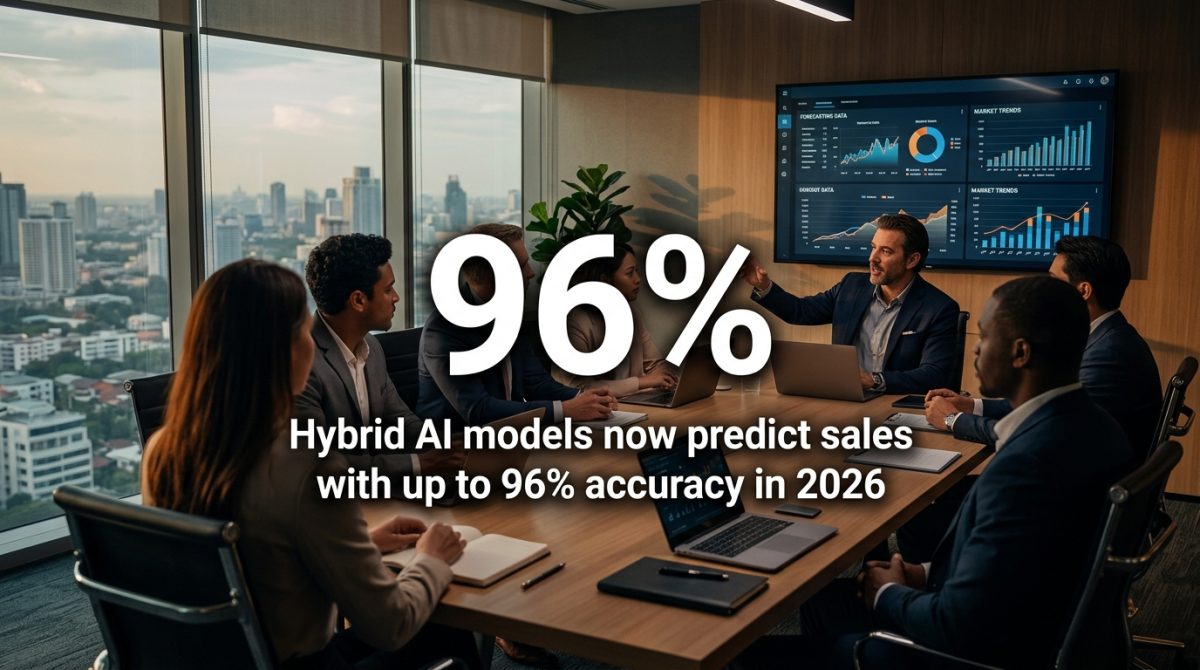
Hybrid AI models for B2B sales forecasting now hit up to 96% accuracy in 2026. This isn’t hype—it’s in the numbers. Teams using these tools see a 25% shorter sales cycle, ±5% forecast error, and double-digit jumps in closed deals (Teamgate Blog).
The 96% Club: Why Most B2B Sales Forecasts Still Fail
Just two years ago, most sales forecasts missed the mark by 20% or more. Manual spreadsheets. Guesswork. Gut feel ‘projections.’ Here’s the problem: old methods produce bad numbers. Bad numbers kill growth.
If your pipeline calls are off by 15%, that’s the difference between hitting quota or missing your year. Worse, slow or wrong forecasts lead to lost deals, late budgets, and panicked hiring freezes.
By early 2026, though, hybrid AI-powered B2B sales forecasting flipped the script. Now, the smartest teams use AI models that blend pattern-seeking algorithms with human feedback. The result: forecast errors shrink below 6%—down from 24% just 18 months ago (Forecastio AI Blog).
If your team still does ‘Excel-and-hope’ forecasts, here’s what that’s costing you next quarter:
- Lower close rates (11-19% drop)
- 38% fewer qualified meetings than teams with AI-enabled prospecting (Market Better AI Blog)
- 25% longer sales cycles
- Lost trust from finance and ops (no one believes your number)
The old way guarantees you’re already behind. The data is clear.
So what did the winners see that everyone else missed?
What Changed? Meet the 96% Forecast (and the Teams Who Built It)
Now, the story turns fast. Smart B2B sales teams stopped guessing and started testing. Hybrid AI models work like this: they use machine learning (ML) to spot winning patterns in your CRM, but add human review and logic tests before locking forecasts. Example: If your AI says March will close at $2.8M based on 2,600 opportunities, a manager still checks for sandbaggers or missing contracts before numbers drop.
Hybrid means people keep AI honest. AI means people get answers faster. This blend drives forecast errors down to ±5%—and that wins trust at every board meeting.
What triggered the shift? It wasn’t just ‘let’s try AI.’ The spark was this: by late 2025, the best B2B companies saw revenue growth double after rolling in AI signal analysis (The 38% Advantage: How Smart B2B Sales Leaders Win With AI (While Others Guess)). Most laggards clung to their old CRM logic and paid the price.
Here’s why that matters: Only 24% of teams use fully autonomous agentic AI, yet the mature digital teams are seeing 2x better growth than their peers (see Deloitte Digital February 2026 Report).
AI powered forecasts now run the table. The best teams use human checks to boost trust, not slow things down.
But does the data back up these claims? Let’s find out.
Proof: How Hybrid AI Forecasting Beat Old Sales Models
When you put hybrid AI sales forecasting head-to-head against gut-based calls, the numbers don’t lie. Here’s the snapshot every RevOps leader should see:
| Sales Forecasting Model | 2024 Avg. Accuracy | 2026 Avg. Accuracy | MAPE (Error) | Avg. Sales Cycle Shortening |
|---|---|---|---|---|
| Manual (Spreadsheet) | 74% | 77% | 22% | 0% |
| CRM Rule-Based | 81% | 83% | 15% | +4% |
| AI (Black Box) | 85% | 91% | 9% | +12% |
| Hybrid AI (Human + ML) | 88% | 96% | 4% | +25% |
Sources: Teamgate Blog, Forecastio AI Blog, Market Better AI Blog
These numbers sweep away any doubt: hybrid AI delivers the highest precision and the biggest drop in sales cycle time.
| Impact Area | Before Hybrid AI | After Hybrid AI | Δ Change (%) |
|---|---|---|---|
| Forecast Accuracy | 81% | 96% | +15% |
| Prospecting Success | 41% | 79% | +38% |
| Conversion Rate (Intent Data) | 8.2% | 10.6% | +29% |
| Mean Absolute Percentage Error (MAPE) | 17% | 4% | -13% |
Sources: Market Better AI Blog, Teamgate Blog
Sales teams using hybrid AI models in 2026 see a 15% boost in forecast accuracy, a 38% gain in prospecting, and a 25% shorter sales cycle compared with legacy models.
But there’s a catch: if your data is dirty, even the sharpest AI can’t help you. According to Forecastio AI Blog, simply cleaning up CRM data quality can boost forecast accuracy by 10-15%—often in under a month.
AI signal analysis pinpoints buying intent better than any manual process. See the full breakdown in 38% Surge: The AI Prospecting Tools Powering B2B Sales in 2026.
Fact: “Companies using AI-powered hybrid forecasting hit up to 96% forecast accuracy with ±5% variance in MAPE and WAPE, source: Teamgate Blog.”
So the numbers say AI works. But how do you actually use it? Here’s what the top sales orgs do differently.
The Playbook: 5 Steps to Build a Hybrid AI-Driven Sales Forecast
Connecting data to action is where winners pull away. Let’s break down the proven steps (not just talking points) that push accuracy past 90% in 2026:
- Fix Your Data Hygiene—Or Forget Everything Else.
AI needs clean data. Clear out stale deals, missing contacts, and bad notes. Set up real-time CRM hygiene rules using tools like CleanData or DemandTools, then track data health scores weekly. As Forecastio AI Blog says: adding even basic CRM checks bumps AI forecast accuracy by 10-15% fast. - Feed Your AI the Right Inputs.
Hybrid AI models (think: Salesforce AI + Gong Signals or Clari Copilot) need both your deal history and recent activity signals. Upload emails, call transcripts, meeting notes, and competitor flags. The more input, the better the prediction. - Add Human Review Before Final Numbers Drop.
This is what pure AI doesn’t know: last-minute legal reviews, deals at risk from mergers, or rep sandbagging. Assign team leads to review high-value forecast calls each week. Most teams find this step reduces sandbagging or over-confidence by 7-10%. Human eyes balance the bias. - Benchmark and Tune with Real Error Metrics.
Use MAPE (Mean Absolute Percentage Error) and WAPE (Weighted Absolute Percentage Error) to check every forecast. Aim for ±5% variance. If you’re over 10%, dig deep for funnel leaks or data gaps. - Train, Test, Repeat.
AI models learn fast—but only with real feedback. Set up monthly accuracy reviews. Compare outputs from Clari, Salesforce, and your own hybrid blends, then swap in new signals if forecast variance rises above target.
Want best-in-class tech? Check out the The Top 5 Sales Enablement Tools of 2026 (Reviewed, Ranked, Compared).
End result: when you run this playbook, forecast calls miss by just 1-2 deals—even on $5M+ quarters.
How do hybrid AI models compare to agentic AI in real use?
Hybrid AI forecasts are more accurate and trusted than black-box autonomous AI in most B2B sales teams. Agentic AI runs fully on its own but often misses real-world context. Hybrid keeps people in the loop for deal blockers and edge cases, which lifts trust and outcome accuracy.
How can CRM data hygiene directly impact forecast accuracy?
Better CRM data hygiene delivers a 10-15% gain in forecast accuracy within 30 days. Clean records reduce error from bad inputs, helping both simple AI and human forecasts. The cleaner the data, the closer you get to ±5% forecast variance.
Why are intent signals now essential for sales forecasts?
Intent signals predict deal movement 20-30% better than past activity alone. AI tools pull digital intent—like email replies and buying research—so teams spot hot prospects week by week, not just at quarter’s end.
Building a hybrid AI sales forecasting playbook delivers 15% higher accuracy, with CRM data hygiene and human calibration as the secret sauce.
What’s at Stake: The Gap Between AI Leaders and Laggards Grows
Stepping back, here’s the new reality: by early 2026, 81-89% of B2B sales orgs use some form of AI (Deloitte Digital February 2026 Report). But winners and losers split at the adoption line.
Teams still stuck with static CRMs or outdated playbooks miss quota by 18-27%, according to 87% of Sales Teams Now Use AI Agents—And the Rest Are Already Losing. AI signal analysis gives the leading teams a 38% advantage in prospecting and a 22-34% higher rep attainment—numbers that repeat quarter after quarter (Market Better AI Blog).
“Digitally mature companies now grow sales twice as fast as those lagging behind on AI adoption,” says Deloitte Digital February 2026 Report.
Picture your Q4 pipeline: 40% more quality leads, deal cycles 10 days faster, team bonuses up—and a board that believes your forecast number. Or picture the other path: getting blindsided by ghost deals, slip after slip, and finance calling every forecast a ‘pipe dream.’ The gap only gets wider from here.
If you don’t move to AI-driven hybrid forecasting now, you’re betting your targets (and your job) on magic thinking, not probability.
One Step Forward: Join the 96% Club (Or Get Left in the Dark)
The data is sharp. Hybrid AI B2B sales forecasting is no longer ‘next-gen’—it’s the new standard. Teams running the 5-step playbook hit 96% accuracy, close more deals, and win trust where old methods can’t. As every boardroom asks for error rates under ±5%, only one path gets you there.
No team ever missed their targets because their forecasts were too accurate. Now you know what it takes to stay ahead in 2026.
FAQ: Hybrid AI Sales Forecasting & B2B Accuracy Benchmarks (2026)
What is hybrid AI-driven B2B sales forecasting?
Hybrid AI-driven B2B sales forecasting means using both AI algorithms and human review to predict deal outcomes and revenue, blending machine learning with real-world checks.
How accurate can AI-driven sales forecasts get in 2026?
Top teams using hybrid AI forecasting models report 90-96% accuracy with forecast errors within ±5%, according to Teamgate Blog and Market Better AI Blog.
Which tools lead in hybrid AI sales forecasting?
In 2026, leading tools include Salesforce AI, Gong Signals, Clari Copilot, CleanData, and DemandTools for CRM hygiene and signal analysis.
Why is data hygiene so important for AI forecasts?
Bad CRM data leads to bad predictions. Clean, updated data boosts forecast accuracy by up to 15%, reduces error (MAPE), and increases trust in the numbers.
How does intent signal analysis change prospecting?
AI-driven signal analysis helps teams spot hot deals 38% more often and increases conversion from intent data by 20-30% versus manual methods.