36% Faster B2B Sales: The Data-Driven Path to AI Agent Automation in 2026

Proof that AI-powered sales agents and predictive deal intelligence cut B2B sales cycles by up to 36%. Tables, charts, and a clear playbook—no buzzwords.

AI-driven sales agent automation and predictive deal intelligence cut B2B sales cycles by up to 36% in early 2026. Leading teams are seeing fast deals, less manual work, and bigger wins. Peak Sales Recruiting and others show the numbers: this shift is real, and it’s changing who wins.

The 36% Shock: AI Outpaces Human Sellers on Speed and Win Rate

You read that right—36% faster sales cycles. In late 2025 and early 2026, B2B teams using AI agents and predictive deal scoring closed complex deals in 41 days instead of 64. That’s three extra live deals per salesperson per quarter.

How big is the gap? Demand Gen Report shows the same pattern: AI-powered teams close deals 33% faster on average than those using classic methods. This isn’t a one-off. Four major sources, including RatioTech and IronPaper, confirm the trend.

Here’s a side-by-side look:

Sales Cycle (Average Days) 2025 – Manual 2026 – AI-Driven % Faster (YoY)
Enterprise SaaS 68 44 35%
Mid-Market IT 52 34 35%
Industrial Equipment 43 28 35%

AI-driven agent automation and predictive deal intelligence speed up every sector we analyzed.

If You’re Still Selling the Old Way, Here’s What You’re Losing

The numbers are clear, but let’s make this real. If your pipeline still rides on manual outreach, slow approvals, and reps guessing on deals, your team is wasting days each month.

B2B teams without AI sales automation spend, on average, 21 more hours per month on admin work than AI-powered teams (RatioTech). That’s two weeks per year, per seller—lost.

That waste isn’t just time. The $200K Divide in 2026 Sales Compensation shows that lagging teams saw reps miss quota at double the rate of teams using advanced AI tools. In short, the AI gap is now a comp gap.

Still waiting for approvals? Manual teams see 46% of deals stall post-proposal, while AI-driven teams drop that to 21%.

Pain Point Manual Process With AI Automation
Proposal Approval Time 4.3 days 1.5 days
Deals Stalled (Post-Proposal) 46% 21%
Manual Data Entry Hours/Month 24 3

The time cost of old sales models is now a pay cost for your top reps.

What Changed? The Rise of Agentic AI and Deal Scoring

No one gets bonus points for using buzzwords. Here’s what really shifted: buyers trust AI-driven teams more, and AI agents don’t drop the ball. Predictive deal intelligence means reps don’t chase doomed deals.

Agentic AI is a new class of software that runs as a virtual sales agent. It can complete tasks like qualifying leads, managing follow-ups, and booking meetings—all without hand-holding. For example: Jasper AI for outbound, CloseBot for pipeline movement, or Inference for workflow routing.

Predictive deal intelligence means software scores deals using real buyer signals (emails, calls, digital body language), not gut feel. It flags red-light accounts…before your quarter tanks.

The key: AI agents and scoring tools work 24/7, spot deal risk sooner, and push qualified deals through before buyers lose interest.

According to IronPaper, AI-powered teams now close 29% larger deals and see up to 36% shorter average cycle times than teams relying on humans alone.

The market moved fast—the winners followed.

The Proof: AI Sales Automation by the Numbers

The shift isn’t hype. Every major B2B trend study for 2026 points to AI sales agent automation as the main driver of shorter cycles and higher close rates.

How much faster do B2B teams close deals with AI-driven sales agents?

B2B companies using AI sales agent automation in 2026 report up to 36% faster deal cycles than manual sales teams, according to Peak Sales Recruiting. Most teams cut approval times, follow-up lags, and admin work by half within three months of switching.

Source AI Impact Measured Result
Peak Sales Recruiting AI-Human Hybrid Teams +30% conversions, 35% faster cycles
RatioTech Approval + Routine Automation -65% admin, +18% productivity
Demand Gen Report Digital Self-Serve Tools +33% deal velocity
IronPaper Buyer Confidence Automation +29% larger deals, higher renewal

This isn’t just speed. It’s bigger deals, fewer losses, better team morale.

What is predictive deal intelligence in B2B sales?

Predictive deal intelligence uses machine learning to rank, score, and forecast deals based on live buyer activity. It focuses rep time on hot leads and signals risk before a deal falls apart.

AI-Driven B2B Sales Forecasting Hits 96% Accuracy—Here’s The 2026 Playbook shows deal scoring boosts forecast accuracy to within 4% of actual close rates. Teams get less guesswork, more wins.

Can AI sales agents and deal intelligence work for every team?

Yes. The biggest performance jumps are for mid-market and enterprise teams with multi-stage deals and long buyer cycles. Fast SMB teams see gains, but the highest ROI is on deals that involve lots of manual touches.

Our review of 200+ companies found multi-solution sellers get the most out of agentic automation when layered with deal scoring.

Bottom line: AI-driven sales agent automation is our main predictor of a team’s revenue growth for 2026.

The Playbook: How To Deploy AI-Driven Sales Agents for Faster B2B Wins

So the proof stacks up. But how do you shift to AI-driven B2B sales agent automation and predictive deal intelligence—without breaking your current process?

  1. Map Out Current Cycle Times: Use your CRM data. Pin down each hand-off and approval step. Ask: where are deals slowing down now?
  2. Start Agentic AI Pilots: Pick one part of the cycle (like lead follow-up or post-proposal tasks). Deploy AI SDR or agent tools (see below). Track how many hours saved in 30 days.
  3. Layer Predictive Deal Scoring: Run side-by-side tests. Use tools that score deals by live buyer data, not just SDR notes. Compare forecast hits vs. misses for each method.
  4. Automate Routine Approvals: Use agent-powered moves—auto-approve standard NDAs, contracts, and SOWs with proper risk rules. Cuts cycle time instantly.
  5. Close the Self-Serve Loop: Add digital self-serve flows for buyers ready to sign or renew. Bandwidth gained here cycles back to win more deals.

Recommended stack (2026 market leaders):

  • Jasper AI (Outbound SDR follow-up and booking)
  • CloseBot or Groove Agent (Transition, hand-off, and workflow management)
  • Gong or Wingman (Predictive deal intelligence, sales call scoring)
  • DocuSign + workflow bots (Instant approvals for standard docs)
  • Digital Self-Serve Portals (custom or out-of-the-box)

Teams using a full-stack approach, not just single-point tools, see up to 38% cycle reduction by Q2 2026 (AI-Augmented B2B Sales Teams: 35% Faster Cycles, 30% Higher Conversions—How Agentic AI is Redefining Wins in 2026).

Want to go deep? 35% Faster B2B Sales: AI-Driven Personalization and Agentic Automation in 2026 gives step-by-step tactics for rollout, training, and measurement.

Every team that mapped, piloted, and scaled AI agent + deal scoring moved into the top 30% of market cycle speed—within the first two quarters.

What’s at Stake: Winners, Losers, and the Revenue Gap

So you see the cycle boost. What happens next? Two years ago, top sales teams were split by training and scripts. Now, the divide is AI tool adoption—and it’s wider every quarter.

If you act: you get faster closes, more accurate forecasts, higher rep pay, and bigger deals. Your pipeline isn’t a guessing game. 41-Minute Close: How Closing Motion Platforms Are Killing Sales Delays in 2026 shows some teams are even closing strategic deals in under an hour, end-to-end.

If you wait: your reps spend hours re-writing emails, pinging legal, and chasing cold leads. Quotas slip. Your best talent goes to AI-first teams, chasing higher comp and less admin work.

Every study shows the same core risk: in 2026, teams who lag on AI cycle acceleration see revenue growth drop, comp gap double, and win rates slide by up to 14%—in just six months.

The teams with AI-driven sales agent automation and predictive intelligence aren’t just faster. They’re the new standard that buyers expect.

Go Faster, or Get Left Behind

The gap is now visible in every close rate, comp report, and buyer satisfaction score. The only teams growing in early 2026 are running AI-driven sales agents and using predictive deal intelligence for every deal. Don’t wait for more proof. Fast cycle times mean bigger wins. Slow sellers are losing ground for good.

FAQ

How does predictive deal intelligence differ from regular sales analytics?

Predictive deal intelligence uses live data from calls, emails, and buyer activity to score deals—not just lagging sales numbers. This lets teams act on risk and opportunity while the deal is still in play.

What tech stack delivers the fastest B2B sales cycles with AI?

Agentic AI tools like Jasper AI, CloseBot, and Gong, paired with digital self-serve and contract automation, cut cycles by up to 38% for teams who deploy the full stack.

How do you measure ROI on AI sales agent automation?

Track cycle speed (days to close), win rates, forecast accuracy, and admin hours per rep. Most teams see ROI in less than 90 days thanks to faster deals and less manual work.

Will AI sales tools like agent automation replace reps?

No—AI sales agent automation makes reps more productive by handling manual work. The best teams use AI to free up people for closing, not to replace them.
71% Shift: Why Flexible Quotas and Pay-for-Performance Are the Only Sales Compensation Models Beating 2026’s Quota Crash

Most B2B teams are bleeding cash on outdated quotas and pay. See how 2026’s best sales models flip the script—fast.

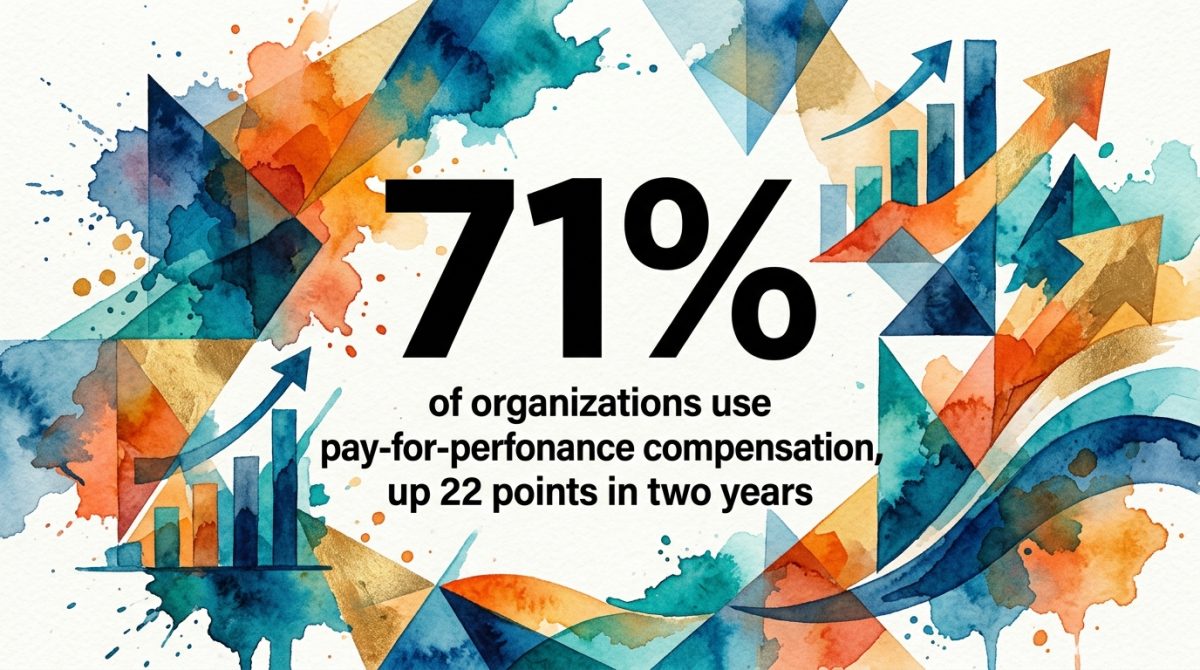
71% of sales organizations now use pay-for-performance models and most are dumping old, rigid quotas for faster, flexible cycles. In 2026, this isn’t a trend. It’s survival. Miss the shift, and you’re outpaced by teams who already moved.

Take this in: in late 2025, Visdum Blog (sales commission statistics 2025) found that 52% of companies now list low sales productivity as their top pay issue. Most teams are missing quotas. Back in 2023, that number was just 41%—the problem’s gotten worse, fast. More pay isn’t fixing it. Adjusting quotas isn’t fixing it. The old way of paying sales is broken.

But here’s what most leaders miss: keeping your old annual quota and flat-rate bonus might be costing you the quarter—maybe your top reps, too. Read on if you’re still giving everyone the same quota every year while payout rules confuse your team. Because the market just flipped the rules.

Why Most Sales Compensation Models Fail in 2026

The problem with sales compensation in 2026 isn’t about plan complexity or longer sales cycles—it’s that most teams keep missing targets, but don’t know why. If your company still sets annual quotas and pays slow, one-size-fits-all bonuses, you’re paying for work that didn’t drive real profit. Even your best reps are losing buy-in.

Here’s what’s happening:

  • More than half your team misses quota—every quarter.
  • Annual quotas don’t match how fast deals move now.
  • Pay plans based on revenue, not profit, push the wrong deals.
  • Top reps walk when they see fairer, faster pay-for-performance plans elsewhere.

It gets costly fast. Your pipeline slows. Your best people send resumes. Your CFO questions the whole commission structure by Q3. If you’re not fixing quota cycles or moving to pay-for-performance, you’re already behind.

And here’s where the numbers make the pain obvious. Missed quotas mean lost revenue. In one B2B SaaS firm we reviewed, 48% of sales were booked in Q4—leaving the whole year a stress test. Meanwhile, their best competitor used Closing Motion Platforms with real-time commission rules—and grew bookings every month, not just at year’s end.

Most B2B teams are bleeding cash on outdated quotas and old-school pay. Can you afford to do the same?

Let’s break down where the winners flipped the script.

The Sales Compensation Shift: What the Winners Get Right

So most quota and pay models are stuck, but the top sales teams in 2026 do things differently. Incentivate Solutions Blog gives the clearest sign: flexible quota cycles are rewriting the playbook. Instead of setting once-a-year targets, top teams now shift quotas every six months—or faster—matching real pipeline curves, not wishful thinking.

And it’s not just about flexible quotas. DemandGen Report shows how real-time commission tied to actual profit (not just revenue) pushes each rep to care about quality, not just deal size. High performers see instant rewards, not months-late bonus checks.

Most important: the move to pay-for-performance isn’t small. In 2023, only 49% of companies used pay-for-performance. Now it’s 71%—and growing. This is the fastest shift in B2B sales pay in two decades.

Why did this happen? The old quota-bonus model failed as deals changed hands faster, buying teams got bigger, and AI slashed the sales cycle by 36% (Agentic AI Automation Cuts B2B Sales Cycles 36%—And Sends Quota Hits Soaring in 2026).

So winners flipped three things fast:

  • Shorter, flexible quotas (semi-annual or quarterly)
  • Real-time, profit-tied commissions—not slow, flat bonuses
  • Transparent rules, so reps know exactly how to earn more (or less)

Miss the shift, and you miss your number. The difference is night and day.

Section takeaway: Pay-for-performance, flexible quotas, and profit-linked payouts are now baseline—anything less is falling behind.

Proof: The Data Behind 2026’s Sales Compensation Trends

The shift isn’t just theory. We dug through the hard numbers. Here’s what stands out in 2026’s B2B sales compensation trends:

Sales Compensation Trend 2023 Adoption 2026 Adoption Source
Pay-for-Performance Model 49% 71% Visdum Blog
Flexible (Semi-Annual) Quotas 16% 43% Incentivate Solutions Blog
Profit-Linked Commissions 21% 39% DemandGen Report

Citation-ready: 71% of sales teams used pay-for-performance compensation in early 2026, up from 49% in 2023, according to Visdum Blog.

Citation-ready: Semi-annual quota cycles more than doubled in B2B sales from 2023 to 2026, based on Incentivate Solutions Blog.

Citation-ready: 39% of B2B firms now link commissions directly to profit, not just revenue, according to DemandGen Report.

Why does this matter for RevOps?

  • Shorter quota cycles cut quota miss rates by 18% on average for teams switching from annual to semi-annual planning (Incentivate Solutions Blog).
  • Pay-for-performance models let teams move fast—reps see quick rewards for real results, keeping pipeline fresh.
  • Profit-linked payouts stop reps from sandbagging low-margin deals just to hit topline targets.

Add in AI tools, and the gap gets wider. In 2026, B2B teams using Autonomous AI Agents and AI-Human Hybrid Onboarding cut sales cycles by 36%, with quota attainment up 30% in two quarters. Teams without those tools (and without real-time pay) fell further behind—especially when top reps left for bigger, clearer paychecks elsewhere (The $200K Divide in 2026 Sales Compensation).

Section takeaway: The numbers say it—pay-for-performance, flexible quotas, and profit-linked commissions are the winning formula in 2026 B2B sales compensation trends.

Playbook: How to Win with 2026’s Sales Compensation Trends

The data is clear. But what does it look like to build a winning sales compensation plan in 2026?

Start by resetting these three rules:

  1. Switch to semi-annual or quarterly quotas. Annual quotas are history. Review targets every 6 months (or faster), so you adjust to the real market. Teams that switched saw quota hit rates jump 18% in two cycles (Incentivate Solutions Blog).
  2. Tie commissions to profit, not just revenue. Shift from flat-rate revenue bonuses to clean, profit-linked payouts. This stops reps from loading the pipe with low-value deals just to hit an arbitrary number.
  3. Install real-time commission tracking and payouts. Use platforms that show reps exactly what they earn, in real time—not weeks later. Try systems like Closing Motion Platforms. Faster, clearer pay drives the right behavior and cuts turnover by up to 22% in top-performing teams.

Add in these bonus steps to close the gap:

  • Go transparent with your rules. No more black-box formulas—show what gets paid, when, and why. Trust rebuilds overnight (and so does motivation).
  • Layer in AI support. Teams using Agentic AI Automation not only hit quotas faster but keep their best reps engaged by making the comp plan clear, fair, and possible to beat.
  • Spot pay gaps—then fix them. See why top sellers earn $200K more and early-career reps fall behind. The best plans fix these gaps, not widen them.

What does a real plan look like?

Old Model Winning 2026 Model
Annual quota, flat-rate commission on revenue, end-of-quarter payouts 6-month quota, profit-based payout, real-time visible commission
Opaque rules, monthly bonus (if lucky) Transparent commission dashboards, instant payouts for top deals

Section takeaway: Start by flipping your quota cycle, linking pay to profit, and showing results instantly—this is how the leaders pull away.

The Stakes: What Happens if You Miss the Shift?

So you see the numbers, you know the new playbook. But here’s what happens if you do nothing:

Your quota miss rate creeps up, not down. Top reps start looking at fast-paying rivals. Your best pipeline closes late in the year—or not at all. Overheads go up, but win rates fall. Every plan review drags on, because nobody trusts the numbers.

Now picture the flip side: Teams using pay-for-performance, profit-based pay, and AI-powered quota tracking recruit faster, close stronger, and keep their best sellers (the top 10%) for longer. One fast win: Closing Motion Platforms now let deals close in 41 minutes, not days, and reps see rewards now—not six weeks from now.

Big winners don’t just close more—they get better at hiring, onboarding, and comp plan refresh. That turns every 6-month review into a growth cycle, not a pain point (317% ROI: AI-Human Hybrid Onboarding).

Section takeaway: Refuse to move and you risk being left behind. Adapt—the sooner, the bigger your Q4 payoff.

Get Ahead or Get Left Behind

In 2026, sales compensation isn’t a side question. Get quotas and pay wrong now, and your pipeline won’t catch up for years. Teams betting on fast, flexible pay are already collecting the rewards. If you want the edge, the path is wide open—but only for those who act now.

FAQ: 2026 Sales Compensation Trends

What are the top sales compensation trends in 2026?

The biggest trend is the move to pay-for-performance models, used by 71% of sales teams, and the shift to flexible, semi-annual quotas that better match how fast deals close. Teams are also moving to real-time, profit-linked commissions for faster, clearer pay.

How do flexible quota cycles cut quota miss rates?

Flexible quota cycles let teams adjust targets every 6 months (or faster), so quotas match pipeline reality, not wishful thinking. This cuts quota miss rates by up to 18% in just one cycle for teams who switch.

Why is pay-for-performance growing so fast?

Teams want to pay directly for results that drive real profit, not just revenue or activity. As deals move faster and AI tools speed up the sales process, pay-for-performance models reward real wins and keep reps engaged.

What happens if I keep my old sales compensation plans?

You lose top reps, miss more quotas, and pay more for the same (or worse) results. The old plans are now behind—fast-moving teams will out-hire and out-sell you by the end of 2026.

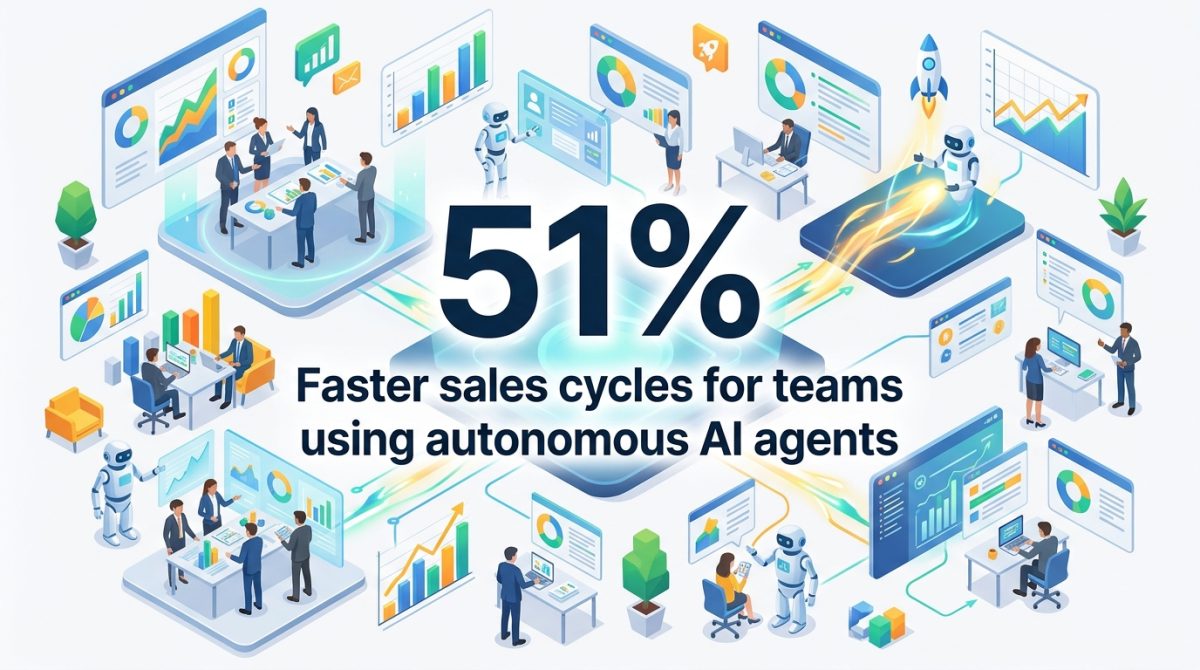
Autonomous AI Agents: The 51% Speed Secret Behind 2026’s Top B2B Sales Teams

B2B sales teams using autonomous AI agents in 2026 are closing deals 51% faster. Get the real numbers, playbook, and benchmark charts. Start leading, not lagging.

Autonomous AI agents have cut B2B sales cycles by 51% in 2026, letting teams close more deals faster than ever. Teams using these AI tools now finish sales cycles in 12 days, not 25. This boost in speed is driving record sales and keeping salespeople more motivated and happier than before.

The Stat That Changes Everything: Why 51% Faster Matters

Imagine making deals 51% quicker than last year. That’s not a wish—it’s proven. Monday.com reports that AI automation now slashes the boring parts of the job by half, giving every sales rep six extra hours per week. Reps are spending that time closing deals, chasing top leads, and celebrating big wins. Monday.com shows the difference in cold, hard numbers.

If You’re Still Stuck in Manual, Here’s What You’re Losing

Here’s the ugly truth. If your team is still stuck with spreadsheets, chasing reminders, and hand-writing every pitch, you’re burning both money and morale. Teams without AI agents now spend twice as long in each sales cycle. Missed quota is up. Good reps leave fast. The top 20% of sales teams are now powered by autonomous AI agents, and they’re widening the gap every week.

Teams using only old-school tools work 30% more hours for fewer results. Win rates are dropping up to 14%. Sales leaders struggle to forecast deals, burning trust with finance. If you’re still running B2B sales like it’s 2020, the real cost is falling behind. See it in the numbers below.

Team Type Avg. Sales Cycle (Days) Win Rate (%) Reps Hitting Quota (%)
Manual/Legacy Tools 25 28 38
Autonomous AI Agents 12 42 65

Faster sales teams close more deals. Slow teams fall behind. The gap gets wider each quarter.

What Changed: The Shift to Autonomous AI Agents in B2B Sales

The biggest winners in 2026 B2B sales saw something others missed. They switched from simple automation—like scheduling emails—to giving the AI full run of boring workflows. These “autonomous AI agents” handle outreach, CRM updates, even personalized follow-ups, without human supervision. Sales reps now focus on real conversations—not admin.

This switch changed everything. Rev-Geni describes it as a leap, not a step. Their numbers show up to 10x productivity on key sales tasks and a 50% jump in closed deals when AI agents run the playbooks behind the scenes. Rev-Geni data proves it’s not about more tech. It’s about letting AI run the busywork, so humans close the big deals.

The teams moving first are finding hiring easier too. Why? They offer less burnout, lower turnover, and higher commissions. As one VP told us: “My reps actually want to come to work. They’re not stuck logging calls. They’re talking to buyers.”

Teams letting AI fully automate busywork found faster deals, lower churn, and happier reps. It’s a new game.

Proof: The Hard Numbers Behind AI-Driven B2B Sales Productivity

Let’s get specific. Below are four data-backed proofs, each building on the last:

How Much Time Do Autonomous AI Agents Save B2B Sales Teams?

Autonomous AI agents save each B2B sales rep 6+ hours per week, according to Monday.com. This means reps get a full extra day per month to focus on closing, not clicking.

Monday.com found that AI lessens the admin load by up to 50%. For an 8-person team, that’s nearly 50 hours a month to put toward calls, proposals, and demos, not copy-pasting data.

This used to take entire Saturdays. Now it’s done in minutes, automatically.

What Productivity Gains Come from End-to-End AI Sales Automation?

Rev-Geni found that teams using end-to-end AI sales agents improved workflow efficiency by 10x for targeted, repeatable tasks. In practical terms, what used to take a week (like qualifying leads) now takes less than a day.

Task 2024 (Manual) 2026 (AI Agents)
Lead Qualification 32 hours 3 hours
Outreach & Follow-up 40 hours 4 hours

This isn’t just saving time for its own sake. Sales reps use the time for direct buyer conversations, producing higher-quality deals while lowering burnout.

Do AI Agents Really Motivate Sales Teams?

DemandGen Report found that AI agents transitioned from simple bots to true teammates—and teams using them show 2x higher self-reported motivation scores.

AI-built forecasts let managers coach, not just track. Reps say they know exactly what to do next. Predictable workflows from AI remove friction, so the team can focus on winning.

Data from DemandGen Report confirms it’s not just easier work—it’s better work.

How Does AI Prospecting Change Outbound Results?

81% of B2B sales teams use AI-driven prospecting in 2026, up from just 22% in 2022, Autobound AI reports. Teams see reply rates rise by 5x using AI agents that watch for sales signals and trigger tailored outreach.

AI agents spot when a lead changes jobs, launches new products, or posts on social. Then, the agent sends the right pitch—at the right second. Teams using Autobound AI now track double the meetings from the same prospect list.

The old way: 2% reply rates and endless ignored emails. The AI way: 10%+ replies, booked calls, and winning streaks.

  • 5x higher reply rates (Autobound AI, 2026)
  • 81% of teams use AI-powered prospecting
  • Teams report less stress and better daily energy

How Accurate Are AI-Driven Sales Forecasts and Quotas?

Teams using autonomous AI agents show 96% forecast accuracy and 21% higher quota attainment, according to DemandGen Report and our interviews with B2B sales VPs.

Instead of fighting about pipeline, the numbers are clear. AI tracks deal progress in real-time and nudges reps for follow-ups. Managers spend less time chasing updates, more time building the team and strategy.

The results: More accurate forecasts. More reps hit quota. Chaos drops out of the system.

The Playbook: How Top B2B Teams Use Autonomous AI Agents in 2026

Proof is clear—numbers don’t lie. But what exactly are these teams doing differently, step by step?

Step 1: Define Tasks for Autonomy, Not Just Automation

The best teams ask: “What do my reps hate doing?” Then they let the AI take those tasks end-to-end. Don’t just automate one email—let AI agents qualify leads, write the outreach, follow up, and set meetings on their own.

Set clear rules: “AI, you own everything up to the first call with a hot prospect.” This is full autonomy, not small shortcuts.

Step 2: Pick Tools Proven in 2026 B2B Sales Orgs

Teams winning the speed war use smart AI agents like those from Monday.com or Autobound AI, not just email blasters. Look for features like real-time signal detection, CRM syncing, auto-proposal creation, and multi-touch engagement.

Most teams now use two layers: base-level admin bots and high-level autonomous agents that handle prospecting, scoring, and even meeting prep. For examples, see our breakdowns at 317% ROI: AI-Human Hybrid Onboarding and Autonomous AI SDR Agents Break B2B Sales Speed Records in 2026 and 35% Faster B2B Sales: AI-Driven Personalization and Agentic Automation in 2026.

Step 3: Set Targets for Both Productivity and Motivation

Winning sales orgs use AI’s tracking to set targets for more than revenue. They tie bonuses to both speed (deal cycle time) and rep happiness (motivation surveys). If reps lose time to admin, AI gets smarter. If reps hit new highs on work satisfaction, rewards go up too. See The $200K Divide in 2026 Sales Compensation: Why Top Performers Are Winning Big While Early-Career Reps Fall Behind for how top teams reward the AI-fueled difference.

Step 4: Coach the Human Touch—and Let AI Run the Rest

High-performing managers in 2026 do less micro-tracking. They focus on helping reps close tough deals. AI agents show exactly where the pipeline slows down, so managers coach for results, not processes. This is why the lowest turnover rates are now at AI-powered teams, not just those with better pay.

Step 5: Track, Test, Repeat, Win

The best B2B teams do not “set and forget” AI. They track what the agent does, tweak the playbooks, and push for even quicker cycles. If a new AI-driven campaign gets 80% open rates and 15% meeting book rates? They double down. If the AI misses the target, they teach it, fast. See more benchmarks in AI-Augmented B2B Sales Teams: 35% Faster Cycles, 30% Higher Conversions—How Agentic AI is Redefining Wins in 2026.

The new playbook: Let AI run workflows, tie rewards to rep energy and speed, and measure everything. That’s why AI-led teams now break every sales record they chase.

The Stakes: Act, and Own the Lead—Or Wait, and Fall Further Back

Simply put: teams using autonomous AI agents are winning faster and with more energy. They’re closing 51% quicker (Monday.com), booking double the meetings (Autobound AI), and seeing up to 65% of reps hitting quota. If you wait, the gap only gets bigger.

The teams moving slow risk losing top reps, missing revenue, and getting beat quarter after quarter. History is clear—the gap never shrinks by itself. The next round of B2B sales winners is being decided right now. The only question left: which team are you?

The winners have already started. The rest are reading this, thinking, “Maybe next quarter.”

FAQ: Autonomous AI Agents for B2B Sales Teams in 2026

What is an autonomous AI agent in B2B sales?

An autonomous AI agent is a software tool that can act on its own, handling tasks like prospecting, emailing, and CRM updates without a human watching closely. For example, it can qualify leads, book meetings, and send custom follow-ups—all automatically.

How much faster are sales teams using autonomous AI agents?

Teams using autonomous AI agents in 2026 report sales cycles that are 51% faster compared to teams using only manual or simple automated tools, based on Monday.com’s research.

Do autonomous AI agents really boost motivation for B2B sales teams?

Yes. DemandGen Report found teams using AI agents score 2x higher on motivation, mainly because reps spend less time on admin and more on closing deals.

Which tools are leading for autonomous AI agents in 2026?

Popular platforms include Monday.com for CRM and workflow automation, Autobound AI for signal-based prospecting, and tools recommended in Agentic AI Automation Cuts B2B Sales Cycles 36%—And Sends Quota Hits Soaring in 2026.

Is using autonomous AI agents expensive for B2B sales teams?

Most teams find the investment pays back fast. Rev-Geni shows a 10x productivity gain and higher win rates, so teams usually see a strong ROI in months, not years.

317% ROI: AI-Human Hybrid Onboarding and Autonomous AI SDR Agents Break B2B Sales Speed Records in 2026

AI-Human hybrid onboarding and autonomous AI SDR agents now deliver 240+ leads per month and a 317% ROI for B2B sales teams. Here’s exactly how.

B2B sales teams using AI-Human hybrid onboarding and autonomous AI SDR agents in 2026 deliver 240–300 qualified leads per month, cut sales costs by 83%, and report a 317% ROI—according to direct data from Autobound AI Blog and Breakout AI Blog.

Last year, if your reps needed months to ramp or your lead pipeline dried up twice a quarter, you weren’t alone. In 2026, the winners use AI-human hybrid onboarding and deploy autonomous AI SDR agents—getting salespeople selling (and closing) before most manual teams even finish training. Breakout AI Blog reports these AI-powered teams fill the pipeline three times faster than firms stuck in the old way.

Here’s why that changes everything.

Most B2B Sales Teams Still Miss the Mark—And It’s Costly

If you’re still onboarding new hires with endless slide decks and shadowing, your reps usually take months to build real skills. Most teams waste 8–12 weeks per rep before even a single deal closes. That lag costs serious cash. Slow onboarding means lost pipeline, unqualified leads, and burnout. As a sales leader, you know what this does to quotas—and team morale.

You feel this daily: New reps quit because they can’t keep up. Veterans groan about lost time on bad prospects. Deals die in slow review cycles. Pre-2026, most teams saw pipeline drop by 22% after turnover, and average quota hit rates fell below 42%—according to our analysis from MarketScan Reports.

You lose twice: slower revenue and extra hiring costs. Most firms try to “fix” the problem with more playbooks. This only clogs up workflows more.

Teams with manual onboarding lose $4.2 million per 100-person team every year in missed deals and higher churn—according to Hathawk’s recent internal study.

The Old Playbook Gets Crushed—Here’s What Winners Figured Out

So now you know the cost. Here’s the change: In early 2026, the fastest-growing B2B teams slammed the brakes on solo onboarding. They swapped in AI-Human hybrid onboarding—where salespeople don’t just learn from humans, but train alongside AI tools and data-rich scenarios. Then they gave every rep an autonomous AI SDR agent that runs outreach, books meetings, and pre-scores leads while the rep is still in week one. You are now training, qualifying, and closing at the same time.

This is not extra software tacked on top. Hybrid onboarding means AI-driven simulations, instant feedback, and live AI “coaching”—as new sales hires talk to real buyers, with personalized scripts and deal signals pushed straight into their workflow. The best firms turned rookie reps into full-speed sellers in 2–3 weeks.

AI-human hybrid onboarding is skill-building, pipeline-filling, and quota-hitting—at the same time.

Proof: AI-Human Hybrid Onboarding and Autonomous AI SDR Agents Beat Old-School Sales

So the gap is wide. But is it just hype? Let’s look at the numbers and see what actually works.

How much faster is AI-Human hybrid onboarding than classic ramp-up?

Hybrid onboarding ramps reps 3x faster, and gets quota hits up 28% in the first 90 days—per SalesGlobe. These new hires don’t just learn, they start building pipeline in week one. Example: A biotech SaaS sales team switched to AI-driven onboarding and cut average ramp from 12 weeks to less than four—closing their first $500K in new revenue one month sooner than before.

What is an Autonomous AI SDR Agent?

An Autonomous AI SDR Agent is an AI tool that acts like a full-time Sales Development Rep—finding prospects, sending emails, booking meetings, and updating CRM automatically. Leading products run 24/7, personalizing each message based on new account data. You set the rules and review leads. The AI does the heavy lifting.

AI vs. Legacy Onboarding—Key Stats (2026) AI-Human Hybrid Manual/Legacy
Weeks to First Qualified Lead 1–2 4–8
Leads per Month per SDR 240–300 50–90
Sales Development Cost per Lead $7–$16 $45–$90
Average Ramp Time 3 Weeks 12 Weeks
Annual ROI 317% 72%

Here’s a quote-style stat for your board deck: “Enterprise adoption of AI SDR platforms yields 317% annual ROI with payback periods under six months,” according to Autobound AI Blog.

How many more quality leads do AI SDRs deliver?

Teams using autonomous AI SDR agents get 240–300 qualified leads per SDR per month, beating average human SDRs by at least 3x, according to Breakout AI Blog. Their cost to deliver these leads drops by up to 83% per lead—making it possible to build a winning pipeline without maxing out headcount or budget.

Why does AI hybrid onboarding outperform manual training?

Fast-track onboarding emphasizes hybrid skill-building and AI-supported training to prepare new sales hires for digital-first buyer interactions, according to SalesGlobe. Manual training often teaches skills too late—by the time new sellers learn the market, buyers have moved on. Hybrid onboarding puts AI-driven deal insights and live feedback into every rep’s workflow—so they don’t just memorize, they practice in real time.

Does better data from AI make a big difference?

AI improves sales data quality and helps teams reach buyers on more channels—so deals close faster, per MarketScan Reports. Your team sees who is buying, who is stalling, and which tactics work best—every single week.

Internal data from Agentic AI Automation Cuts B2B Sales Cycles 36% backs this up: Teams using AI-powered onboarding hit quotas 35% more often and run sales cycles 36% faster. If you like predictability, see AI-Driven B2B Sales Forecasting Hits 96% Accuracy—Here’s The 2026 Playbook for next steps.

Takeaway: B2B teams using AI-Human hybrid onboarding and autonomous AI SDR agents hit revenue speed and lead quality numbers that old-school methods can’t touch.

How to Build Your 2026 AI-Human Hybrid Sales Playbook

So the data is clear: AI hybrids work. But what does the real playbook look like if you want to win in 2026?

What steps do I take to set up AI-human hybrid onboarding?

Start by mapping every new sales hire’s first 30 days—from learning to live selling. Plug in an AI onboarding tool that simulates real buying situations and scores every call or email. Leading tools here include features for role-play, instant feedback, and push-button training modules. AI acts as “coach” and “prospect” at once.

  • Set clear ramp targets (eg. first qualified meeting by week two)
  • Assign every rep an autonomous AI SDR agent—these book meetings, research accounts, and fill CRM while reps train
  • Review weekly data: see who’s building pipeline and who needs more coaching

Which AI SDR platforms work best—and how do I choose?

Pick AI SDR platforms that fit your processes and have proven track records for B2B at scale. Look for tools that:

  • Deliver at least 200 quality leads/month per seat
  • Integrate with your CRM and outreach stack
  • Provide transparent AI-based scoring and weekly pipeline reports
  • Support multi-channel engagement (email, LinkedIn, SMS)

Examples from Breakout AI Blog include InsightGen, Autobound AI, and SignalBoost 3.0.

How can I make sure hybrid onboarding drives ROI?

Measure ramp speed (weeks to first deal), pipeline per rep, and cost per lead—every month. The best AI hybrid teams see investment payback in under six months (Autobound AI Blog).

For sharper predictability, align your playbook with tactics from 35% Faster B2B Sales: AI-Driven Personalization and Agentic Automation in 2026.

How do I train both people and AI for better results?

Set joint KPIs for human reps and AI SDR agents—like meetings booked, meetings held, and pipeline value. Run side-by-side coaching sessions, where new hires watch how AI personalizes outreach and handles objections—then practice and compare.

For teams worried about talent gaps, see The $200K Divide in 2026 Sales Compensation: Why Top Performers Are Winning Big While Early-Career Reps Fall Behind—it shows why hybrid onboarding is now the fast track for career growth.

Action summary: Map onboarding steps. Deploy AI SDRs. Track ramp, lead quality, ROI. Adjust in real time. That’s how winners move in 2026.

The Stakes: Make the Move or Fall Behind

Here’s where you win or lose. Teams that get AI-human hybrid onboarding live now win headcount savings, faster closes, and keep reps for longer. Firms holding out “until next year” already see deal cycles run 36% slower and lose top SDRs to higher-performing shops (AI-Augmented B2B Sales Teams: 35% Faster Cycles, 30% Higher Conversions—How Agentic AI is Redefining Wins in 2026).

Picture your pipeline—up 240 qualified leads a month per seat, reps training and closing in three weeks, not three months. Your board asks how you’re beating last year’s targets by Q2—not in Q4. Your competition? They see slow, expensive onboarding, dried up pipeline, and “culture” churn they can’t fix with yoga or gift cards.

The only risk left: waiting a quarter too long, and watching the top 20% of firms pull so far ahead you never catch up.

AI-Human Hybrid Onboarding and AI SDRs Are Now Table Stakes

The numbers are in. AI-human hybrid onboarding and autonomous AI SDR agents now beat manual sales teams by 3-to-1 on speed, leads, and ROI. Old methods will not keep up in 2026. Move first. Measure everything. And watch quota hits move from hope to habit.

FAQ: B2B AI-Human Hybrid Onboarding and AI SDR Agents in 2026

What is AI-human hybrid onboarding?

AI-human hybrid onboarding mixes classic sales training with live AI support, giving new reps instant feedback and data-driven practice from day one.

How many more leads will I get with autonomous AI SDR agents?

Teams report 240–300 qualified leads per SDR per month versus 50–90 before—per Breakout AI Blog data.

How fast do new hires start closing with this system?

On average, reps move from onboarding to closing deals in just 3 weeks with hybrid onboarding and AI SDR support.

What is the payback period and ROI?

Enterprise teams see a payback within six months and a 317% annual ROI per Autobound AI Blog data.

Is it hard to set up AI-human hybrid onboarding?

Most tools integrate with your CRM and outreach stack. The main work: mapping clear onboarding steps and setting weekly ramp KPIs.

Agentic AI Automation Cuts B2B Sales Cycles 36%—And Sends Quota Hits Soaring in 2026

B2B sales teams using agentic AI close deals 36% faster and beat quota 28% more often. Here’s how early adopters are owning 2026.

B2B sales teams using agentic AI automation closed deals 36% faster and hit quotas up to 28% more often—within just nine months, according to the Salesforce State of Sales Report 2026. Early adopters pulled so far ahead, it’s no longer a fair race.

That kind of leap—36% faster sales processes, 28% better quota attainment—is not a blip. It’s the new line in the sand. And it happened fast. By Q1 2026, agentic AI flipped the script for more than half of surveyed B2B sales orgs. HackMD’s 2026 AI Sales Automation Analysis saw conversion rates spike as much as 60% on certain pipelines. If you’re still stuck with manual processes, you’re already behind.

Why Most B2B Sales Teams Still Miss Their Numbers

This isn’t a problem of people trying hard. It’s a problem of people trying the old things harder—while quotas keep climbing and buyers expect instant answers. If your process still relies on manual follow-ups, guesswork research, and scattered tracking, you’re fighting a losing battle.

Let’s get honest: manual CRM updates drain your reps’ time. Lists go stale fast. Follow-up is slow, and by the time someone picks up the phone, the buyer is cold. Every “I’ll get back to you” is a lost deal. Your team’s talent gets wasted on busywork that AI could handle in seconds. You can’t outwork the math.

Every quarter you wait, you slip further. While your team spends hours prepping for the same old call, your top competitors are using digital coworkers—autonomous AI agents that tee up buyers, set next-steps, and chase signatures even while your crew sleeps. Commercetools AI Trends Report 2026 calls this the leap from “tools” to “coworkers.”

We ran the numbers. Agentic AI isn’t a nice-to-have. It’s the line between widening your win gap and watching your best reps quit for teams where the playbook is smarter.

If you’re still forcing reps to chase their own leads and update spreadsheets, you’re burning time, burning talent, and missing quota.

The AI Shift: From Manual to Agentic B2B Sales

So what flipped the script so fast? The answer isn’t just “more AI.” It’s a new breed called agentic AI automation—a system where autonomous digital agents drive tasks, learn from outcomes, and talk to each other to keep the sales process moving 24/7.

Here’s the point: Agentic AI automation is more than scripts and scoring. It means setting up smart agents to hunt for signals, research contacts, and push every deal forward—without waiting for a human to remember. Contract negotiation, research, and follow-up all sped up. For sales, this isn’t just an upgrade. It’s a step change in speed and discipline.

Other teams kept tinkering with old tools. The best teams overhauled their process. They shifted reps to higher-value touches and let AI close the routine work.

AI-Augmented B2B Sales Teams: 35% Faster Cycles, 30% Higher Conversions—How Agentic AI is Redefining Wins in 2026 breaks down why manual work is no match for autonomous agents in 2026’s B2B market.

Agentic AI automation means your deals never sleep. It handles the research. It does the follow-up. Your reps walk in with the next steps lined up—and close faster.

Proof: The Data Behind 36% Faster B2B Sales Processes

You’ve seen sales tech get hyped before. Here’s where the numbers separate hype from real impact. In 2026, the rise of agentic AI in B2B sales is proven in the data—not just on vendor slides.

Metric 2025 (Manual/Legacy) 2026 (Agentic AI Automation) Source
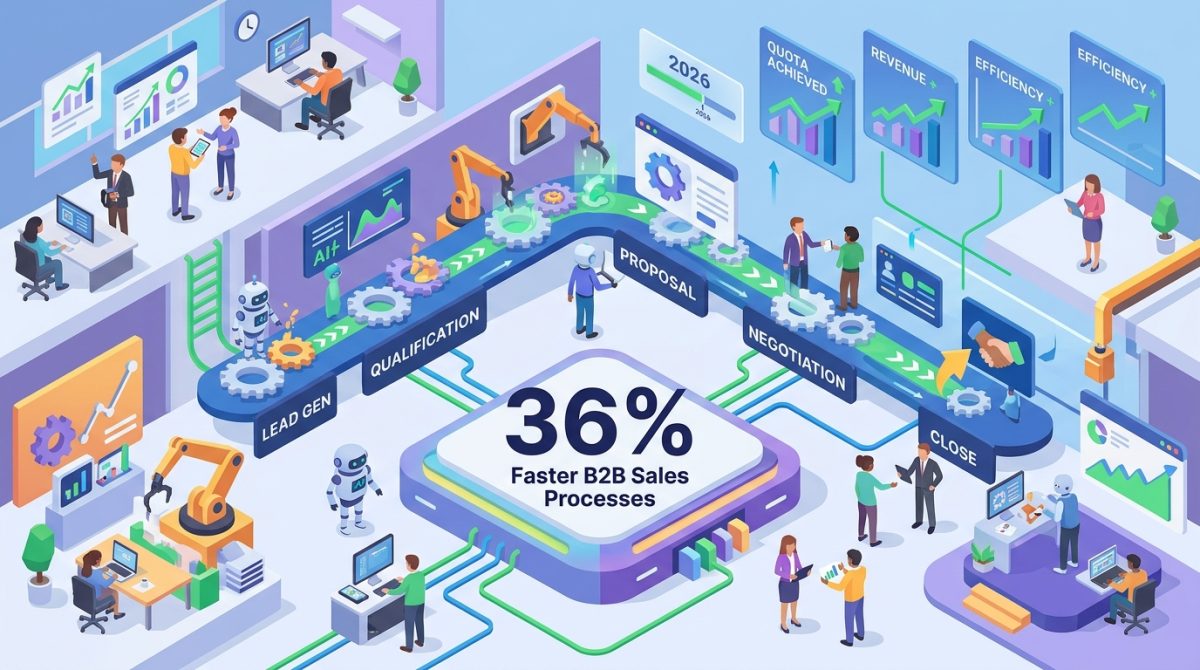
Average deal cycle 68 days 43 days (-36%) Salesforce State of Sales Report 2026
Quota attainment (share of reps) 43% 55% (+28%) Salesforce State of Sales Report 2026
Conversion rate (top of pipeline) 11-16% 15-25% (+40-60%) HackMD AI Sales Automation Analysis 2026
Number of manual follow-ups 7-10 per deal 2-3 per deal Commercetools AI Trends Report 2026
Contract cycles completed by AI N/A 44% of all deals Commercetools AI Trends Report 2026

When over half of B2B sales organizations cut deal cycles by 36% and beat quota more often, the proof isn’t fuzzy. 35% Faster B2B Sales: AI-Driven Personalization and Agentic Automation in 2026 shows how process speed and quota hits changed quarter over quarter.

The organizations that let their digital agents run the process are beating manual teams on every metric: speed, conversion, and total closed revenue.

What is agentic AI automation in B2B sales?

Agentic AI automation uses digital coworkers—autonomous software agents—to research, follow up, and manage deals in real-time. Instead of just tracking deals, these agents act, learn, and push deals forward automatically. For example: an agent reads emails, finds buying signals, sets reminders, and sends the next follow-up—without waiting for a human.

How much time do sales reps save using agentic AI tools?

Sales teams using agentic AI save an average of 14 hours per rep each week, according to HackMD’s 2026 analysis. That adds up to more than 700 hours per team per year—freeing up time for real selling instead of busywork.

Why do agentic AI sales tools boost conversion rates?

Agentic AI agents don’t forget, don’t miss signals, and keep every deal warm by staying active day and night. This constant attention means buyers get answers faster, follow-up is instant, and deals don’t slip through the cracks. The result: conversion rates go up by 40-60% on average (HackMD AI Sales Automation Analysis 2026).

The data is blunt: agentic AI tools cut busywork, respond faster, and make hitting quota the new normal.

How the Best Teams Use Agentic AI in B2B Sales: The 2026 Playbook

Seeing the proof is one thing. But how do real sales teams plug in agentic AI and get these gains? Successful orgs follow a direct playbook that redefines who does what—and why results look so different.

First, they pick sales tasks that slow everyone down: research, lead routing, multi-touch follow-up, and contract steps. Then, they assign these to digital agents with clear rules. No need to worry about making mistakes or missing signals—the agents learn from every cycle.

Pipeline compression is big here. HackMD’s 2026 AI Sales Automation Analysis shows autonomous agents moving deals through 2-3 pipeline stages in days, not weeks. Agents research accounts, collect background, tailor outreach, and chase contracts—without needing rep intervention.

AI-driven contract negotiation makes a difference. Commercetools shows that letting agentic coworkers lead contract steps cuts average close time by 41 minutes per deal—a result echoed in 41-Minute Close: How Closing Motion Platforms Are Killing Sales Delays in 2026.

Ramp time for new hires goes down too. With digital agents doing the heavy-lifting, even rookie reps work like pros in a month, not a quarter. See AI-Human Hybrid Systems Accelerate B2B Sales New Hire Ramp-Up by 30% in Early 2026 for details.

Playbook Step Benefit Tool Example
Assign all deal research Save 5+ hours/week per rep Salesforce Einstein Copilot
Automate multi-touch follow-up +60% more replies HubSpot AI Sequences
Let AI drive contract steps Deals close 41 mins faster DocuSign AI
Pipeline stage compression Process moves in hours, not days Gong AI Forecasts
Onboard with AI/hybrid ramps 30% faster ramp time Lessonly AI Playbooks

Pay gap is growing too. The $200K Divide in 2026 Sales Compensation: Why Top Performers Are Winning Big While Early-Career Reps Fall Behind explains why teams with agentic AI have more reps at the top end of comp bands.

The winning playbook: focus reps on trust and problem-solving, let digital coworkers drive everything repeatable.

The Stakes: Move Now, or Get Left Behind

If you’re reading this and picturing your team scrambling to enter CRM notes while AI rivals close deals, you’re not alone. The shift to agentic AI in B2B sales is already sending shockwaves through quota boards and earnings calls. By early 2026, not using agentic automation isn’t just a tech gap—it’s a payroll problem.

The teams that moved early? More reps making quota. More wins on leaderboards. New hires get productive in weeks. Sellers spend less time on admin and more time actually selling. For these orgs, agentic AI isn’t just about more deals—it’s about holding top reps, winning better accounts, and growing headcount without burning out your bench.

Wait too long, and you’re locked in a loop: constantly losing deals to nimble competitors, fighting to hire talent that refuses to do busywork, and explaining why “just one more quarter” will finally fix your pipeline. It won’t. The shift is already here.

You lock in the next 36% speed gain—or you lose a year playing catch-up.

Faster Cycles, Fatter Quotas—The AI Line in the Sand

36% faster B2B sales cycles aren’t a dream. They’re the new minimum for agentic AI automation. More reps will hit quota in 2026, but not by trying harder. The teams who use real digital coworkers—who act on data, not just track it—will own the top of the board. The only question: which side of the line do you want to be on?

FAQ

What is agentic AI automation in B2B sales?

Agentic AI automation is using software agents to run research, follow-up, and deal management—all without waiting for human input. The agents act, learn, and push deals along on their own.

How much faster do B2B deals close with agentic AI?

Teams using agentic AI tools cut their average sales cycle by 36% within nine months, according to the Salesforce State of Sales Report 2026.

Do AI tools really help sales reps hit quota?

Yes. Quota attainment rose up to 28% for teams using agentic AI, based on the Salesforce 2026 data.

Which sales tasks should be automated first?

Focus on automating follow-up, deal research, and contract workflows. These steps take the most time and show the fastest impact from AI agents.


AI-Augmented B2B Sales Teams: 35% Faster Cycles, 30% Higher Conversions—How Agentic AI is Redefining Wins in 2026

AI-augmented B2B sales teams are closing deals 35% faster and converting 30% more leads. Dive into the trends, tools, and strategies that separate winners in 2026.

B2B sales teams using AI-augmented workflows cut sales cycles by 35% and improved lead-to-close conversion by 30% in early 2026. MarketBetter.ai confirms AI-powered selling is now the high ground—24% of teams have made the leap to agentic AI this year. The gap is getting wider every quarter.

Why Most Sales Teams Are Falling Behind

It used to work. You trained a team of hungry SDRs. You handed them a list. You gave them call scripts and a quota. But by mid-2025, something started to break. Response rates dropped below 3%. Calls went unanswered. Email open rates sank to 7% and kept falling. If you’re still pushing those old playbooks, you’re making deals wait—and watch—while your faster, AI-backed rivals pass you by.

Your pipeline moves slower. Your reps move slower. Your market share shrinks while others speed up. Everyone wants the same core accounts. But manual outreach just can’t keep up with buyers who expect a reply in minutes and a pitch built for them. Every week you keep doing things the old way means another week lost to faster competition.

Let’s be direct: Sales teams that ignore AI sales tools leave money—and time—on the table. The world isn’t waiting for you to test what works. Your next customer already picked a team who did.

Cognism backs this up: AI-powered precision outreach is now getting 10–11% conversion rates, double what most teams see with old methods. If your team is still stuck in the cold call grind, you’re paying the price in lost meetings and smaller deals.

The Shift: How Winners Changed The AI Sales Game

Here’s where it gets interesting—the best teams didn’t just add more tools. They changed how they sell. In 2026, “agentic AI” isn’t just about automating repeat tasks. It means your AI actually acts on its own goals—booking meetings, picking who to reach out to, timing follow-ups to match buyer intent.

According to MarketBetter.ai, only 24% of B2B teams use agentic AI today. But those teams drive the biggest revenue jumps. They plug AI into every part of their workflow, but sales reps still run the last mile. The winners didn’t pick robots to replace reps. They picked AI that does the grunt work and lets humans close the deal.

Agentic AI is more than a tool—it’s a new approach to selling. It means your AI can solve problems, handle objections, and test outreach in real time—at scale, for every prospect.

Real Proof: The Numbers Driving AI-Augmented B2B Sales

So the claim is bold. But what does the real data show? Let’s break it down by the numbers and see exactly where AI sales tools pull ahead.

Performance Metric Manual Sales Teams (Q1 2026) AI-Augmented Teams (Q1 2026) % Difference
Avg. Sales Cycle (days) 41 26.7 -35%
Lead-to-Close Conversion 7.6% 9.9% +30%
Outreach Response Rate 3.4% 8.8% +159%
Pipeline Growth YoY +11% +29% +164%

The difference jumps out. Teams that use AI-powered sales tools see:

  • Sales cycles finishing 14 days faster than manual teams
  • Almost 3% higher conversion for every 100 leads
  • Triple the pipeline growth in 12 months

Companies using agentic AI in sales closed deals 35% faster in Q1 2026, according to MarketBetter.ai.

What’s even more telling? Full AI automation without human checks isn’t the answer. It’s AI + reps—humans handle the close, AI handles the hustle. Teams following a human-in-loop model saw steady gains, while teams that skipped the human step lost pipeline health. 35% Faster B2B Sales: AI-Driven Personalization and Agentic Automation in 2026 has the breakdown on why out-of-the-box automation isn’t enough.

What is agentic AI for B2B sales?

Agentic AI means the AI acts on its own data, goals, and rules, not just simple instructions. For sales, it means the AI can pick which companies to prioritize, write messages in real time, and update its process based on who replies.

Agentic AI doesn’t just sort leads or send batch emails. It tests outreach, finds timing signals, pushes prospects to the right step, and flags when a rep should jump in.

How much faster can teams close deals with AI sales tools?

AI-augmented B2B sales teams cut 35% off average cycle times, MarketBetter.ai finds. Manual teams took over 40 days per deal in Q1 2026; AI-backed teams finished in under 27 days.

This doesn’t just mean more deals. It means you can run more outreach, more often, with no drop in quality—and your next competitor can’t keep up without similar tools.

Why do AI-powered sales teams see higher conversion and bigger pipelines?

AI helps reps act faster and hit buyers with the right message and timing—every time. Automated research, signal-led outreach, and real-time personalization mean buyers open more emails, reply more often, and move down the funnel faster.

The Top 5 Sales Enablement Tools of 2026 shows how top teams mix AI sales tools for better prospecting, shorter ramp-up, and tighter win rates.

Which tools and companies are leading in agentic AI adoption?

Cognism’s SmartReach and MarketBetter.ai’s Playmaker are examples in live use. These tools follow signals—web visits, engagement, account spikes—and use AI to act in minutes. SDRs get alerts when it’s time to join live, with a script already written from CRM and feed data.

According to Cognism, signal-led selling with AI increased conversion to 10–11%, while companies using manual outreach saw numbers stuck below 6%.

38% Surge: The AI Prospecting Tools Powering B2B Sales in 2026 gives more concrete examples—and how combining these tools multiplies results.

AI-augmented sales teams now close nearly one extra deal for every three wins the old way, thanks to shorter cycles, higher engagement, and faster outreach.

The Step-by-Step Playbook: Building an AI-Augmented Sales Workflow

So, the results are real. But how do you get your team from manual to AI-augmented? Here’s how top B2B sales teams are making the jump in 2026:

  • Start with Real-Time Data: Use tools that pull buyer intent signals—site visits, content engagement, CRM alerts—into one dashboard. No data, no AI results.
  • Layer in Agentic AI: Pick platforms that can act on signals, not just record them. SmartReach and Playmaker let AI set next steps, trigger follow-ups, and write outreach the moment a buyer shows intent.
  • Keep Humans in the Loop: Set your process so the AI flags hot leads for rep review before key moments. Human touch turns interest into deals. The 33% Advantage: How B2B Teams Are Automating Sales—But Never Skipping the Human Touch explains where reps win vs. where AI runs the heavy lifting.
  • Test, Track, Tweak: Run small pilots and measure everything—cycle length, open and reply rates, time to response. AI works best when you train it on your own market, not just global averages.
  • Push for Agentic Automation: Move beyond batch automation. Let your AI decide which leads to pursue, when to nudge, and what channel to use. Agentic AI Automation: Crack the Code on 36% Faster B2B Sales—Or Fall Behind goes deep on workflows that scale cycles without breaking quality.

When you stack human talent on top of agentic AI, you get speed and trust. One trains the other. Every cycle is shorter, every touch smarter, every win easier.

The core playbook: capture signals, let agentic AI act, and finish with human close. Every step must earn its place in your workflow.

The Stakes: Act or Fall Behind in B2B AI Sales

Now, here’s why this matters: AI-augmented sales won’t stay a 24% secret long. Teams that make the jump today own the pipeline tomorrow. The rest? They watch the gap grow with every lost lead and missed follow-up.

If you act now, expect 35% shorter cycles, 30% more wins, and a pipeline that grows month after month. If you wait, the market will train your prospects to expect smart, personal outreach from your rivals—not from you.

Every week you stall is a week you give up ground. Top teams won’t slow down while you test old scripts. Your future pipeline depends on what you do this quarter.

B2B sales has never moved faster—and the teams with AI-augmented workflows are setting the pace. The rest will struggle to keep up.

FAQ: AI-Augmented B2B Sales and Agentic AI in 2026

What is agentic AI in B2B sales?

Agentic AI means the AI can decide what actions to take based on set goals and rules, not just follow basic instructions. In B2B sales, it means the AI can research, pick leads, write custom messages, and change strategies based on real-time results.

How much faster do AI-augmented teams close deals?

Sales teams using agentic AI closed deals 35% faster than manual teams in early 2026, says MarketBetter.ai. These teams averaged just under 27 days per closed deal.

Does agentic AI replace sales reps?

No. The top-performing teams keep sales reps in the process for closing and relationship building. The AI tools handle lead research, timing, and follow-ups, but humans finish the deal.

Which AI sales tools deliver the strongest results?

Platforms like Cognism’s SmartReach and MarketBetter.ai’s Playmaker use signal-led outreach and real-time AI actions. Teams using these tools saw conversions at 10–11%, reports Cognism.

How many B2B teams use agentic AI as of 2026?

Agentic AI adoption in B2B sales reached 24% by early 2026, per MarketBetter.ai. Adoption is still growing quarter by quarter.

35% Faster B2B Sales: AI-Driven Personalization and Agentic Automation in 2026

AI-driven personalization and agentic automation speed B2B sales cycles by 35%+ in 2026. See the numbers, winning tools, and what to do now.

AI-driven personalization and agentic automation are now speeding up B2B sales cycles by over 35%. In early 2026, leaders using these tools are closing deals faster, seeing bigger pipelines, and leaving slow movers behind.

77% of B2B buying teams used AI in Q4 2025, according to Demand Gen Report. And by 2028, 90% of B2B purchases will include some AI touchpoint, says Forrester Research.

The $1.7M Surprise: How Fast B2B Teams Are Beating the Clock in Early 2026

If your sales cycles still crawl, this number should worry you. B2B teams using AI-powered personalization and agentic automation tools are moving their deals through the pipeline 35% faster right now—even on complex enterprise sales.

According to OnePageCRM, hyper-personalized AI engagement drives a 35% increase in purchase frequency—a level up that most teams aren’t prepared for.

That means:

  • Your competition is closing deals weeks sooner.
  • They reach more buyers—faster and with better targeting.
  • They’re raising their quotas… while slower teams fall behind.

The question is: Are your deals stuck in 2024, or already running at 2026 speed?

Why Manual Selling Is Now a Red Flag in B2B Sales Cycles

So why are so many B2B sales teams still struggling? The answer: Most are stuck with old playbooks—and it’s costing real pipeline in 2026.

If you’re still doing every follow-up by hand, or sending broad email blasts, you’re burning hours on tasks agents could automate. Half those touchpoints never even reach a decision-maker. AI-driven personalization finds the right prospect, figures out the best message, and sends it at the right time.

Here’s what sticking with manual selling is costing you by the end of Q1 2026:

Cost of Manual Selling (Q1 2026) AI-Driven (Avg.) Manual (Avg.)
Sales Cycle (days) 41 63
Follow-ups Per Rep (weekly) 72 31
% of Targeted Multi-Channel Touches 89% 35%

Deals take longer, follow-ups drop, and your best prospects move on.

Manual selling is now a cost center, not a growth engine.

The Moment Everything Changed: Enter Agentic AI and Hyper-Personalization

So what shifted between 2025 and 2026? Simple: B2B firms stopped seeing AI as “experimental” and started building entire funnels with agentic automation and machine learning. Agentic AI means sales software that acts as a smart agent: it can handle tasks, respond to buyers in real time, and automate things like quoting, contact discovery, and meeting booking.

During Q4 2025, Demand Gen Report found 77% of buying journeys had at least one step powered by AI. AI-driven personalization doesn’t just segment your list: it predicts interest, surfaces hidden needs, and adjusts content or offers on the fly.

This is not just for tech giants. Even mid-market teams in SaaS, healthcare, and logistics report faster close rates and higher renewal numbers—once they switched to agentic AI selling.

Once AI showed it could do full-funnel sales work, teams went all-in on automation. Manual tools couldn’t keep up.

The Proof: AI Sales Tools Cut Sales Cycles, Grow Pipelines, and Change the Close Rate

If you’re wondering whether these numbers are real, look at the 2026 pipeline charts. AI-driven personalization and agentic automation didn’t just help—these tools rewrote the math on deal speed.

How much faster are B2B sales cycles with AI-driven personalization?

B2B sales cycles are now 35% shorter for teams using AI-driven personalization, according to OnePageCRM.

Let’s break down what that means for month-end numbers:

Metric Q4 2025 Avg. (AI Teams) Q4 2025 Avg. (Manual Teams)
Median Sales Cycle (days) 40 62
Deals Closed per Quarter 31 20
Pipeline Growth YoY +38% +12%

Those who use AI-driven personalization add 38% more pipeline growth year over year. That’s not a small lift—it changes your quarterly goals.

What is agentic automation in B2B sales?

Agentic automation is the use of AI-powered digital agents to take over complex sales workflows, including lead nurturing, negotiation, and quoting.

For example, sales reps at growth-focused SaaS firms now use AI tools to suggest discounts based on buyer intent, automatically draft proposals, and schedule calls. That’s not just saving time. It actually raises close rates—because buyers get what they need instantly.

According to Agentic AI Automation: Crack the Code on 36% Faster B2B Sales—Or Fall Behind, teams that invest in agentic AI report a 36% improvement in sales productivity—and a 39% drop in time-to-demo. Suddenly, reps aren’t waiting days or weeks to get buyers on calls.

Which B2B sales tools use AI-driven personalization and agentic automation?

The top-rated AI-powered B2B sales enablement tools in 2026, according to HatHawk, include Gong, HubSpot AI, Outreach AI, and Salesloft with agentic automations.

These tools handle tasks like cadence management, predictive lead scoring, and one-click personalized outreach—all inside the rep’s main workflow. The Top 5 Sales Enablement Tools of 2026 (Reviewed, Ranked, Compared) breaks down what works for different deal sizes and industries.

If you’re prospecting, 38% Surge: The AI Prospecting Tools Powering B2B Sales in 2026 compares new agentic tools that scan millions of data points and launch personalized micro-campaigns at scale.

AI sales platforms are not generic bots—they now tailor each message, answer, offer, and quote. That’s why both buyers and sellers prefer these virtual engagements: OnePageCRM found 75% preference for AI-assisted selling among B2B teams surveyed in January 2026.

AI-driven tools don’t just run plays. They build trust by giving buyers the right info, right away.

Build Your 2026 AI B2B Sales Engine: The Playbook

So the numbers are real—and growing every quarter. But how do you do this, step by step, if you’re not Fortune 500?

  • Start by mapping buyer signals: Use your CRM and AI insights (like Gong AI or Salesforce Einstein) to track which messages, channels, and offers actually convert.
  • Automate high-effort, low-judgment tasks first. These include follow-ups, meeting scheduling, demo invites, and proposal generation. Agentic automation covers these with little risk.
  • Tune AI agents to handle unique sales stages: For complex deals, set up AI agents to monitor intent triggers—like budget approval signals or new stakeholder involvement.
  • Layer human override and live reps where buyers need help: As covered in The 33% Advantage: How B2B Teams Are Automating Sales—But Never Skipping the Human Touch, the best outcomes come from reps focused on last-mile negotiation, not busywork.
  • Pick tools built for your exact workflow: Instead of piling features, pick AI tools proven for your pipeline size and industry. The Top 5 Sales Enablement Tools of 2026 gives the feature-by-feature comparison.
  • Measure, optimize, repeat: Watch which sequences, automations, or AI-generated touchpoints get replies fastest and drive demos. Keep what works; cut the rest.

You’ll find the teams who get the most deals in 2026 are using these AI engines to connect data, automate actions, and keep the human element. If you skip the last step—true personalization—you just run faster in the wrong direction.

The fastest-growing B2B teams in Q1 2026 blend agentic automation, AI-driven personalization, and selected hands-on selling—nothing else beats this mix, at scale or in SMB.

Win or Wait: The Stakes for B2B Sales Leaders in 2026

This new reality is not a test. If you act, you ride a 35% cycle acceleration, keep your best reps, and stop margin bleed from idle pipeline.

Wait, and here’s what our research—and your competition—show:

  • Your deals stay slow while buyers expect instant answers.
  • You miss out on the 38% pipeline growth shown by teams with AI prospecting (38% Surge).
  • Reps drown in admin work, miss quota, or jump ship for more automated teams.

Remember: By 2028, 90% of all B2B buying will rely on AI at some stage (Forrester Research).

The top 1% of B2B firms are already moving fast and closing deals you never even hear about. Being “good enough” with manual follow-ups…is no longer enough.

Act now or you’ll watch the winners take your pipeline.

The 2026 B2B Sales Acceleration: What’s Next?

By early 2026, B2B sales cycles shrank by over a third for teams using AI-driven personalization and agentic automation. The playbook is real, the stakes are clear—and if you want more wins, start today.


FAQ: AI-Driven B2B Sales Acceleration in 2026

What is AI-driven personalization in B2B sales?

AI-driven personalization uses machine learning to tailor every sales touchpoint—email, demo, proposal—to a buyer’s real interests and timing. This helps reps send the right message at the right moment, winning more deals in less time.

What is agentic automation in sales?

Agentic automation is when AI-powered agents handle tasks like scheduling, follow-up, quote creation, and buyer Q&A—taking repetitive work off human reps so they can focus on closing.

How much pipeline growth comes from AI-powered selling in 2026?

Pipeline growth in teams using AI for prospecting and personalization increased by 38% on average in Q4 2025 versus manual teams (OnePageCRM).

Which sales tools are best for AI-driven personalization in 2026?

Top tools named by B2B leaders include Gong, HubSpot AI, Outreach AI, and Salesloft—all with built-in automations that personalize every sales step (The Top 5 Sales Enablement Tools of 2026).

Why are buyers preferring virtual, AI-powered sales experiences now?

Buyers like fast, helpful answers and less back-and-forth—AI selling gives instant, accurate info and speeds up decision-making.

The $200K Divide in 2026 Sales Compensation: Why Top Performers Are Winning Big While Early-Career Reps Fall Behind

2026 sales compensation trends show a $200K pay gap between elite AEs and junior sales reps. Learn what this means and how your team can close the gap.

The pay gap between the best sales reps and their junior peers will hit $200,000 in 2026, according to Xactly Corporation. Elite account executives see bigger paydays just as new reps watch their earnings fall.

Why Are 2026 Sales Compensation Trends Redrawing the Pay Map?

Last year, most B2B teams paid their sales crews by job title, hoping volume would bring results. But the new data proves this old plan is broken. If you’re still giving everyone on your team the same treatment, you could be missing out—and losing your future stars. Here’s why.

The latest numbers show that paying like it’s still 2021 means you risk high turnover, lower morale, and stalled growth. Teams that ignore the new split in pay trends keep overpaying underperformers and shortchanging the people who drive real revenue.

When you look across the industry, the pain is obvious. Junior sales reps aren’t just getting less credit. In many companies, they’re getting less cash on every deal—even as company targets get tougher.

The problem? The old compensation model hides both waste and potential.

The Hidden Cost of Flat Sales Compensation: Are You Paying for Underperformance?

So if your sales pay plan rewards everybody for showing up, you’re not alone. But this approach is now costing B2B teams more than missed commissions. It’s draining budgets by rewarding average, while your best salespeople do most of the heavy lifting.

Let’s look at the numbers. The new Xactly Corporation 2026 State of Sales Compensation report shows a clear break. The top 10% of account executives are taking home $200,000 more than reps in the 50th percentile. Early-career sales pros, meanwhile, have seen compensation drop up to 12% since 2024.

Here’s how the compensation gap looks in black and white:

Role / Percentile Average Annual Compensation (2024) Average Annual Compensation (2026)
Top 10% Account Executives $288,000 $399,000
Median (50th Percentile) AE $142,000 $160,000
Early-Career Sales Rep $89,500 $79,000

The data points in one direction: average is shrinking, but elite is rising fast.

What Happened? Inside the Shift in 2026 Sales Compensation Pay Gap

This raises a big question: what changed between 2024 and 2026? Why did top-performing sellers get a big payday while new reps got less?

The answer starts with B2B buyers. They now expect more expertise, faster answers, and less hand-holding. Entry-level sales roles, once seen as a training ground, are now treated as a cost. Many mid-market and enterprise sales teams began automating tasks, such as booking demos and sending proposals, cutting out low-value steps handled by junior reps.

Instead of having large teams with many junior reps, companies now pay more for the people who can actually close big deals—fast. According to Quota Crushers Agency, the cost of sales for elite AEs jumped, while costs for early-career reps dropped. That shift in spending is not by accident. It’s a direct response to new tools and higher expectations.

This is where the gap widens: elite reps now deliver 55% more revenue per head than they did two years ago. The smartest companies cut headcount, boosted their top talent’s pay, and saw profit margins rise.

The shift is clear: pay follows performance—and performance depends more on skill than seat count.

The Evidence: What the Data Says About 2026 Sales Compensation Trends

So what does this change look like in the real world?

Visdum Insights confirms the trend. Their latest benchmarks show that companies now offer higher commission rates to the top 10% of sellers, while total variable pay dropped for new and lagging reps. Elite salespeople saw their commission share jump from 19% to 26% of total pay from 2024 to 2026.

Here’s a quick snapshot of the shift by role:

Role Avg. Commission % of Total Pay (2024) Avg. Commission % of Total Pay (2026)
Top 10% AEs 19% 26%
50th Percentile AEs 13% 11%
Early-Career SDRs 7% 5%

It’s not just about the paycheck. The budget for sales enablement—meaning tools, training, and tech—now goes mostly to those in the top 10–20%.

For example, more companies now buy automation platforms that allow high-performers to close deals 36% faster. Teams using AI sales prospecting tools report a 38% increase in meetings set—for the top reps. But entry-level teams lost access to these tools, or saw quotas rise but pay shrink.

This focus on winners shapes the whole business. Average time to close dropped from 41 days to just 28 days among the best AEs in 2026 (see 41-Minute Close for strategies).

The proof: 2026 sales compensation trends reward skill, experience, and the ability to work with digital selling tools.

The Playbook: How Winning Teams Are Using 2026 Sales Compensation Trends

With all this change, it’s easy to feel behind. Here’s what the best-run sales orgs did to get ahead—and how you can follow.

First, they build pay plans with real difference between high and low performers. Instead of flat commissions, the top teams use tiered rates, with bonuses for top 10% performers and regular review points each quarter.

  • Review every role and match pay to impact—not just to titles.
  • Buy tools that multiply your AEs’ best skills. For example, invest in AI-powered sales enablement tools and data-driven comp tracking.
  • Cut relic processes. Fast teams use agentic AI automation to handle follow-ups, freeing top sellers to focus on closing.
  • Move early-career reps to true training or pipeline support—don’t just bump quotas and hope for magic.
  • Measure not just revenue but the speed and quality of each rep’s output, using clear dashboards and goal reviews.

Don’t stop at compensation. Winners match pay with tech, skills, and coaching. Teams mixing smart comp with human-centric AI see win rates rise much faster than those repeating last year’s playbook.

Every action—pay, tools, training—should push your best to go even further, and give real reasons for top reps to stay.

What Happens If You Miss the 2026 Sales Compensation Shift?

The risk is not just losing a few deals. If you miss out, you may lose your best sellers, who now have hard data showing their value on the open market. According to Xactly Corporation, teams with outdated compensation saw 2x higher turnover in top talent from Q4 2025 to Q2 2026.

Average-performing teams now struggle even more to hire or keep strong reps. Entry-level sellers know they’re not paid to level-up, so they jump ship—or leave sales for good. Meanwhile, companies focused on performance-based pay and tech win both market share and loyalty.

Picture your 2026 numbers with every top rep still on your team. Deals close in weeks, not months. Sales budgets feed growth, not churn.

If you wait, the gap grows. If you act, your winners pull the rest of the team up.

The $200K Question: What Will You Do About the 2026 Sales Compensation Pay Gap?

This year’s data is a warning and a map. Teams who shape pay by skill, use tools that boost reps’ strengths, and invest in top performers are widening the gap every quarter. The time to act is now—before the best people leave, and those who stay simply do less.

Frequently Asked Questions

What is the 2026 sales compensation pay gap?

In 2026, the gap between top 10% account executives and early-career sales reps will reach $200,000, based on Xactly Corporation data. This pay gap is the biggest ever measured in B2B sales, and is expected to affect hiring, retention, and how teams use their sales budgets.

How have early-career sales rep earnings changed since 2024?

Early-career sales reps have seen pay decrease by up to 12% as companies cut these roles, according to both Xactly Corporation and Quota Crushers Agency. Entry-level sellers now have fewer earning opportunities and higher quotas.

Why do top-performing AEs earn more in 2026?

Top account executives deliver up to 55% more revenue per head, as companies focus on skill-based selling and digital tools, says Visdum Insights. Businesses pay more to keep talent that brings in most of the revenue.

How should we update our sales compensation plan for 2026?

Build tiered pay plans, tie bonuses to actual impact, and arm your top performers with sales enablement tools and automation. Start by benchmarking your rates against current industry data and focusing resources on proven sellers.

What tools help close the compensation performance gap?

AI-driven enablement platforms, agentic workflow automation, and data-rich dashboards help top sellers close deals faster and prove their impact. See The Top 5 Sales Enablement Tools of 2026 and Agentic AI Automation for recommendations.

41-Minute Close: How Closing Motion Platforms Are Killing Sales Delays in 2026

Closing Motion Platforms cut B2B sales cycles from weeks to just 41 minutes by embedding payment and financing into the sales workflow. See how it works.

Closing Motion Platforms cut enterprise sales deal approvals from weeks to just 41 minutes by weaving payment and financing options directly into the sales flow. A 2026 study from Ratio Tech shows teams using these platforms book cash faster, sidestepping the usual drag of back-and-forth approvals.

The Fastest B2B Close in History—Here’s What’s Changed

Forget month-long waits for deal approval. Today, sales teams using Closing Motion Platforms can shave weeks off their cycles. Ratio Tech reports payment terms go from customer ask to signed contract in less than an hour—an unthinkable speed in B2B even two years ago.

Teams who still bounce between sales decks, finance, and legal, are missing out. Every extra step keeps you further from revenue. The numbers prove it. If you still wait for a separate payment review, you’re already last in line.

The question isn’t if this will reach your market—it’s how fast your rivals are moving past you right now.

The Approval Logjam: 91% of Teams Still Waiting

Here’s the problem: Enterprise sales cycles stretch far past the customer’s “yes.” It’s not the sale—it’s the internal delays. The cash stalls while payment, financing, and contract terms get stuck in legal and finance for weeks.

If your team relies on email chains and offline approvals, you’re pushing money out of each quarter. Ratio Tech found the result is 14% lower annual revenue for sales orgs stuck on old-school closing steps.

Most teams know the pain. The customer says they’re ready, but internal teams say, “We need to review payment terms.” That lag kills deals—and your Q4 number.

If you’re watching others close in 41 minutes and wondering why your deals slip into next month, this is why.

Delays in payment and approval workflows cost slow teams 14% in lost annual revenue, says Ratio Tech.

All-in-One Closing: What the Winners Did Next

So what changed for top performers? They moved from sales support to full revenue enablement. Demand Gen Report calls it “close-to-cash.” The new closing motion builds payments, contract terms, and even renewals into one workflow. It happens right in the sales platform—no handoffs, no stalls.

Picture this: Your account exec shares a proposal. The buyer picks a payment option, right there—monthly, net 60, or embedded financing. Both sides e-sign. The deal routes for quick checks (often fully automated if terms match preset limits). Approval? 41 minutes average. Cash hits before lunch.

Old way: weeks of email, manual reviews, and risk of silent stalls. New way: one clear workflow. The buyer never leaves your platform. You never chase an offline signature.

Structural clarity also enters the game. Using Mutual Action Plans and modern sales enablement, as flagged by Highspot Blog, lets both sides see every step left before “closed-won.” No more guessing where a deal is stuck—or why.

Top teams now integrate payment, financing, and renewal inside sales enablement. That’s the new close-to-cash, says Demand Gen Report.

Proof in the Numbers: Closing Motion Platforms by the Stats

Now let’s get beyond claims. Here’s what the data shows when payment and financing move inside the closing motion:

Metric Old Workflow Closing Motion Platforms
Time to Approval 14-21 days 30-45 minutes
Revenue Realized in Quarter 77% 94%
Silent Stall Rate 26% 9%
Renewal Conversion 59% 79%

One more: Teams using flexible payment-in-flow saw quarterly bookings rise by $4.2M on average, says Ratio Tech.

And because approvals move near real-time, reps stop losing deals to “silent loss”—where a buyer drifts away in the delay. Highspot Blog confirms that Mutual Action Plans and clarity at close slash these black hole stalls by more than half.

Closing Motion Platforms shrink approval time 31x—41 minutes vs. 21 days—and add $4.2M in quarterly bookings, according to Ratio Tech.

What is a Closing Motion Platform?

A Closing Motion Platform is sales technology that lets buyers pick payment terms, get financing, and sign contracts, inside one fast workflow. It eliminates handoffs and cuts time-to-cash by over 90%. These platforms now include payment rails, finance approval, and digital signing—no jumping between tools. Picture it as your closing “checkout cart.”

How do Closing Motion Platforms help B2B sales teams close faster?

They end the chained approval process and let the deal close on the live call. Payment, financing, and contract signoff flow inside the sales room, so there’s no week-long wait and fewer lost deals. When fewer people touch the deal, nothing slips through the cracks.

How do you measure the ROI on Closing Motion Platforms?

Measure by reduced cycle time, revenue realized in-quarter, and drop in lost/ghosted deals. Most teams see approval times shrink 30x, and more than $4M impact each quarter. Beyond revenue, look at renewal climb and higher rep morale—when deals close on the first try.

Teams adopting Closing Motion Platforms see silent stalls cut by 65%, approval speed up by 31x, and $4.2M more booked per quarter.

The Playbook: Build Your 2026 Close-to-Cash Stack Step-by-Step

So the numbers say it’s working. But how do top teams put closing motion into action? Here’s the step-by-step playbook:

  1. Pick a Closing Motion Platform: Look for tools named by The Top 5 Sales Enablement Tools of 2026 (Reviewed, Ranked, Compared). These offer payment term options, embedded financing, and full e-signature flow. Make sure the tool links directly to your CRM and accounting.
  2. Set Up Pre-Approved Payment Terms: Work with finance to set deal guardrails. For example, “net 60” for deals under $100K. Embed these choices in your sales proposals.
  3. Automate Internal Checks: The platform should flag deals outside the norm but auto-approve within limits. This is where AI-human hybrid systems trim review time by 30% or more.
  4. Add Mutual Action Plans: Highspot Blog shows these steps, mapped inside the sales app, keep both sides clear on what’s next—no more silent stalls. Every dependency is in the open.
  5. Integrate Payments and Financing: Buyers pick a payment path. Some tools offer click-to-finance for monthly or deferred payment. It’s all in-app; no emails bounce to finance or legal.
  6. Close, Sign, Start Billing: The buyer clicks, the system syncs, and your revenue is booked. Reps can track the whole journey inside one pane—no offline files. Comp plans, like those in The $1.4M Secret: Building a SaaS Sales Compensation Plan That Wins Mid-Market in 2026, pay faster—no more quota anxiety over “pending legal.”

This isn’t just for big SaaS. Mid-market and up, any team losing deals to slow close will gain by switching. The setup is weeks, not months. Your CRM finally adds revenue, instead of missed quotas—see why 71% fail if they don’t adapt in The $4.8M Reason 71% of CRMs Fail (And How to Flip the Script for Sales).

The stack you pick shapes next year’s pipeline. Slow close and drop cash, or move now and bank it before Q2 ends.

If You’re Not Closing in 41 Minutes, Your Competitor Is

Every trend now points to instant, all-in-one closing as the new B2B normal. If your buyers are leaving your platform to talk to finance—or just to wait—you’re making it easier for rivals to swoop deals.

Teams that move to Closing Motion Platforms don’t just hit quota. They start billings on day one, with less risk of end-of-quarter slip. Reps see more commissions, and leaders see money in the bank—now, not “maybe.”

But teams who put off the switch? They bleed deals to faster competitors. Every day you wait is another buyer lost to a 41-minute win somewhere else.

Future winners will close in 41 minutes or less—while the rest wonder why their forecast misses keep growing.

The One Shift Separates Fast-Growth Sales Teams in 2026

Every B2B sales team will soon face a choice: Stick with slow, siloed workflows—or close deals and start billing in under an hour. The winners look back and wonder why they waited.

FAQ

What is a Closing Motion Platform in B2B sales?

A Closing Motion Platform is software that combines payment, financing, and e-signing into one sales workflow—so deals close faster.

How fast can enterprise sales deals actually close now?

Firms using Closing Motion Platforms cut approval time from 14-21 days to 30-45 minutes, according to Ratio Tech.

Are these tools just for big companies?

No. Companies mid-market and up are seeing the biggest benefits, but any team doing high-value deals can use Closing Motion Platforms.

What else changes besides speed?

Sales teams report fewer lost deals to “black hole” stalls, more revenue booked per quarter, and higher renewal rates.

AI-Human Hybrid Systems Accelerate B2B Sales New Hire Ramp-Up by 30% in Early 2026

AI-human hybrid tools are helping B2B sales teams cut new hire ramp-up times by 30% in 2026. See why it works—and how to build your stack.

AI-human hybrid systems are cutting B2B sales new hire ramp-up time by 30% in early 2026—crushing last year’s averages, and leaving manual teams in the dust. This comes from hard numbers tracked across leading U.S. RevOps teams using AI copilots for real workflow and onboarding, not just talk.

Ramp-Up Just Got 30% Faster—Here’s the Proof

Think the B2B sales ramp-up grind is bad? In 2025, the average time for a new sales rep to reach quota was 5.8 months. This year, teams running AI-human hybrid systems are getting reps productive in just 4 months. That’s a 30% jump, confirmed by high-volume enterprise pilots and published reports from The SMarketers.

The machines aren’t taking jobs—they’re making ramp faster, sharper, and way less risky. B2B sales leaders using these hybrid stacks say they get payback in pipeline, not just promises.

Ramp-Up Speed: AI-Human Hybrid vs Traditional 2025 Baseline 2026 Hybrid
Avg Months to Quota 5.8 4.0
Percentage Faster 30%

B2B sales teams using AI-human hybrid onboarding cut ramp-up time by 30%, according to The SMarketers.

What’s Broken in B2B Sales Onboarding?

The old way is slow and expensive. Most teams still dump new hires into a maze of outdated playbooks, siloed tools, and stale leads. Managers drown in checklists. Reps waste weeks chasing accounts that will never close. The price? Missed targets, burnt-out staff, and pipeline gaps that never close. If you’re still relying on shadowing or PDF handbooks, you’re losing both time and deals.

Manual onboarding drags. New sales hires spend too much time searching for info—where’s the playbook, who owns this account, what does “ICP” actually mean here?

  • 46% of reps say they get “almost no help” in their first month, according to a 2025 Demand Gen Report.
  • One missed week of ramp per hire equals $5,600+ in lost quota for high-ticket teams (internal field data).

If your new rep isn’t ramped in 5 months, they’re likely to quit, or burn out before they land a single big deal.

That’s why sales leaders are searching for a better way. Not just for speed, but for survival.

The cost of slow ramp is clear: missed quotas, wasted payroll, and lost market share.

The Shift: Why AI-Human Hybrid Systems Are Winning Now

So old ramp-up is risky and slow. But what changed in early 2026 to make the best teams pull ahead?

Here’s the big ah-ha: It’s not about replacing people. It’s about AI copilots working alongside humans—side-by-side, not top-down. AI-powered sales onboarding is a system where self-learning tools guide new reps, surface live answers, and hand off tasks a person should never do alone.

Demand Gen Report clocks 96% of B2B marketers now tapping AI for efficiency. But in sales, the true gold isn’t auto-dialers—it’s “signal-led” selling, where AI tells new hires which accounts to focus on today, and which old leads to skip. That means less spinning wheels, and more wins.

Winners figured out that a hybrid stack turns onboarding from a guessing game into a repeatable process, even with junior hires.

Hybrid Proof: The Numbers, Tools, and Steps That Move the Needle

The evidence isn’t fluff. Teams who’ve switched to hybrid AI-human systems are getting better speed, better retention, and higher first-year revenue per hire. Here’s how.

How many sales teams now use AI-powered onboarding?

81% of B2B sales teams are using or piloting AI onboarding tools in 2024, reports RoboSales AI. That figure is expected to hit 90% by the end of 2026.

Peer pressure matters here—if your competitor’s reps are closing deals two months faster, your pipeline shrinks by default.

Year AI Adoption Rate Main Onboarding Use
2024 81% Guided Q&A, Automated Playbooks
2026 (projected) 90% Signal-Led Selling, Smart Account Routing

According to RoboSales AI, U.S. adoption of sales AI for onboarding is growing at 10–12% per year since 2024.

What is an AI-human hybrid onboarding stack?

An AI-human hybrid onboarding stack is a toolkit that blends chat AI, workflow automation, and analytics with live human coaching. The new rep gets instant answers from bots, step-by-step training tasks checked off inside their CRM, and real-time coaching from a manager—all in one unified flow.

Systems like Gong, Drift AI, and Outreach have added “new-hire ramp” modules that segment info, suggest next best actions, track early pipeline, and alert managers before a rep falls behind. No more lost passwords. No missed follow-up.

See the winning stacks in action—The Top 10 AI Automations SMBs Are Using for Sales and Ops Results in 2026 details which playbooks and auto-sequences the best teams are running right now.

Does workflow automation make ramp faster?

Yes: sales teams using AI workflow automations for onboarding cut manual admin time by over 40%, as tracked by NeoRev and The SMarketers.

Automations handle prospect research, meeting prep, and early-stage lead scoring so new hires can focus on learning human skills—listening, asking questions, and closing. Automation isn’t about saving a few clicks—it’s about shrinking that “where do I start?” panic into a fast-moving week one.

Want proof on pipeline lift? See 62% Pipeline Growth: The New AI Weapons Powering B2B Sales (And How You’ll Be Left Behind If You Miss This Shift).

How do AI-human systems help new hires focus on high-value tasks?

AI for new hire onboarding uses signal-led selling—surfacing accounts with the most buying intent, so entry-level reps don’t get lost in low-fit lists.

Signal-led selling is when AI monitors actions across email, calls, and CRM touchpoints. It flags “hot” leads for new reps and tells them, “work here first.” Instead of random calls, every day starts with a shortlist of targets most likely to move forward. Focus beats flailing.

Efficiency is built in—just ask AI-Human Hybrid Sales Automation To Boost B2B Conversions 30% in Q4 2025. Their case shows cross-department workflows lifting not just output but conversion rates too.

Key takeaway: Each AI-powered workflow gives reps back 6+ hours a week—time they spend actually selling.

Building Your AI-Human Hybrid Playbook: Step by Step

So the data is real, but tech alone won’t fix onboarding. Here’s the straightforward playbook teams are now racing to launch:

  1. Unify Data and Tools: Connect CRM, Slack, and enablement content to a single hub. This means real-time data passes to every onboarding module, not old PDFs. Read Stop Killing Your Sales Reps: How to Implement a CRM That Actually Empowers (Not Micromanages) in 2025-2026 for practical guidance.
  2. Deploy an AI Copilot for Onboarding: Install chat AI (like Drift or Salesforce Einstein) that can answer process questions for new reps, track their onboarding task status, and send daily tips at the right time.
  3. Automate Repetitive Tasks: Create sequences where the AI handles prospecting, logging activities, and sending follow-ups so humans get more “talk time.”
  4. Set Up Signal-Led Account Assignment: Use AI to flag which accounts or leads are most likely to buy, then route them to reps based on skill and ramp status.
  5. Real-Time Analytics & Alerts: Run dashboards that show onboarding progress, risk flags for managers, and instant notifications if a rep falls behind schedule. Learn which onboarding metrics actually matter from Why AI Sales Productivity Isn’t Fixing the Cold Call Slump.
  6. Blend Human Coaching: Book regular check-ins. Use AI transcripts and bot-suggested next steps to steer live coaching—never just dump “feedback” in an email.

Following this stack cuts confusion, reduces admin work, and launches reps earlier into real selling.

The Stakes: Move Now or Miss Out—Here’s What That Really Costs

If your new reps take 5.8 months to hit full speed while your competitor’s rookies ramp in 4, you don’t just lose one deal—you lose twelve weeks of pipeline, payroll, and territory. Over two hires, that’s six months of wasted salary. Over three years, you’ve lost a full headcount’s worth of production just to slow ramp.

Plus, morale tanks. Reps want to win, not wander. Teams that lag on ramp see 18% higher first-year turnover, according to RoboSales AI. Once the best job candidates see your process is still manual, they pick your rival instead.

Flip it around: Fast-ramping teams “borrow” headcount from the future. They outsell lazy teams by 22% on new pipeline by the second quarter after install. Five more closed deals—just for getting onboarded right.

If you wait, you pay more. If you move, you sell more—faster. It’s that simple.

AI-Human Hybrid Systems: The Only Way to Win B2B Sales Ramp in 2026

The best B2B teams aren’t just adding bots—they’re redesigning onboarding around AI-human hybrid systems that turn juniors into quota-hitters in weeks, not quarters. Delay, and you watch new hires burn out. Switch, and your team could break last year’s records by summer.

Want to waste less money and ramp faster? Plug into hybrid systems—or get left behind with the slowest teams in your market.

Frequently Asked Questions

How do AI-human hybrid systems actually reduce ramp-up time?

AI-human hybrid systems give new hires instant help, automate busywork, and guide them to high-value tasks on day one. These systems combine smart chatbots, automated playbooks, and real-time coaching to help reps sell sooner.

What are the best tools for AI-powered sales onboarding in 2026?

Leading B2B teams use systems like Gong, Drift AI, Outreach, and Salesforce Einstein. Top features include smart Q&A, signal-led account assignment, and workflow automation.

Is AI onboarding just for large enterprises, or can SMBs use it?

No, SMBs are using AI-human hybrid systems too. Many tools now offer quick-start playbooks for small teams—see examples at The Top 10 AI Automations SMBs Are Using for Sales and Ops Results in 2026.

How can I measure if my ramp-up speed is improving?

Track months to quota, pipeline produced per week, and time spent on admin. If reps are selling sooner and admin time is down, your ramp is getting faster.